







Copy in clipboard...
Iran will shelve limited opening of Hormuz if US disrupts shipping: SNSC
Naval blockade constitutes ‘violation of ceasefire’
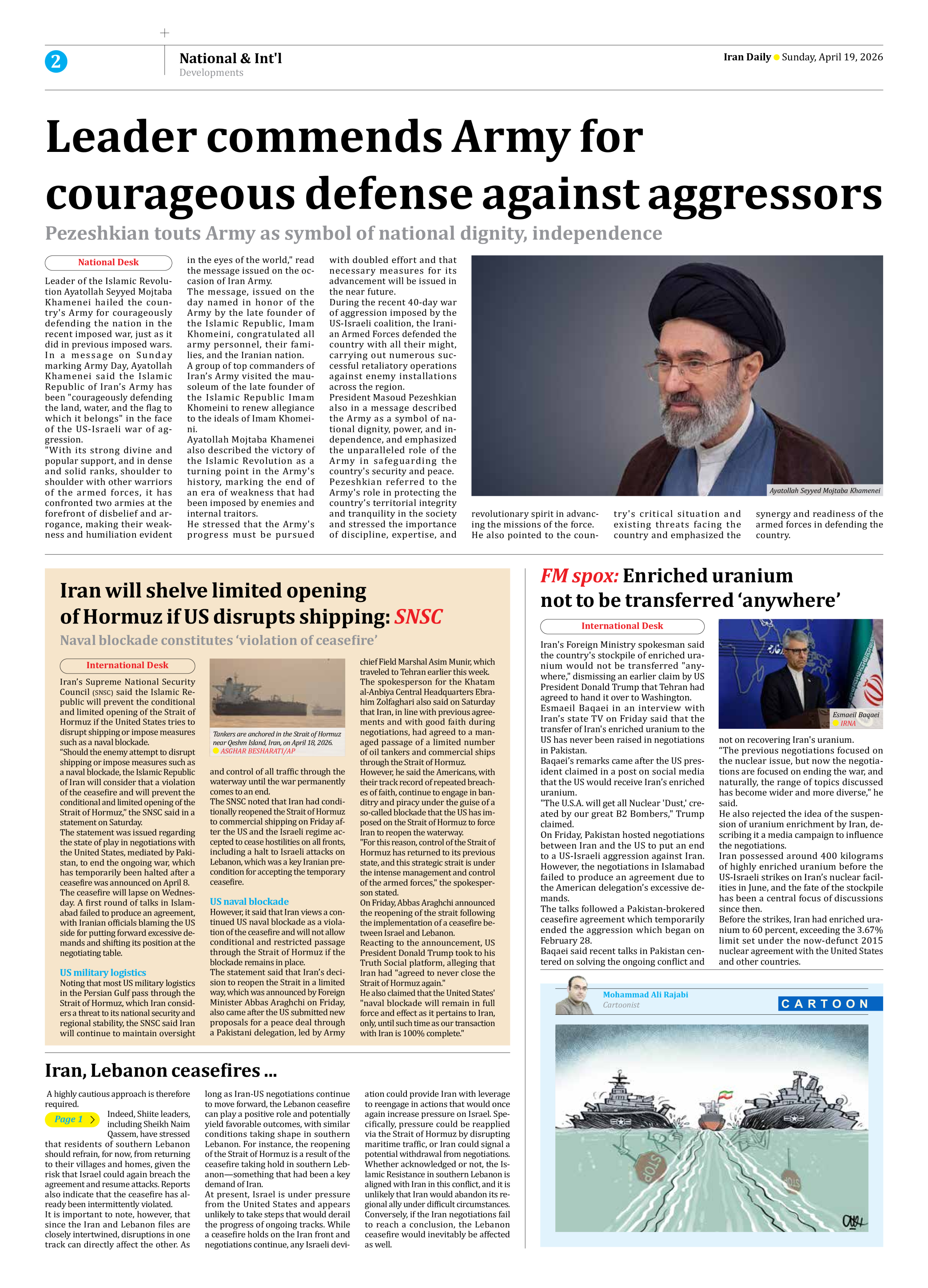
Iran’s Supreme National Security Council (SNSC) said the Islamic Republic will prevent the conditional and limited opening of the Strait of Hormuz if the United States tries to disrupt shipping or impose measures such as a naval blockade.
“Should the enemy attempt to disrupt shipping or impose measures such as a naval blockade, the Islamic Republic of Iran will consider that a violation of the ceasefire and will prevent the conditional and limited opening of the Strait of Hormuz,” the SNSC said in a statement on Saturday.
The statement was issued regarding the state of play in negotiations with the United States, mediated by Pakistan, to end the ongoing war, which has temporarily been halted after a ceasefire was announced on April 8.
The ceasefire will lapse on Wednesday. A first round of talks in Islamabad failed to produce an agreement, with Iranian officials blaming the US side for putting forward excessive demands and shifting its position at the negotiating table.
US military logistics
Noting that most US military logistics in the Persian Gulf pass through the Strait of Hormuz, which Iran considers a threat to its national security and regional stability, the SNSC said Iran will continue to maintain oversight and control of all traffic through the waterway until the war permanently comes to an end.
The SNSC noted that Iran had conditionally reopened the Strait of Hormuz to commercial shipping on Friday after the US and the Israeli regime accepted to cease hostilities on all fronts, including a halt to Israeli attacks on Lebanon, which was a key Iranian precondition for accepting the temporary ceasefire.
US naval blockade
However, it said that Iran views a continued US naval blockade as a violation of the ceasefire and will not allow conditional and restricted passage through the Strait of Hormuz if the blockade remains in place.
The statement said that Iran’s decision to reopen the Strait in a limited way, which was announced by Foreign Minister Abbas Araghchi on Friday, also came after the US submitted new proposals for a peace deal through a Pakistani delegation, led by Army chief Field Marshal Asim Munir, which traveled to Tehran earlier this week.
The spokesperson for the Khatam al-Anbiya Central Headquarters Ebrahim Zolfaghari also said on Saturday that Iran, in line with previous agreements and with good faith during negotiations, had agreed to a managed passage of a limited number of oil tankers and commercial ships through the Strait of Hormuz.
However, he said the Americans, with their track record of repeated breaches of faith, continue to engage in banditry and piracy under the guise of a so-called blockade that the US has imposed on the Strait of Hormuz to force Iran to reopen the waterway.
"For this reason, control of the Strait of Hormuz has returned to its previous state, and this strategic strait is under the intense management and control of the armed forces," the spokesperson stated.
On Friday, Abbas Araghchi announced the reopening of the strait following the implementation of a ceasefire between Israel and Lebanon.
Reacting to the announcement, US President Donald Trump took to his Truth Social platform, alleging that Iran had "agreed to never close the Strait of Hormuz again."
He also claimed that the United States' "naval blockade will remain in full force and effect as it pertains to Iran, only, until such time as our transaction with Iran is 100% complete."