







Yazd’s ancient Alexander Prison welcomes tourists year-round
Sikandar Prison, also known as Alexander’s Prison and recognized as the Ziaieh School, is one of the most historical, tourist-friendly, and captivating attractions of Yazd province. It is located in the old, mud-brick neighborhood of Fahadan.
This ancient monument welcomes thousands of heritage enthusiasts throughout the year, especially during various holidays. It is an eternal and unique structure whose very name encourages many tourists to come and visit it.
The historical fabric of Yazd surrounds this building, and within this fabric, the Ziaieh School is a name familiar to everyone. Its architectural style and construction are both fascinating and remarkable, captivating every viewer. The dome of the Ziaieh School is an example of Mongol-era domes in Iran, IRNA wrote.
The monument is situated in the Fahadan neighborhood, next to the Tomb of the Twelve Imams of Yazd. It was built in 1234 CE and was completed in 1306 CE by Zia al-Din Hussein, the father of Sharaf al-Din Ali Yazdi. The tall dome is made of raw mudbrick and features decorations including stucco work and watercolor paintings in gold and lapis lazuli.
The prayer hall of the school contains a prayer niche, or mihrab. Porticoes, known as rivaqs, have been built around the school’s courtyard, with the western side featuring a larger portico and a stucco mihrab. The Katibeh, Hosseinian, and Taghlidi schools of Yazd bear a strong resemblance to the Ziaieh School.
The architecture of this building follows the Azari style and, despite its simplicity, is both unique and beautiful. The use of raw mudbrick in a structure of this size, and its survival over the centuries, demonstrates the remarkable skill of its architects. The employment of raw mudbrick in this climate has been key to the building’s durability over the years. Little tilework has been used in its decoration. Among the most important elements of Alexander’s Prison are its dome chamber and its high ivan, or portico.
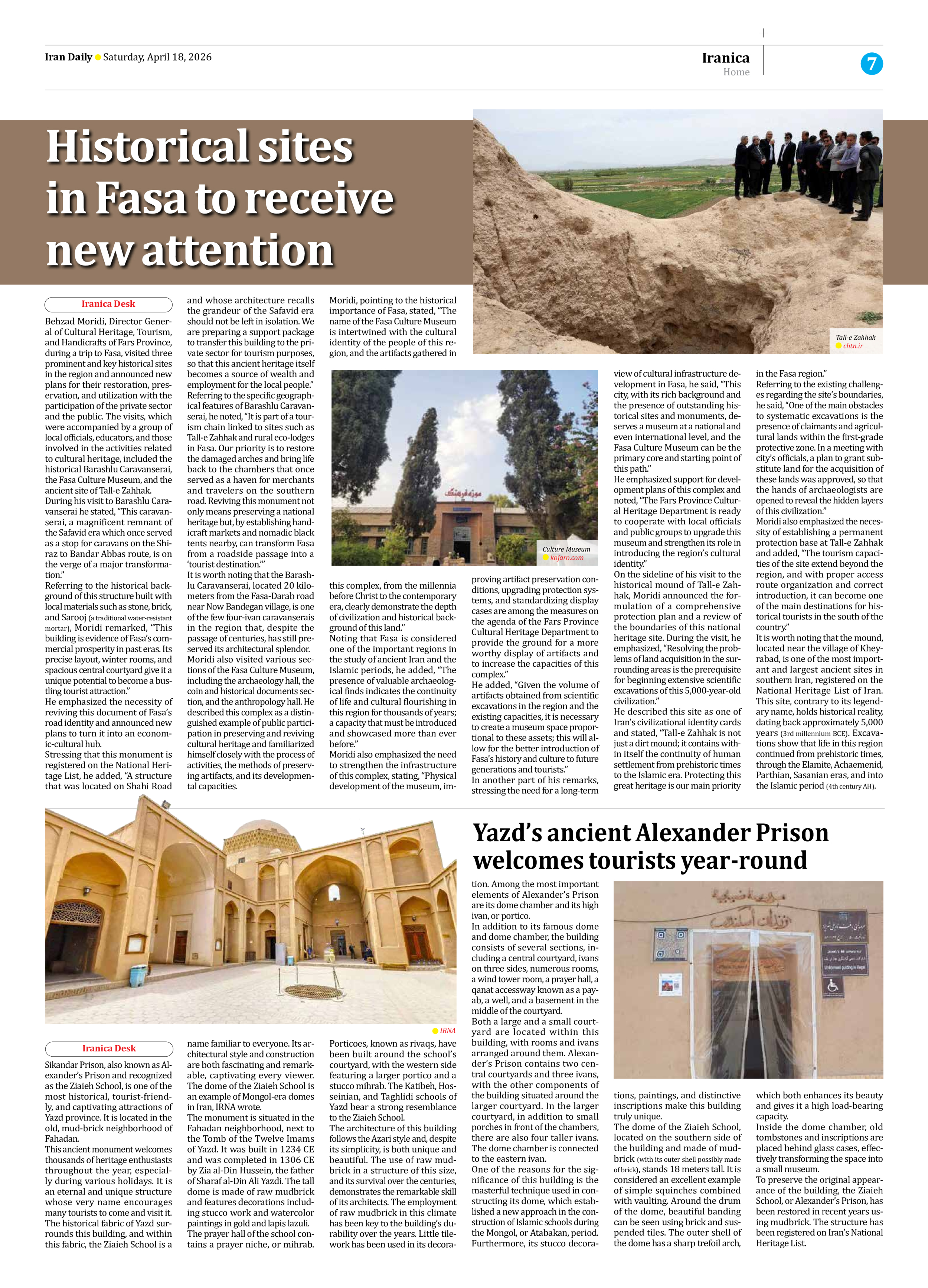
In addition to its famous dome and dome chamber, the building consists of several sections, including a central courtyard, ivans on three sides, numerous rooms, a wind tower room, a prayer hall, a qanat accessway known as a payab, a well, and a basement in the middle of the courtyard.
Both a large and a small courtyard are located within this building, with rooms and ivans arranged around them. Alexander’s Prison contains two central courtyards and three ivans, with the other components of the building situated around the larger courtyard. In the larger courtyard, in addition to small porches in front of the chambers, there are also four taller ivans. The dome chamber is connected to the eastern ivan.
One of the reasons for the significance of this building is the masterful technique used in constructing its dome, which established a new approach in the construction of Islamic schools during the Mongol, or Atabakan, period. Furthermore, its stucco decorations, paintings, and distinctive inscriptions make this building truly unique.
The dome of the Ziaieh School, located on the southern side of the building and made of mudbrick (with its outer shell possibly made of brick), stands 18 meters tall. It is considered an excellent example of simple squinches combined with vaulting. Around the drum of the dome, beautiful banding can be seen using brick and suspended tiles. The outer shell of the dome has a sharp trefoil arch, which both enhances its beauty and gives it a high load-bearing capacity.
Inside the dome chamber, old tombstones and inscriptions are placed behind glass cases, effectively transforming the space into a small museum.
To preserve the original appearance of the building, the Ziaieh School, or Alexander’s Prison, has been restored in recent years using mudbrick. The structure has been registered on Iran’s National Heritage List.