







Historical sites in Fasa to receive new attention
Behzad Moridi, Director General of Cultural Heritage, Tourism, and Handicrafts of Fars Province, during a trip to Fasa, visited three prominent and key historical sites in the region and announced new plans for their restoration, preservation, and utilization with the participation of the private sector and the public. The visits, which were accompanied by a group of local officials, educators, and those involved in the activities related to cultural heritage, included the historical Barashlu Caravanserai, the Fasa Culture Museum, and the ancient site of Tall-e Zahhak.
During his visit to Barashlu Caravanserai he stated, “This caravanserai, a magnificent remnant of the Safavid era which once served as a stop for caravans on the Shiraz to Bandar Abbas route, is on the verge of a major transformation.”
Referring to the historical background of this structure built with local materials such as stone, brick, and Sarooj (a traditional water-resistant mortar), Moridi remarked, “This building is evidence of Fasa’s commercial prosperity in past eras. Its precise layout, winter rooms, and spacious central courtyard give it a unique potential to become a bustling tourist attraction.”
He emphasized the necessity of reviving this document of Fasa’s road identity and announced new plans to turn it into an economic-cultural hub.
Stressing that this monument is registered on the National Heritage List, he added, “A structure that was located on Shahi Road and whose architecture recalls the grandeur of the Safavid era should not be left in isolation. We are preparing a support package to transfer this building to the private sector for tourism purposes, so that this ancient heritage itself becomes a source of wealth and employment for the local people.”
Referring to the specific geographical features of Barashlu Caravanserai, he noted, “It is part of a tourism chain linked to sites such as Tall-e Zahhak and rural eco-lodges in Fasa. Our priority is to restore the damaged arches and bring life back to the chambers that once served as a haven for merchants and travelers on the southern road. Reviving this monument not only means preserving a national heritage but, by establishing handicraft markets and nomadic black tents nearby, can transform Fasa from a roadside passage into a ‘tourist destination.’”
It is worth noting that the Barashlu Caravanserai, located 20 kilometers from the Fasa-Darab road near Now Bandegan village, is one of the few four-ivan caravanserais in the region that, despite the passage of centuries, has still preserved its architectural splendor.
Moridi also visited various sections of the Fasa Culture Museum, including the archaeology hall, the coin and historical documents section, and the anthropology hall. He described this complex as a distinguished example of public participation in preserving and reviving cultural heritage and familiarized himself closely with the process of activities, the methods of preserving artifacts, and its developmental capacities.
Moridi, pointing to the historical importance of Fasa, stated, “The name of the Fasa Culture Museum is intertwined with the cultural identity of the people of this region, and the artifacts gathered in this complex, from the millennia before Christ to the contemporary era, clearly demonstrate the depth of civilization and historical background of this land.”
Noting that Fasa is considered one of the important regions in the study of ancient Iran and the Islamic periods, he added, “The presence of valuable archaeological finds indicates the continuity of life and cultural flourishing in this region for thousands of years; a capacity that must be introduced and showcased more than ever before.”
Moridi also emphasized the need to strengthen the infrastructure of this complex, stating, “Physical development of the museum, improving artifact preservation conditions, upgrading protection systems, and standardizing display cases are among the measures on the agenda of the Fars Province Cultural Heritage Department to provide the ground for a more worthy display of artifacts and to increase the capacities of this complex.”
He added, “Given the volume of artifacts obtained from scientific excavations in the region and the existing capacities, it is necessary to create a museum space proportional to these assets; this will allow for the better introduction of Fasa’s history and culture to future generations and tourists.”
In another part of his remarks, stressing the need for a long-term view of cultural infrastructure development in Fasa, he said, “This city, with its rich background and the presence of outstanding historical sites and monuments, deserves a museum at a national and even international level, and the Fasa Culture Museum can be the primary core and starting point of this path.”
He emphasized support for development plans of this complex and noted, “The Fars Province Cultural Heritage Department is ready to cooperate with local officials and public groups to upgrade this museum and strengthen its role in introducing the region’s cultural identity.”
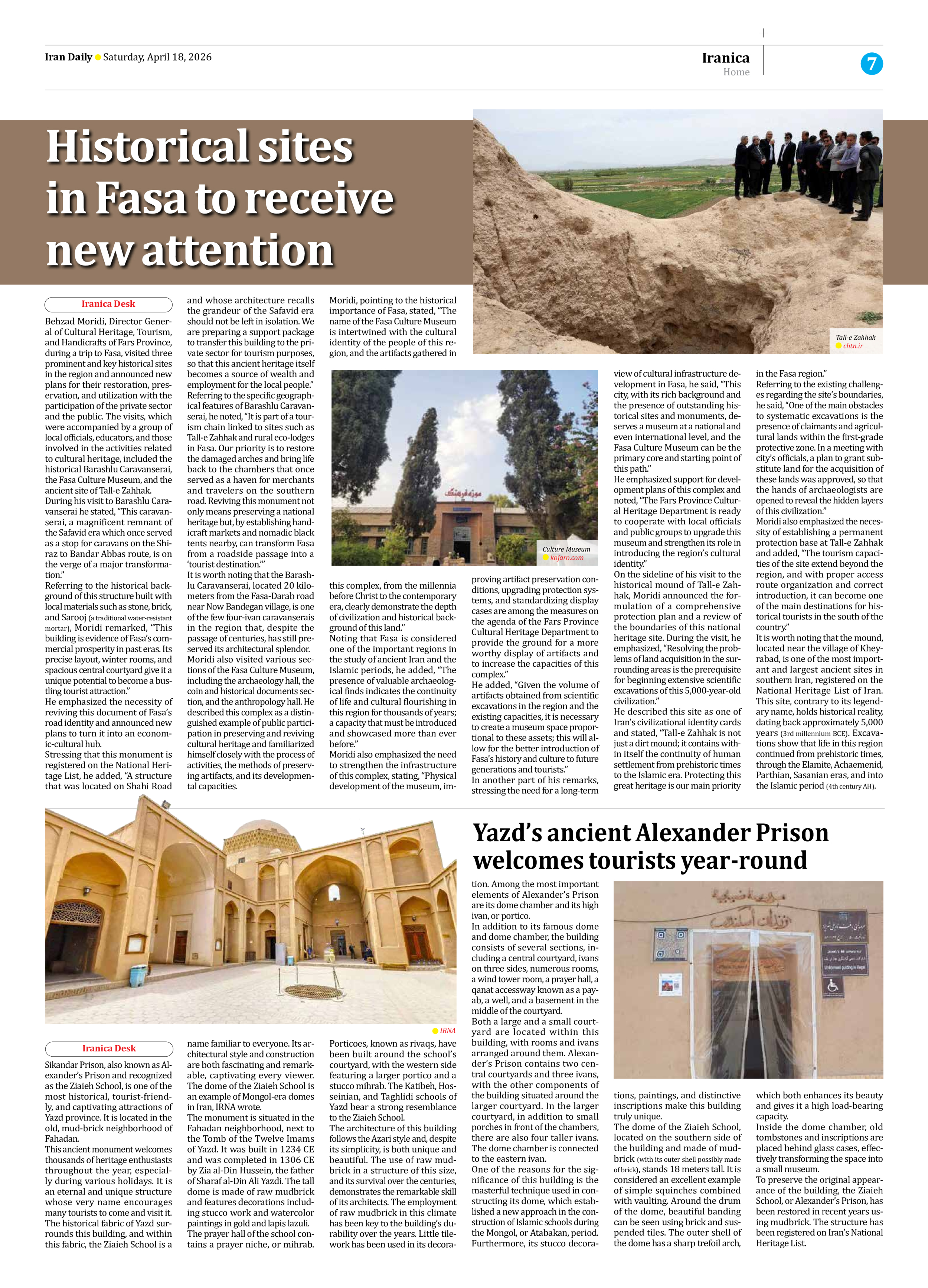
On the sideline of his visit to the historical mound of Tall-e Zahhak, Moridi announced the formulation of a comprehensive protection plan and a review of the boundaries of this national heritage site. During the visit, he emphasized, “Resolving the problems of land acquisition in the surrounding areas is the prerequisite for beginning extensive scientific excavations of this 5,000-year-old civilization.”
He described this site as one of Iran’s civilizational identity cards and stated, “Tall-e Zahhak is not just a dirt mound; it contains within itself the continuity of human settlement from prehistoric times to the Islamic era. Protecting this great heritage is our main priority in the Fasa region.”
Referring to the existing challenges regarding the site’s boundaries, he said, “One of the main obstacles to systematic excavations is the presence of claimants and agricultural lands within the first-grade protective zone. In a meeting with city’s officials, a plan to grant substitute land for the acquisition of these lands was approved, so that the hands of archaeologists are opened to reveal the hidden layers of this civilization.”
Moridi also emphasized the necessity of establishing a permanent protection base at Tall-e Zahhak and added, “The tourism capacities of the site extend beyond the region, and with proper access route organization and correct introduction, it can become one of the main destinations for historical tourists in the south of the country.”
It is worth noting that the mound, located near the village of Kheyrabad, is one of the most important and largest ancient sites in southern Iran, registered on the National Heritage List of Iran. This site, contrary to its legendary name, holds historical reality, dating back approximately 5,000 years (3rd millennium BCE). Excavations show that life in this region continued from prehistoric times, through the Elamite, Achaemenid, Parthian, Sasanian eras, and into the Islamic period (4th century AH).