





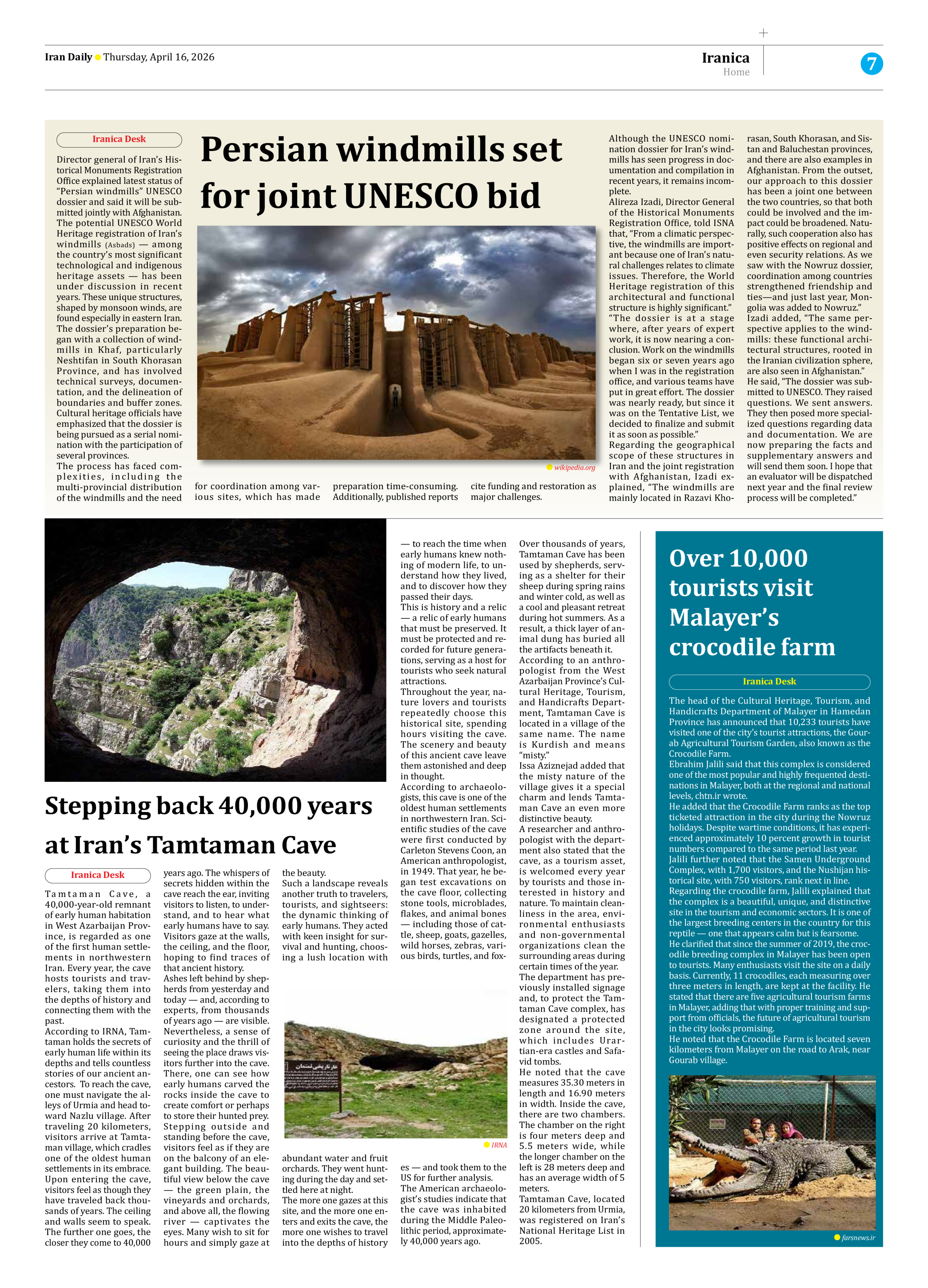


Stepping back 40,000 years at Iran’s Tamtaman Cave
Tamtaman Cave, a 40,000-year-old remnant of early human habitation in West Azarbaijan Province, is regarded as one of the first human settlements in northwestern Iran. Every year, the cave hosts tourists and travelers, taking them into the depths of history and connecting them with the past.
According to IRNA, Tamtaman holds the secrets of early human life within its depths and tells countless stories of our ancient ancestors. To reach the cave, one must navigate the alleys of Urmia and head toward Nazlu village. After traveling 20 kilometers, visitors arrive at Tamtaman village, which cradles one of the oldest human settlements in its embrace.
Upon entering the cave, visitors feel as though they have traveled back thousands of years. The ceiling and walls seem to speak. The further one goes, the closer they come to 40,000 years ago. The whispers of secrets hidden within the cave reach the ear, inviting visitors to listen, to understand, and to hear what early humans have to say. Visitors gaze at the walls, the ceiling, and the floor, hoping to find traces of that ancient history.
Ashes left behind by shepherds from yesterday and today — and, according to experts, from thousands of years ago — are visible. Nevertheless, a sense of curiosity and the thrill of seeing the place draws visitors further into the cave. There, one can see how early humans carved the rocks inside the cave to create comfort or perhaps to store their hunted prey.
Stepping outside and standing before the cave, visitors feel as if they are on the balcony of an elegant building. The beautiful view below the cave — the green plain, the vineyards and orchards, and above all, the flowing river — captivates the eyes. Many wish to sit for hours and simply gaze at the beauty.
Such a landscape reveals another truth to travelers, tourists, and sightseers: the dynamic thinking of early humans. They acted with keen insight for survival and hunting, choosing a lush location with abundant water and fruit orchards. They went hunting during the day and settled here at night.
The more one gazes at this site, and the more one enters and exits the cave, the more one wishes to travel into the depths of history — to reach the time when early humans knew nothing of modern life, to understand how they lived, and to discover how they passed their days.
This is history and a relic — a relic of early humans that must be preserved. It must be protected and recorded for future generations, serving as a host for tourists who seek natural attractions.
Throughout the year, nature lovers and tourists repeatedly choose this historical site, spending hours visiting the cave. The scenery and beauty of this ancient cave leave them astonished and deep in thought.
According to archaeologists, this cave is one of the oldest human settlements in northwestern Iran. Scientific studies of the cave were first conducted by Carleton Stevens Coon, an American anthropologist, in 1949. That year, he began test excavations on the cave floor, collecting stone tools, microblades, flakes, and animal bones — including those of cattle, sheep, goats, gazelles, wild horses, zebras, various birds, turtles, and foxes — and took them to the US for further analysis.
The American archaeologist’s studies indicate that the cave was inhabited during the Middle Paleolithic period, approximately 40,000 years ago.
Over thousands of years, Tamtaman Cave has been used by shepherds, serving as a shelter for their sheep during spring rains and winter cold, as well as a cool and pleasant retreat during hot summers. As a result, a thick layer of animal dung has buried all the artifacts beneath it.
According to an anthropologist from the West Azarbaijan Province’s Cultural Heritage, Tourism, and Handicrafts Department, Tamtaman Cave is located in a village of the same name. The name is Kurdish and means “misty.”
Issa Aziznejad added that the misty nature of the village gives it a special charm and lends Tamtaman Cave an even more distinctive beauty.
A researcher and anthropologist with the department also stated that the cave, as a tourism asset, is welcomed every year by tourists and those interested in history and nature. To maintain cleanliness in the area, environmental enthusiasts and non-governmental organizations clean the surrounding areas during certain times of the year.
The department has previously installed signage and, to protect the Tamtaman Cave complex, has designated a protected zone around the site, which includes Urartian-era castles and Safavid tombs.
He noted that the cave measures 35.30 meters in length and 16.90 meters in width. Inside the cave, there are two chambers. The chamber on the right is four meters deep and 5.5 meters wide, while the longer chamber on the left is 28 meters deep and has an average width of 5 meters.
Tamtaman Cave, located 20 kilometers from Urmia, was registered on Iran’s National Heritage List in 2005.