







Copy in clipboard...
Persian windmills set for joint UNESCO bid
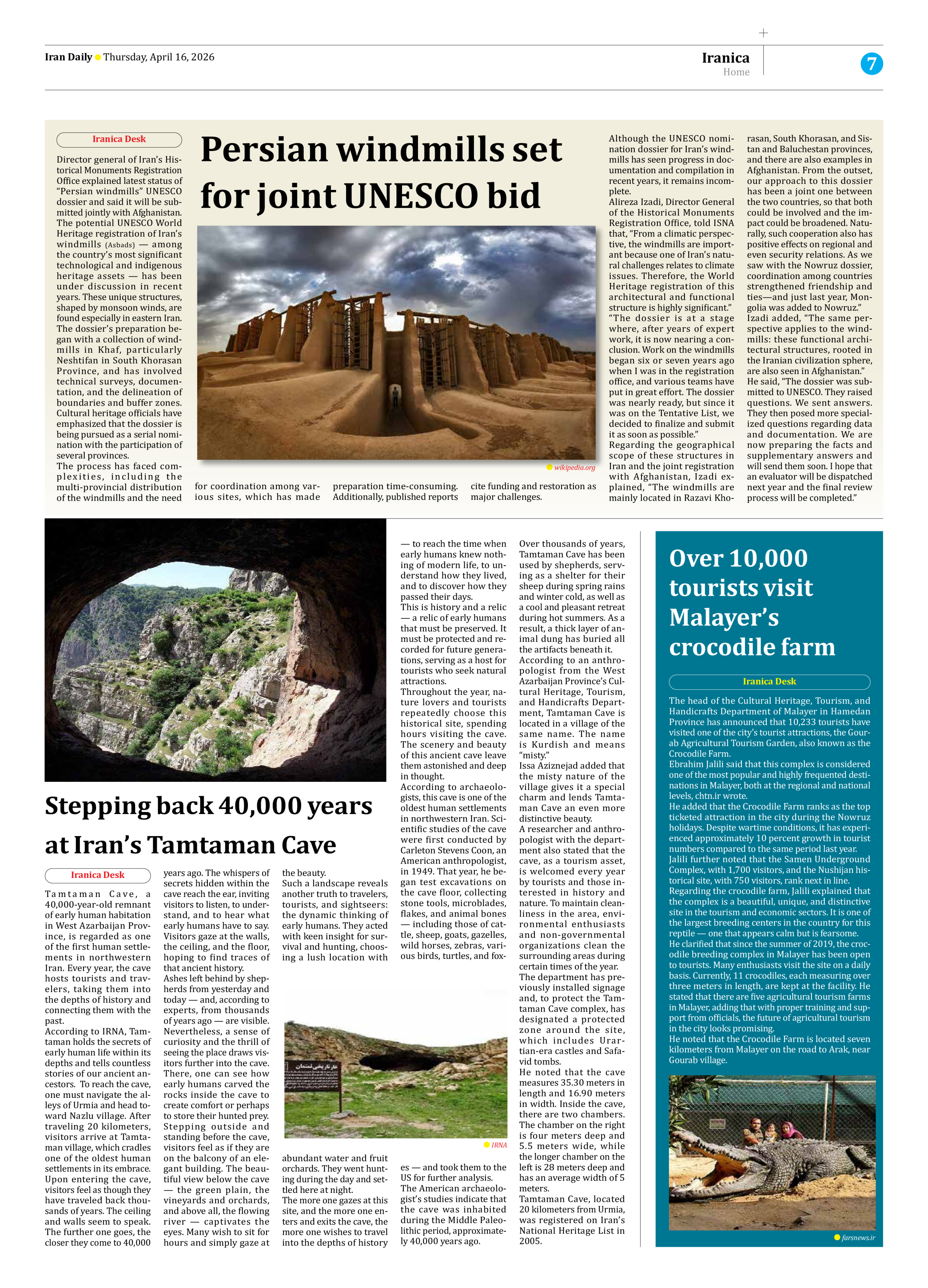
The dossier’s preparation began with a collection of windmills in Khaf, particularly Neshtifan in South Khorasan Province, and has involved technical surveys, documentation, and the delineation of boundaries and buffer zones. Cultural heritage officials have emphasized that the dossier is being pursued as a serial nomination with the participation of several provinces.
The process has faced complexities, including the multi-provincial distribution of the windmills and the need for coordination among various sites, which has made preparation time-consuming. Additionally, published reports cite funding and restoration as major challenges.
Although the UNESCO nomination dossier for Iran’s windmills has seen progress in documentation and compilation in recent years, it remains incomplete.
Alireza Izadi, Director General of the Historical Monuments Registration Office, told ISNA that, “From a climatic perspective, the windmills are important because one of Iran’s natural challenges relates to climate issues. Therefore, the World Heritage registration of this architectural and functional structure is highly significant.”
“The dossier is at a stage where, after years of expert work, it is now nearing a conclusion. Work on the windmills began six or seven years ago when I was in the registration office, and various teams have put in great effort. The dossier was nearly ready, but since it was on the Tentative List, we decided to finalize and submit it as soon as possible.”
Regarding the geographical scope of these structures in Iran and the joint registration with Afghanistan, Izadi explained, “The windmills are mainly located in Razavi Khorasan, South Khorasan, and Sistan and Baluchestan provinces, and there are also examples in Afghanistan. From the outset, our approach to this dossier has been a joint one between the two countries, so that both could be involved and the impact could be broadened. Naturally, such cooperation also has positive effects on regional and even security relations. As we saw with the Nowruz dossier, coordination among countries strengthened friendship and ties—and just last year, Mongolia was added to Nowruz.”
Izadi added, “The same perspective applies to the windmills: these functional architectural structures, rooted in the Iranian civilization sphere, are also seen in Afghanistan.”
He said, “The dossier was submitted to UNESCO. They raised questions. We sent answers. They then posed more specialized questions regarding data and documentation. We are now preparing the facts and supplementary answers and will send them soon. I hope that an evaluator will be dispatched next year and the final review process will be completed.”