







Iran, Qatar highlight intertwined regional interests, US expulsion
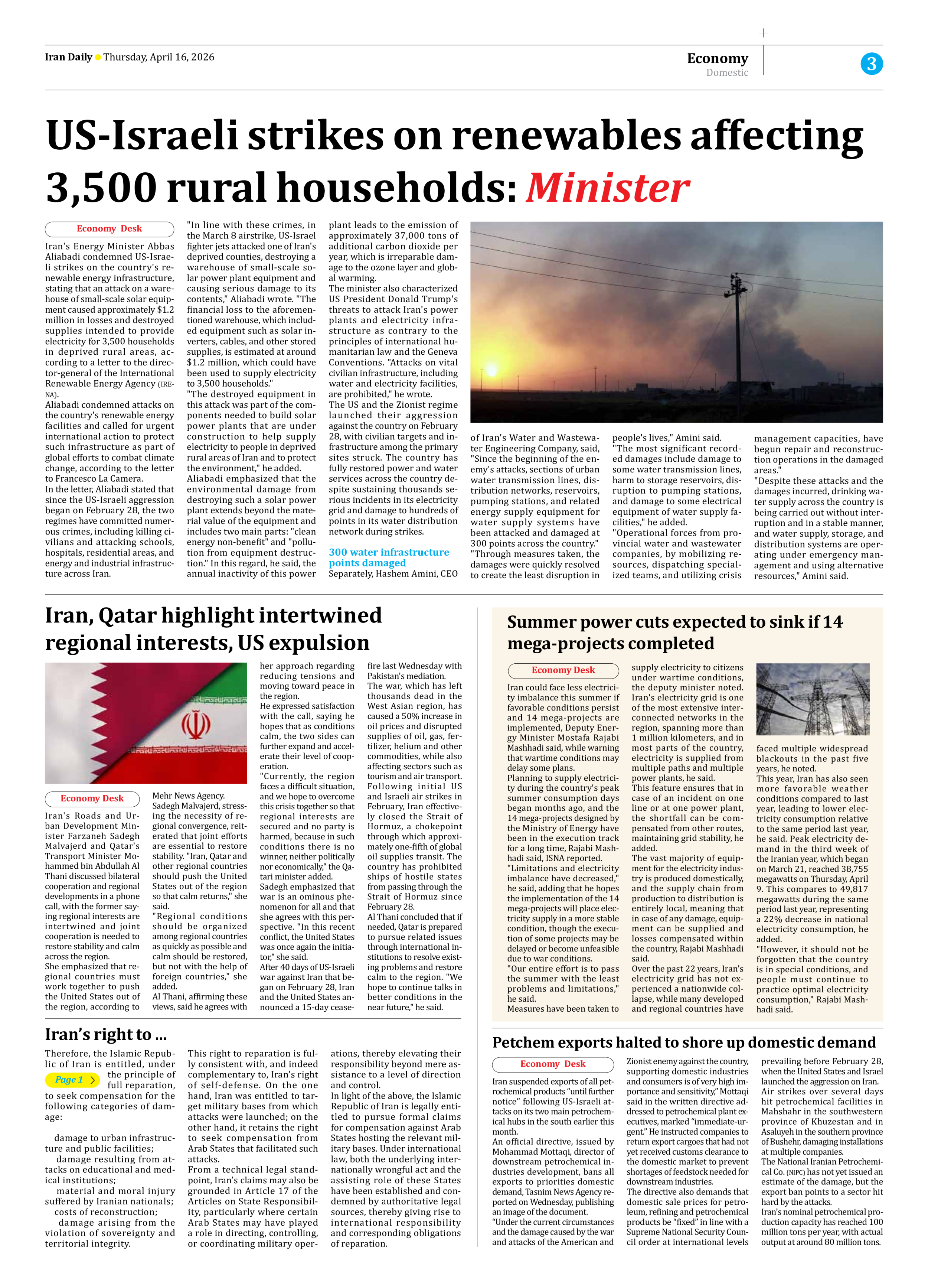
Iran's Roads and Urban Development Minister Farzaneh Sadegh Malvajerd and Qatar's Transport Minister Mohammed bin Abdullah Al Thani discussed bilateral cooperation and regional developments in a phone call, with the former saying regional interests are intertwined and joint cooperation is needed to restore stability and calm across the region.
She emphasized that regional countries must work together to push the United States out of the region, according to Mehr News Agency.
Sadegh Malvajerd, stressing the necessity of regional convergence, reiterated that joint efforts are essential to restore stability. "Iran, Qatar and other regional countries should push the United States out of the region so that calm returns," she said.
"Regional conditions should be organized among regional countries as quickly as possible and calm should be restored, but not with the help of foreign countries," she added.
Al Thani, affirming these views, said he agrees with her approach regarding reducing tensions and moving toward peace in the region.
He expressed satisfaction with the call, saying he hopes that as conditions calm, the two sides can further expand and accelerate their level of cooperation.
"Currently, the region faces a difficult situation, and we hope to overcome this crisis together so that regional interests are secured and no party is harmed, because in such conditions there is no winner, neither politically nor economically," the Qatari minister added.
Sadegh emphasized that war is an ominous phenomenon for all and that she agrees with this perspective. "In this recent conflict, the United States was once again the initiator," she said.
After 40 days of US-Israeli war against Iran that began on February 28, Iran and the United States announced a 15-day ceasefire last Wednesday with Pakistan's mediation.
The war, which has left thousands dead in the West Asian region, has caused a 50% increase in oil prices and disrupted supplies of oil, gas, fertilizer, helium and other commodities, while also affecting sectors such as tourism and air transport.
Following initial US and Israeli air strikes in February, Iran effectively closed the Strait of Hormuz, a chokepoint through which approximately one-fifth of global oil supplies transit. The country has prohibited ships of hostile states from passing through the Strait of Hormuz since February 28.
Al Thani concluded that if needed, Qatar is prepared to pursue related issues through international institutions to resolve existing problems and restore calm to the region. "We hope to continue talks in better conditions in the near future," he said.