







US-Israeli strikes on renewables affecting 3,500 rural households: Minister
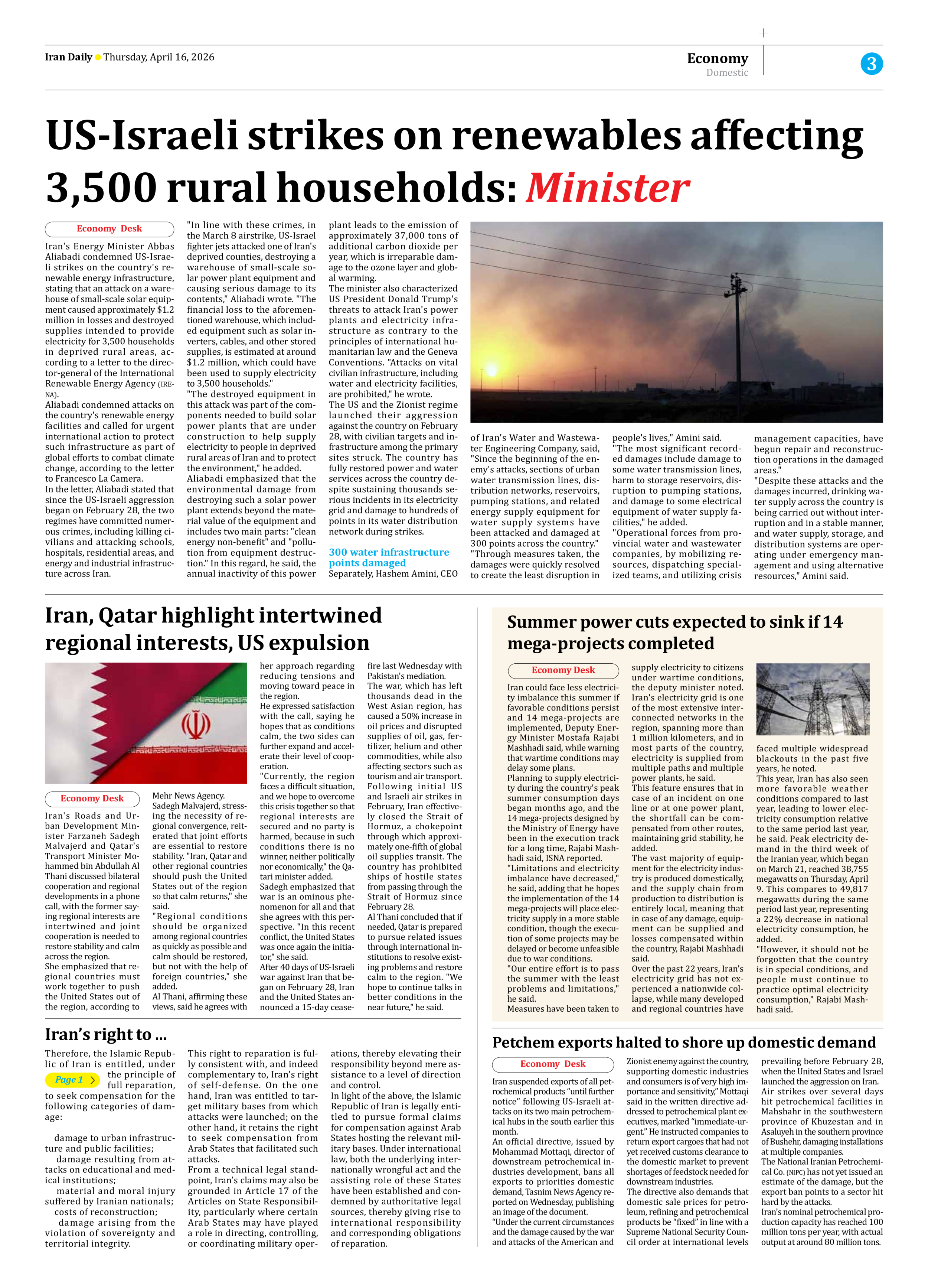
Iran's Energy Minister Abbas Aliabadi condemned US-Israeli strikes on the country's renewable energy infrastructure, stating that an attack on a warehouse of small-scale solar equipment caused approximately $1.2 million in losses and destroyed supplies intended to provide electricity for 3,500 households in deprived rural areas, according to a letter to the director-general of the International Renewable Energy Agency (IRENA).
Aliabadi condemned attacks on the country's renewable energy facilities and called for urgent international action to protect such infrastructure as part of global efforts to combat climate change, according to the letter to Francesco La Camera.
In the letter, Aliabadi stated that since the US-Israeli aggression began on February 28, the two regimes have committed numerous crimes, including killing civilians and attacking schools, hospitals, residential areas, and energy and industrial infrastructure across Iran.
"In line with these crimes, in the March 8 airstrike, US-Israel fighter jets attacked one of Iran's deprived counties, destroying a warehouse of small-scale solar power plant equipment and causing serious damage to its contents," Aliabadi wrote. "The financial loss to the aforementioned warehouse, which included equipment such as solar inverters, cables, and other stored supplies, is estimated at around $1.2 million, which could have been used to supply electricity to 3,500 households."
"The destroyed equipment in this attack was part of the components needed to build solar power plants that are under construction to help supply electricity to people in deprived rural areas of Iran and to protect the environment," he added.
Aliabadi emphasized that the environmental damage from destroying such a solar power plant extends beyond the material value of the equipment and includes two main parts: "clean energy non-benefit" and "pollution from equipment destruction." In this regard, he said, the annual inactivity of this power plant leads to the emission of approximately 37,000 tons of additional carbon dioxide per year, which is irreparable damage to the ozone layer and global warming.
The minister also characterized US President Donald Trump's threats to attack Iran's power plants and electricity infrastructure as contrary to the principles of international humanitarian law and the Geneva Conventions. "Attacks on vital civilian infrastructure, including water and electricity facilities, are prohibited," he wrote.
The US and the Zionist regime launched their aggression against the country on February 28, with civilian targets and infrastructure among the primary sites struck. The country has fully restored power and water services across the country despite sustaining thousands serious incidents in its electricity grid and damage to hundreds of points in its water distribution network during strikes.
300 water infrastructure points damaged
Separately, Hashem Amini, CEO of Iran's Water and Wastewater Engineering Company, said, "Since the beginning of the enemy's attacks, sections of urban water transmission lines, distribution networks, reservoirs, pumping stations, and related energy supply equipment for water supply systems have been attacked and damaged at 300 points across the country."
"Through measures taken, the damages were quickly resolved to create the least disruption in people's lives," Amini said.
"The most significant recorded damages include damage to some water transmission lines, harm to storage reservoirs, disruption to pumping stations, and damage to some electrical equipment of water supply facilities," he added.
"Operational forces from provincial water and wastewater companies, by mobilizing resources, dispatching specialized teams, and utilizing crisis management capacities, have begun repair and reconstruction operations in the damaged areas."
"Despite these attacks and the damages incurred, drinking water supply across the country is being carried out without interruption and in a stable manner, and water supply, storage, and distribution systems are operating under emergency management and using alternative resources," Amini said.