







Copy in clipboard...
Top cmdr. warns US over illegal naval blockade in Persian Gulf
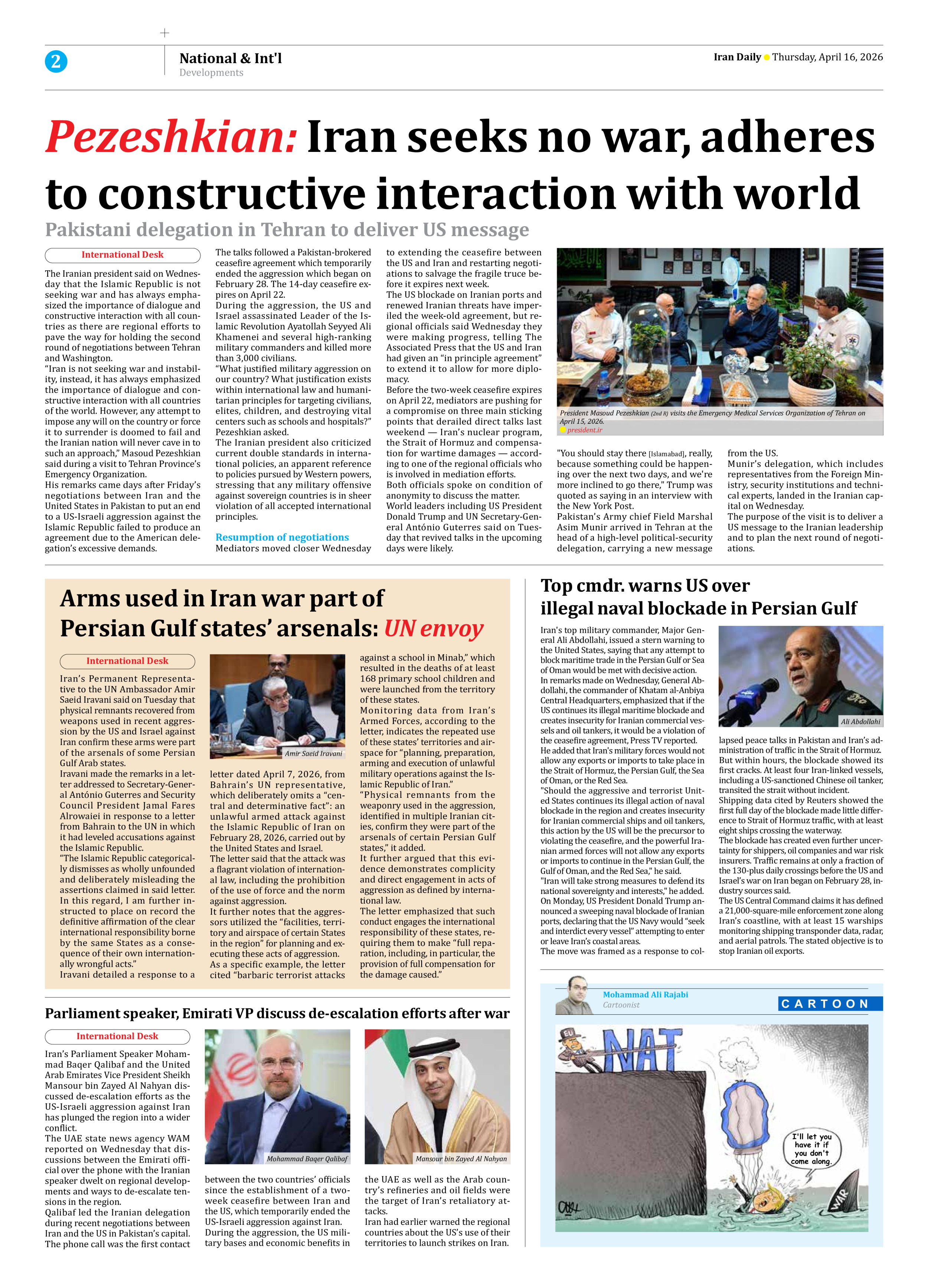
In remarks made on Wednesday, General Abdollahi, the commander of Khatam al-Anbiya Central Headquarters, emphasized that if the US continues its illegal maritime blockade and creates insecurity for Iranian commercial vessels and oil tankers, it would be a violation of the ceasefire agreement, Press TV reported.
He added that Iran's military forces would not allow any exports or imports to take place in the Strait of Hormuz, the Persian Gulf, the Sea of Oman, or the Red Sea.
"Should the aggressive and terrorist United States continues its illegal action of naval blockade in the region and creates insecurity for Iranian commercial ships and oil tankers, this action by the US will be the precursor to violating the ceasefire, and the powerful Iranian armed forces will not allow any exports or imports to continue in the Persian Gulf, the Gulf of Oman, and the Red Sea," he said.
"Iran will take strong measures to defend its national sovereignty and interests," he added.
On Monday, US President Donald Trump announced a sweeping naval blockade of Iranian ports, declaring that the US Navy would “seek and interdict every vessel” attempting to enter or leave Iran’s coastal areas.
The move was framed as a response to collapsed peace talks in Pakistan and Iran’s administration of traffic in the Strait of Hormuz.
But within hours, the blockade showed its first cracks. At least four Iran-linked vessels, including a US-sanctioned Chinese oil tanker, transited the strait without incident.
Shipping data cited by Reuters showed the first full day of the blockade made little difference to Strait of Hormuz traffic, with at least eight ships crossing the waterway.
The blockade has created even further uncertainty for shippers, oil companies and war risk insurers. Traffic remains at only a fraction of the 130-plus daily crossings before the US and Israel’s war on Iran began on February 28, industry sources said.
The US Central Command claims it has defined a 21,000-square-mile enforcement zone along Iran’s coastline, with at least 15 warships monitoring shipping transponder data, radar, and aerial patrols. The stated objective is to stop Iranian oil exports.