







Copy in clipboard...
Pezeshkian: Iran seeks no war, adheres to constructive interaction with world
Pakistani delegation in Tehran to deliver US message
The Iranian president said on Wednesday that the Islamic Republic is not seeking war and has always emphasized the importance of dialogue and constructive interaction with all countries as there are regional efforts to pave the way for holding the second round of negotiations between Tehran and Washington.
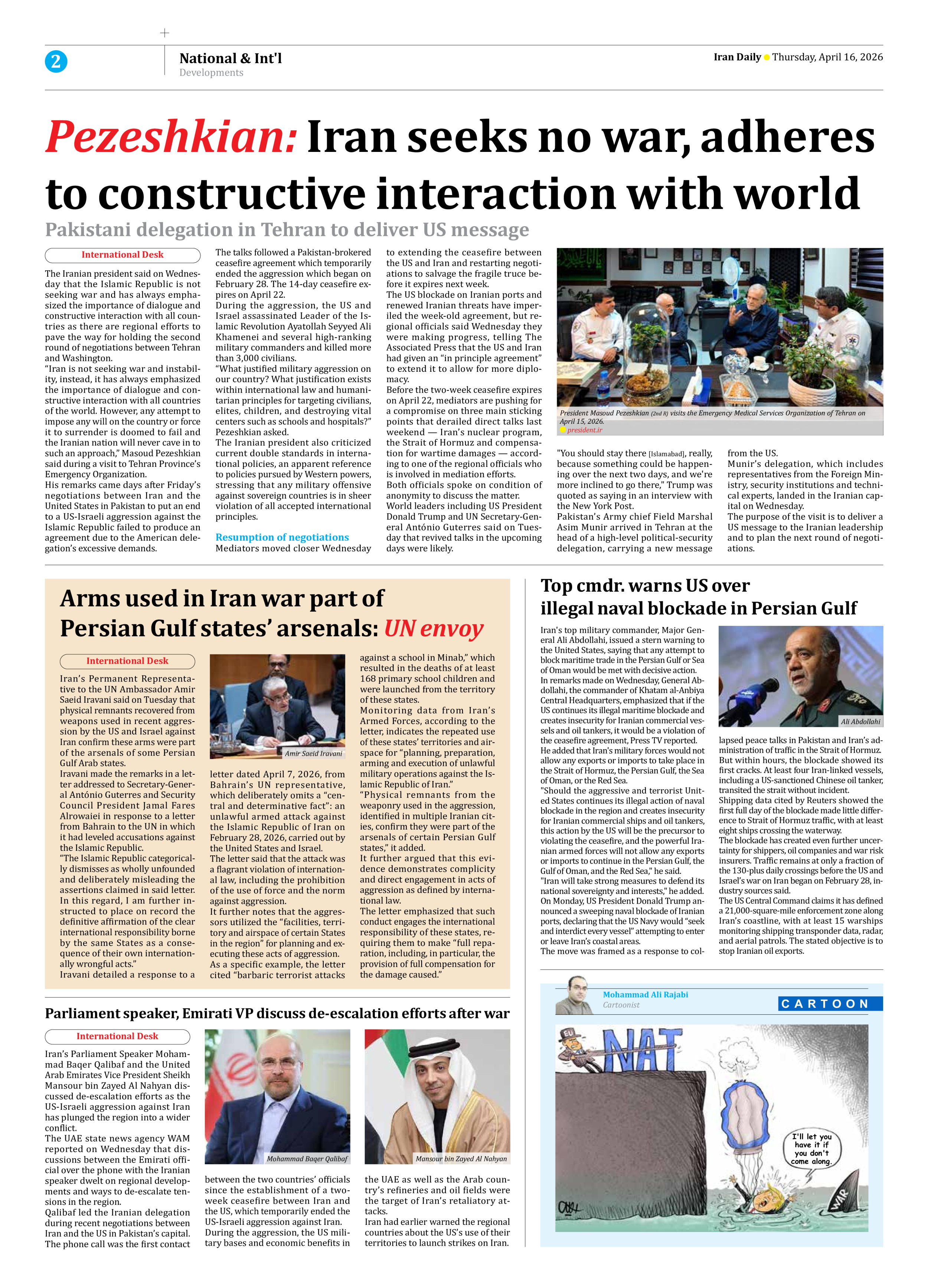
“Iran is not seeking war and instability, instead, it has always emphasized the importance of dialogue and constructive interaction with all countries of the world. However, any attempt to impose any will on the country or force it to surrender is doomed to fail and the Iranian nation will never cave in to such an approach,” Masoud Pezeshkian said during a visit to Tehran Province’s Emergency Organization.
His remarks came days after Friday’s negotiations between Iran and the United States in Pakistan to put an end to a US-Israeli aggression against the Islamic Republic failed to produce an agreement due to the American delegation’s excessive demands.
The talks followed a Pakistan-brokered ceasefire agreement which temporarily ended the aggression which began on February 28. The 14-day ceasefire expires on April 22.
During the aggression, the US and Israel assassinated Leader of the Islamic Revolution Ayatollah Seyyed Ali Khamenei and several high-ranking military commanders and killed more than 3,000 civilians.
“What justified military aggression on our country? What justification exists within international law and humanitarian principles for targeting civilians, elites, children, and destroying vital centers such as schools and hospitals?” Pezeshkian asked.
The Iranian president also criticized current double standards in international policies, an apparent reference to policies pursued by Western powers, stressing that any military offensive against sovereign countries is in sheer violation of all accepted international principles.
Resumption of negotiations
Mediators moved closer Wednesday to extending the ceasefire between the US and Iran and restarting negotiations to salvage the fragile truce before it expires next week.
The US blockade on Iranian ports and renewed Iranian threats have imperiled the week-old agreement, but regional officials said Wednesday they were making progress, telling The Associated Press that the US and Iran had given an “in principle agreement” to extend it to allow for more diplomacy.
Before the two-week ceasefire expires on April 22, mediators are pushing for a compromise on three main sticking points that derailed direct talks last weekend — Iran’s nuclear program, the Strait of Hormuz and compensation for wartime damages — according to one of the regional officials who is involved in mediation efforts.
Both officials spoke on condition of anonymity to discuss the matter.
World leaders including US President Donald Trump and UN Secretary-General António Guterres said on Tuesday that revived talks in the upcoming days were likely.
"You should stay there [Islamabad], really, because something could be happening over the next two days, and we're more inclined to go there," Trump was quoted as saying in an interview with the New York Post.
Pakistan’s Army chief Field Marshal Asim Munir arrived in Tehran at the head of a high-level political-security delegation, carrying a new message from the US.
Munir’s delegation, which includes representatives from the Foreign Ministry, security institutions and technical experts, landed in the Iranian capital on Wednesday.
The purpose of the visit is to deliver a US message to the Iranian leadership and to plan the next round of negotiations.