







Eastern border trade posts 30% surge after war as basic supplies secured
By Sadeq Dehqan
Staff writer
Iran has maintained uninterrupted supplies of basic and consumer goods during a 40-day military onslaught that began late February, while trade transit through its eastern and northeastern borders has grown by approximately 30% compared to pre-war levels, a senior trade actor said.
Ensuring the supply of imported goods, particularly essential and consumer items needed by the population, has been among the country's top priorities during crisis and wartime conditions. Over the past six weeks, despite military attacks on the country and public concerns about potential shortages of essential items, officials have repeatedly stated that basic goods supplies have remained fully secured during wartime, and that no shortages would be felt even if the conflict were to continue for several months.
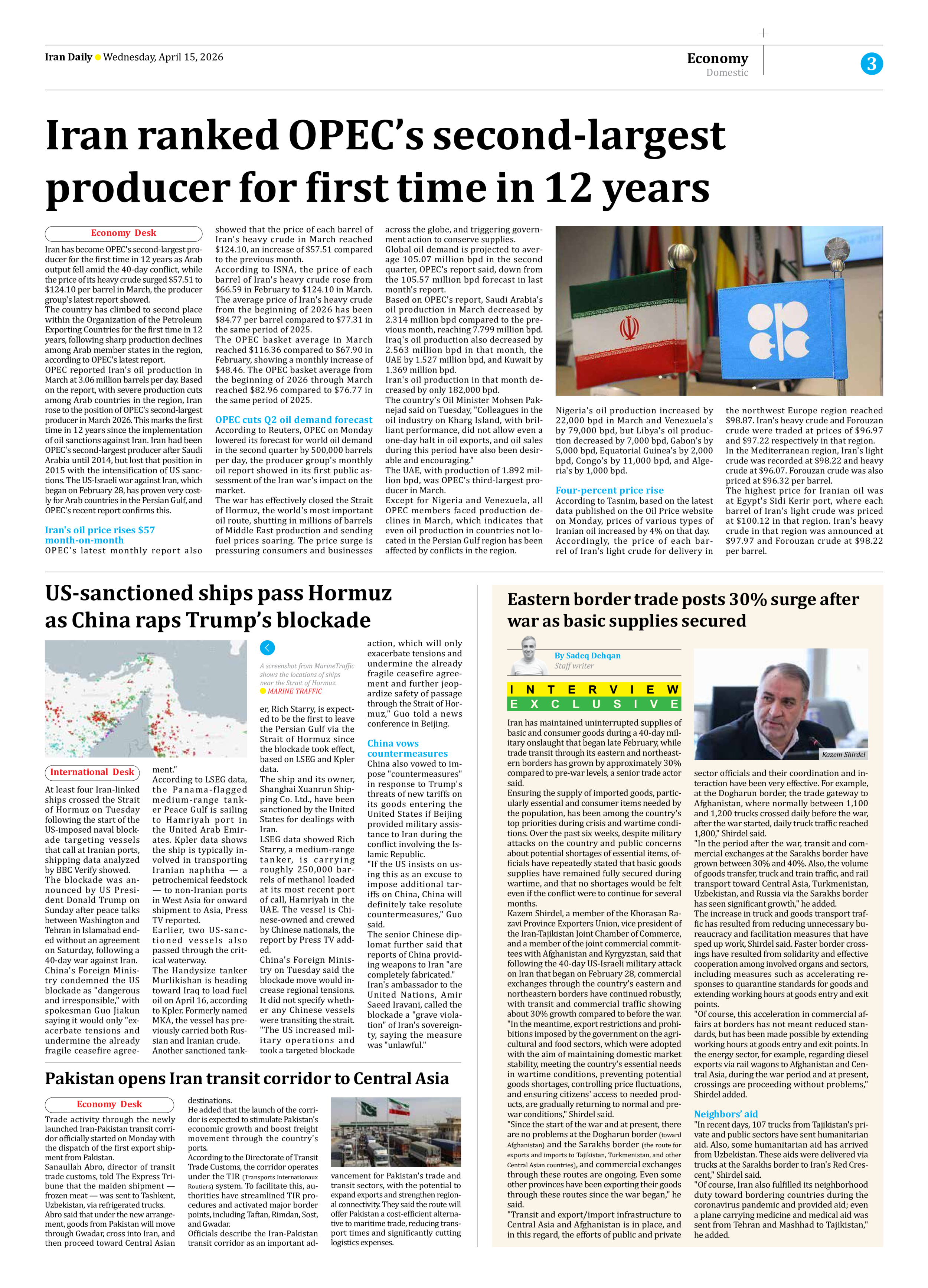
Kazem Shirdel, a member of the Khorasan Razavi Province Exporters Union, vice president of the Iran-Tajikistan Joint Chamber of Commerce, and a member of the joint commercial committees with Afghanistan and Kyrgyzstan, said that following the 40-day US-Israeli military attack on Iran that began on February 28, commercial exchanges through the country's eastern and northeastern borders have continued robustly, with transit and commercial traffic showing about 30% growth compared to before the war.
"In the meantime, export restrictions and prohibitions imposed by the government on the agricultural and food sectors, which were adopted with the aim of maintaining domestic market stability, meeting the country's essential needs in wartime conditions, preventing potential goods shortages, controlling price fluctuations, and ensuring citizens' access to needed products, are gradually returning to normal and pre-war conditions," Shirdel said.
"Since the start of the war and at present, there are no problems at the Dogharun border (toward Afghanistan) and the Sarakhs border (the route for exports and imports to Tajikistan, Turkmenistan, and other Central Asian countries), and commercial exchanges through these routes are ongoing. Even some other provinces have been exporting their goods through these routes since the war began," he said.
"Transit and export/import infrastructure to Central Asia and Afghanistan is in place, and in this regard, the efforts of public and private sector officials and their coordination and interaction have been very effective. For example, at the Dogharun border, the trade gateway to Afghanistan, where normally between 1,100 and 1,200 trucks crossed daily before the war, after the war started, daily truck traffic reached 1,800," Shirdel said.
"In the period after the war, transit and commercial exchanges at the Sarakhs border have grown between 30% and 40%. Also, the volume of goods transfer, truck and train traffic, and rail transport toward Central Asia, Turkmenistan, Uzbekistan, and Russia via the Sarakhs border has seen significant growth," he added.
The increase in truck and goods transport traffic has resulted from reducing unnecessary bureaucracy and facilitation measures that have sped up work, Shirdel said. Faster border crossings have resulted from solidarity and effective cooperation among involved organs and sectors, including measures such as accelerating responses to quarantine standards for goods and extending working hours at goods entry and exit points.
"Of course, this acceleration in commercial affairs at borders has not meant reduced standards, but has been made possible by extending working hours at goods entry and exit points. In the energy sector, for example, regarding diesel exports via rail wagons to Afghanistan and Central Asia, during the war period and at present, crossings are proceeding without problems," Shirdel added.
Neighbors’ aid
"In recent days, 107 trucks from Tajikistan's private and public sectors have sent humanitarian aid. Also, some humanitarian aid has arrived from Uzbekistan. These aids were delivered via trucks at the Sarakhs border to Iran's Red Crescent," Shirdel said.
"Of course, Iran also fulfilled its neighborhood duty toward bordering countries during the coronavirus pandemic and provided aid; even a plane carrying medicine and medical aid was sent from Tehran and Mashhad to Tajikistan," he added.