







Iran ranked OPEC’s second-largest producer for first time in 12 years
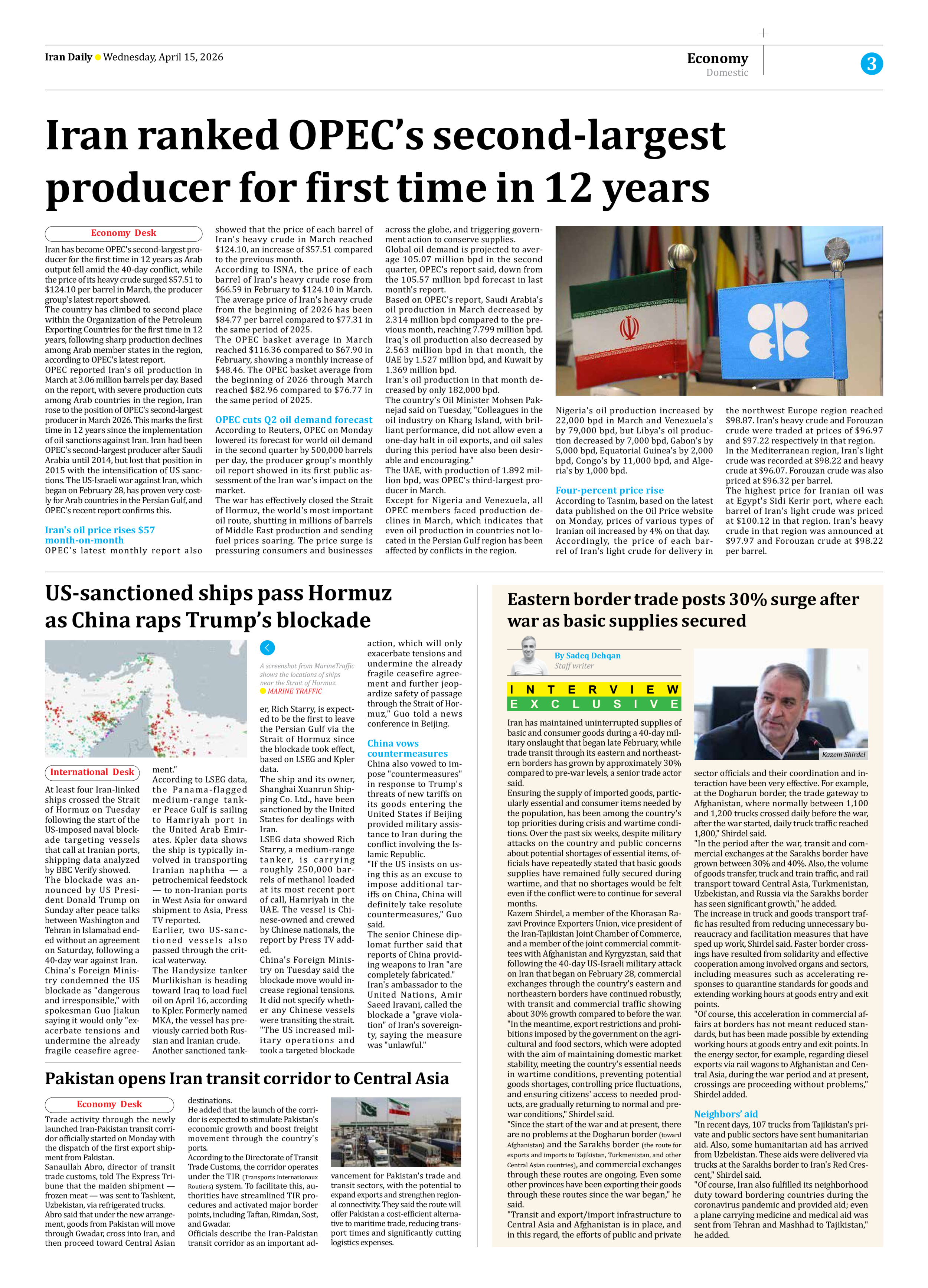
Iran has become OPEC's second-largest producer for the first time in 12 years as Arab output fell amid the 40-day conflict, while the price of its heavy crude surged $57.51 to $124.10 per barrel in March, the producer group's latest report showed.
The country has climbed to second place within the Organization of the Petroleum Exporting Countries for the first time in 12 years, following sharp production declines among Arab member states in the region, according to OPEC's latest report.
OPEC reported Iran's oil production in March at 3.06 million barrels per day. Based on the report, with severe production cuts among Arab countries in the region, Iran rose to the position of OPEC's second-largest producer in March 2026. This marks the first time in 12 years since the implementation of oil sanctions against Iran. Iran had been OPEC's second-largest producer after Saudi Arabia until 2014, but lost that position in 2015 with the intensification of US sanctions. The US-Israeli war against Iran, which began on February 28, has proven very costly for Arab countries in the Persian Gulf, and OPEC's recent report confirms this.
Iran's oil price rises $57
month-on-month
OPEC's latest monthly report also showed that the price of each barrel of Iran's heavy crude in March reached $124.10, an increase of $57.51 compared to the previous month.
According to ISNA, the price of each barrel of Iran's heavy crude rose from $66.59 in February to $124.10 in March. The average price of Iran's heavy crude from the beginning of 2026 has been $84.77 per barrel compared to $77.31 in the same period of 2025.
The OPEC basket average in March reached $116.36 compared to $67.90 in February, showing a monthly increase of $48.46. The OPEC basket average from the beginning of 2026 through March reached $82.96 compared to $76.77 in the same period of 2025.
OPEC cuts Q2 oil demand forecast
According to Reuters, OPEC on Monday lowered its forecast for world oil demand in the second quarter by 500,000 barrels per day, the producer group's monthly oil report showed in its first public assessment of the Iran war's impact on the market.
The war has effectively closed the Strait of Hormuz, the world's most important oil route, shutting in millions of barrels of Middle East production and sending fuel prices soaring. The price surge is pressuring consumers and businesses across the globe, and triggering government action to conserve supplies.
Global oil demand is projected to average 105.07 million bpd in the second quarter, OPEC's report said, down from the 105.57 million bpd forecast in last month's report.
Based on OPEC's report, Saudi Arabia's oil production in March decreased by 2.314 million bpd compared to the previous month, reaching 7.799 million bpd.
Iraq's oil production also decreased by 2.563 million bpd in that month, the UAE by 1.527 million bpd, and Kuwait by 1.369 million bpd.
Iran's oil production in that month decreased by only 182,000 bpd.
The country’s Oil Minister Mohsen Paknejad said on Tuesday, "Colleagues in the oil industry on Kharg Island, with brilliant performance, did not allow even a one-day halt in oil exports, and oil sales during this period have also been desirable and encouraging."
The UAE, with production of 1.892 million bpd, was OPEC's third-largest producer in March.
Except for Nigeria and Venezuela, all OPEC members faced production declines in March, which indicates that even oil production in countries not located in the Persian Gulf region has been affected by conflicts in the region.
Nigeria's oil production increased by 22,000 bpd in March and Venezuela's by 79,000 bpd, but Libya's oil production decreased by 7,000 bpd, Gabon's by 5,000 bpd, Equatorial Guinea's by 2,000 bpd, Congo's by 11,000 bpd, and Algeria's by 1,000 bpd.
Four-percent price rise
According to Tasnim, based on the latest data published on the Oil Price website on Monday, prices of various types of Iranian oil increased by 4% on that day.
Accordingly, the price of each barrel of Iran's light crude for delivery in the northwest Europe region reached $98.87. Iran's heavy crude and Forouzan crude were traded at prices of $96.97 and $97.22 respectively in that region.
In the Mediterranean region, Iran's light crude was recorded at $98.22 and heavy crude at $96.07. Forouzan crude was also priced at $96.32 per barrel.
The highest price for Iranian oil was at Egypt's Sidi Kerir port, where each barrel of Iran's light crude was priced at $100.12 in that region. Iran's heavy crude in that region was announced at $97.97 and Forouzan crude at $98.22 per barrel.