







Copy in clipboard...
A 2,000-year-old art form shines again on glass canvases in Iran
Reverse glass painting has a long and rich history. This art form, often executed in two dimensions with vibrant, luminous colors, has been popular within the folk and ethnic cultures of many countries around the world, according to IRNA.
The origins of such painting in Europe date back to the third century BCE. The oldest discovered example comes from southern Italy: a glass vessel featuring an engraved gold leaf placed between two colorless glass bowls. These objects, known as gold glass, have surviving examples housed in the British Museum. The production of glass objects, along with enameling and gilding on them, reached its zenith during the 11th and 12th centuries CE. During this period, thin painted metal sheets were affixed to the back of glass, with one of the most beautiful examples from the 13th century found in the “Chapel of St. Stephen” within St. Minster’s Church in England.
Stained glass used to decorate churches became widespread in Europe from roughly the 9th and 10th centuries CE. It was produced by first painting flat glass pieces with molten colored glass and then heating them to fix the designs. The finest example of this technique is from the 12th century at Chartres Cathedral in France. This type of painting, which involves no subsequent heating of the glass objects, is also known as “cold painting.”
Precise details about how this art form entered Iran are not available. However, it is probable that the art arrived through merchants from Venice, Italy — which for centuries was a global hub for glassmaking and related decoration. This European art was soon imbued with a distinctly local character thanks to the creativity of Iranian artists.
The earliest reverse glass paintings in Iran were beautiful gol-o-morgh (flower and bird) pieces, which were used in the stucco work of ceilings and walls in aristocratic homes, a tradition dating back to the Zandieh period (1751-1794). The finest examples of reverse glass painting from the Zand era were created by the renowned Shirazi painter Agha Sadegh. He was a student of Ali Ashraf, a famous painter of the 12th century AH (18th century CE). Gradually, reverse glass and mirror painting with gol-o-morgh themes became more widespread. Over time, depictions of young women in European attire, as well as landscapes, were added to these paintings. These changes occurred under the influence of the growing popularity of European-style prints in Iran and subsequent Iranian imitations of them, which had found favor with the general public.
With the beginning of Fath-Ali Shah’s reign in the first half of the 13th century AH (early 19th century CE), the style of portraiture and figure painting became prevalent among court painters. Many examples of this style are preserved in the painting collection of the Golestan Palace. At present, the art of reverse glass painting is common in most countries around the world, and notable 20th-century painters have worked in this field, although the art has never regained the popularity it enjoyed in years past.
The art of painting on glass, which from ancient times played a role in decorating orsi (traditional sash) windows, mirror work, and the stained glass of Iran’s historic buildings, has experienced a resurgence in recent years among young artists, adopting a new style and approach. This art form, a fusion of color, light, and transparency, has successfully carved out a place for itself within Iran’s contemporary decorative arts.
Painting on glass in the history of Iranian art is rooted in Persian aesthetic sensibilities and its interaction with Islamic arts. In the past, this art was mainly used in the design of painted glassware and decorative vessels. Today, however, by utilizing new industrial paints and modern techniques, it is finding new life in decorative panels, interior design, and mixed media art.
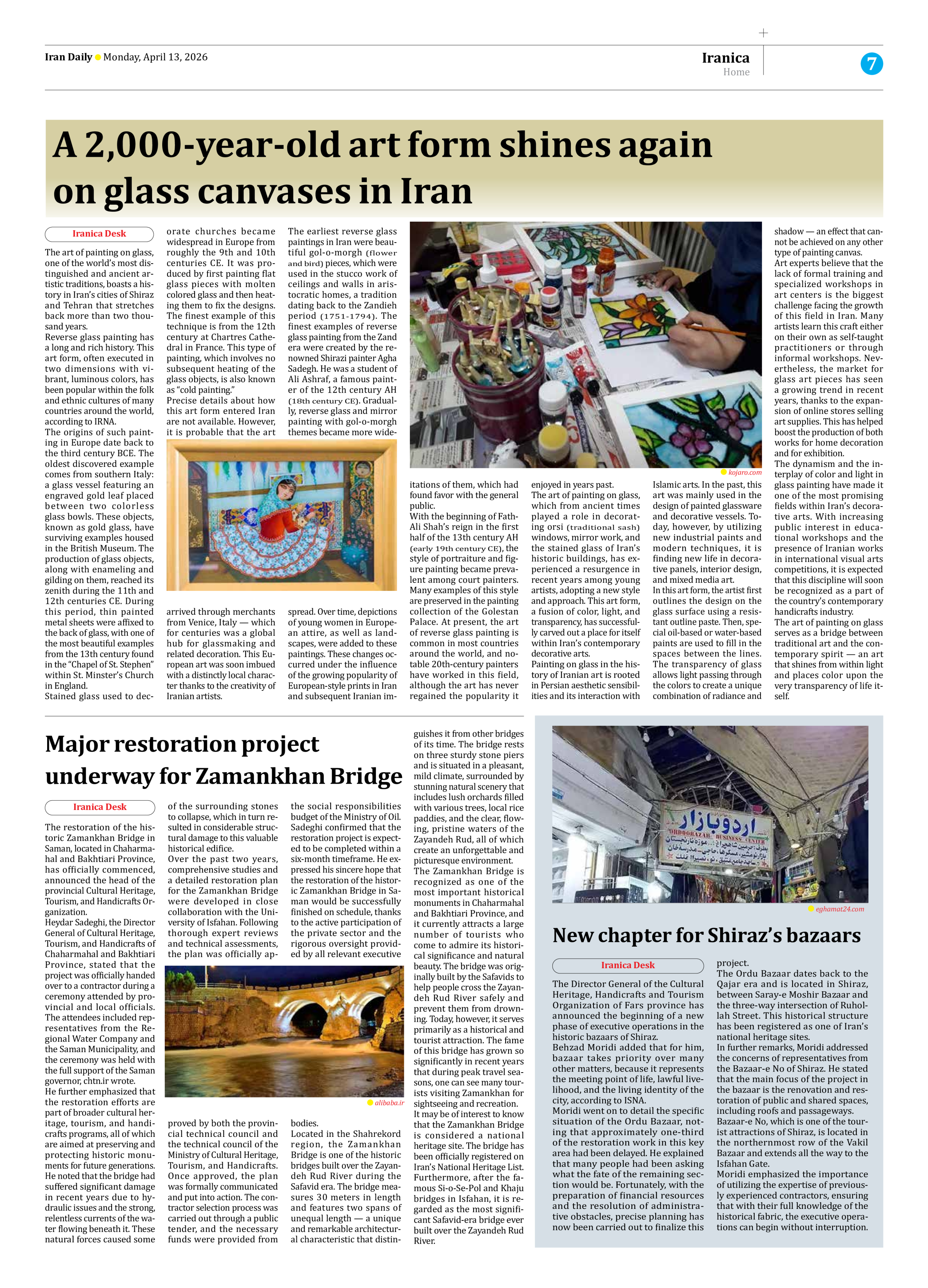
In this art form, the artist first outlines the design on the glass surface using a resistant outline paste. Then, special oil-based or water-based paints are used to fill in the spaces between the lines. The transparency of glass allows light passing through the colors to create a unique combination of radiance and shadow — an effect that cannot be achieved on any other type of painting canvas.
Art experts believe that the lack of formal training and specialized workshops in art centers is the biggest challenge facing the growth of this field in Iran. Many artists learn this craft either on their own as self-taught practitioners or through informal workshops. Nevertheless, the market for glass art pieces has seen a growing trend in recent years, thanks to the expansion of online stores selling art supplies. This has helped boost the production of both works for home decoration and for exhibition.
The dynamism and the interplay of color and light in glass painting have made it one of the most promising fields within Iran’s decorative arts. With increasing public interest in educational workshops and the presence of Iranian works in international visual arts competitions, it is expected that this discipline will soon be recognized as a part of the country’s contemporary handicrafts industry.
The art of painting on glass serves as a bridge between traditional art and the contemporary spirit — an art that shines from within light and places color upon the very transparency of life itself.