







Copy in clipboard...
Yazd’s Grand Mosque is timeless Iranian treasure
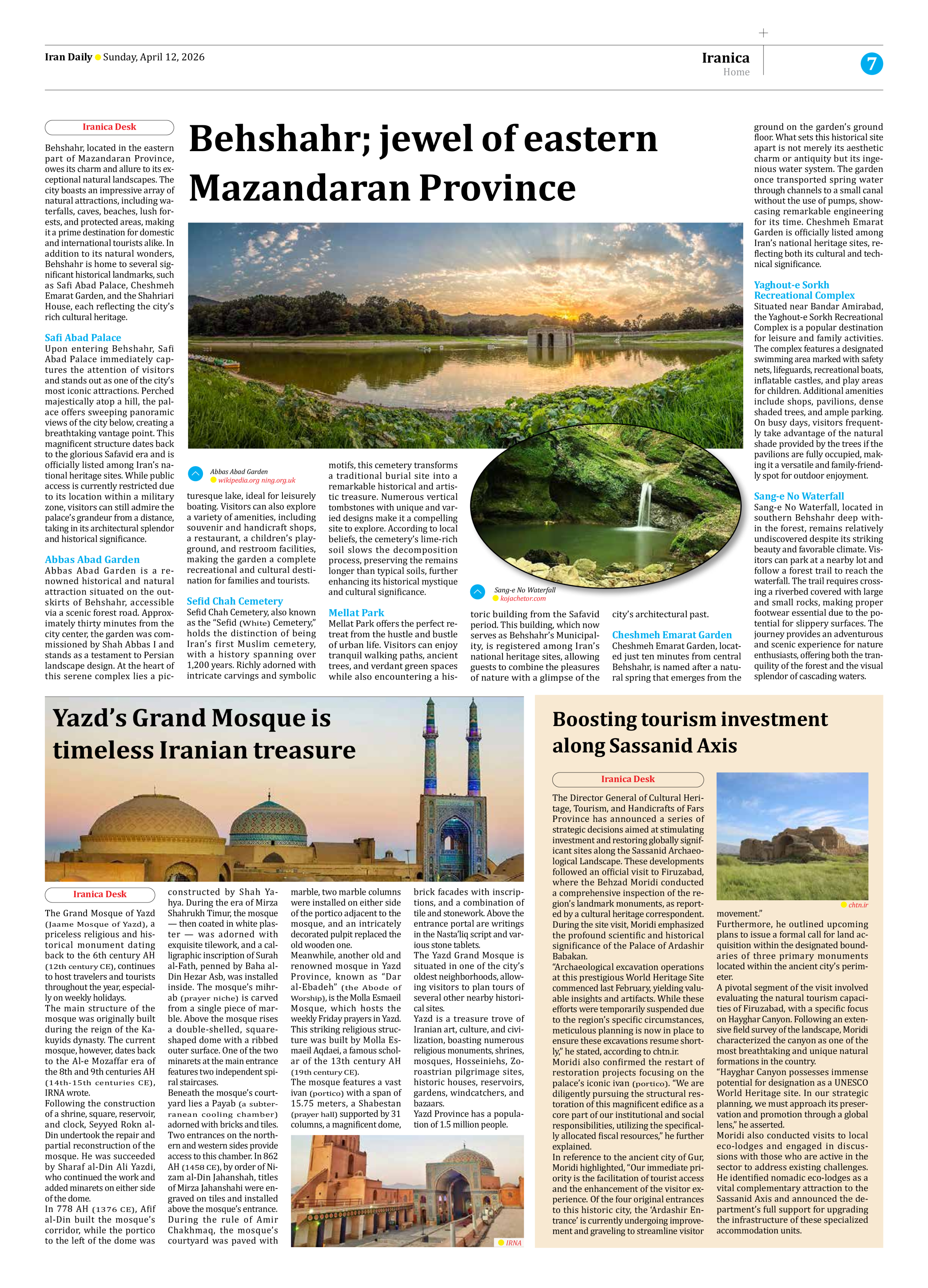
The main structure of the mosque was originally built during the reign of the Kakuyids dynasty. The current mosque, however, dates back to the Al-e Mozaffar era of the 8th and 9th centuries AH (14th-15th centuries CE), IRNA wrote.
Following the construction of a shrine, square, reservoir, and clock, Seyyed Rokn al-Din undertook the repair and partial reconstruction of the mosque. He was succeeded by Sharaf al-Din Ali Yazdi, who continued the work and added minarets on either side of the dome.
In 778 AH (1376 CE), Afif al-Din built the mosque’s corridor, while the portico to the left of the dome was constructed by Shah Yahya. During the era of Mirza Shahrukh Timur, the mosque — then coated in white plaster — was adorned with exquisite tilework, and a calligraphic inscription of Surah al-Fath, penned by Baha al-Din Hezar Asb, was installed inside. The mosque’s mihrab (prayer niche) is carved from a single piece of marble. Above the mosque rises a double-shelled, square-shaped dome with a ribbed outer surface. One of the two minarets at the main entrance features two independent spiral staircases.
Beneath the mosque’s courtyard lies a Payab (a subterranean cooling chamber) adorned with bricks and tiles. Two entrances on the northern and western sides provide access to this chamber. In 862 AH (1458 CE), by order of Nizam al-Din Jahanshah, titles of Mirza Jahanshahi were engraved on tiles and installed above the mosque’s entrance.
During the rule of Amir Chakhmaq, the mosque’s courtyard was paved with marble, two marble columns were installed on either side of the portico adjacent to the mosque, and an intricately decorated pulpit replaced the old wooden one.
Meanwhile, another old and renowned mosque in Yazd Province, known as “Dar al-Ebadeh” (the Abode of Worship), is the Molla Esmaeil Mosque, which hosts the weekly Friday prayers in Yazd.
This striking religious structure was built by Molla Esmaeil Aqdaei, a famous scholar of the 13th century AH (19th century CE).
The mosque features a vast ivan (portico) with a span of 15.75 meters, a Shabestan (prayer hall) supported by 31 columns, a magnificent dome, brick facades with inscriptions, and a combination of tile and stonework. Above the entrance portal are writings in the Nasta’liq script and various stone tablets.
The Yazd Grand Mosque is situated in one of the city’s oldest neighborhoods, allowing visitors to plan tours of several other nearby historical sites.
Yazd is a treasure trove of Iranian art, culture, and civilization, boasting numerous religious monuments, shrines, mosques, Hosseiniehs, Zoroastrian pilgrimage sites, historic houses, reservoirs, gardens, windcatchers, and bazaars.
Yazd Province has a population of 1.5 million people.