







Post-war restoration planned for cultural landmarks
The Minister of Cultural Heritage, Tourism, and Handicrafts stated that the restoration of damaged structures will commence after the war, adding, 131 of our museums and historical monuments were targeted in the US-Israel aggression, and my colleagues are currently documenting the damage through images and reports.”
Seyyed Reza Salehi-Amiri noted that reports of the damage have been sent to eight international institutions. He added that UNESCO, while condemning and recognizing these acts as crimes, is expected to dispatch experts to assess the destruction, according to IRNA.
He stated that over 300 researchers are currently evaluating the extent of the damage and planning the restoration processes, which will begin once the conflict ends.
The minister emphasized that worldwide, in all conflicts, cultural and civilizational heritage sites are considered “red lines” and are protected under international law. Numerous conventions within the UN, The Hague, and UNESCO strictly define any attack on such centers as a crime against humanity.
Salehi-Amiri characterized the conflict as an attack by a “civilization-less”entity against a deeply civilized nation. He recalled that last year, Iran registered the Khorramabad Valley, a 63,000-year-old site, with UNESCO.
“The head of the UNESCO panel struck the gavel three times and declared, ‘Let the world know that, for the first time, we are registering a 63,000-year-old site belonging to Iran.’ This reflects the grandeur of our history, a capacity unmatched by any other country.”
He explained that while Iran currently has 29 World Heritage sites, another 58 are on the tentative list. “Due to annual quotas, it would normally take 58 years to register these. If UNESCO waived these time restrictions, we would become the world’s leading civilizational power. The enemy deliberately targeted this heritage because our culture is Iran’s honor, identity, and greatest source of soft power.”
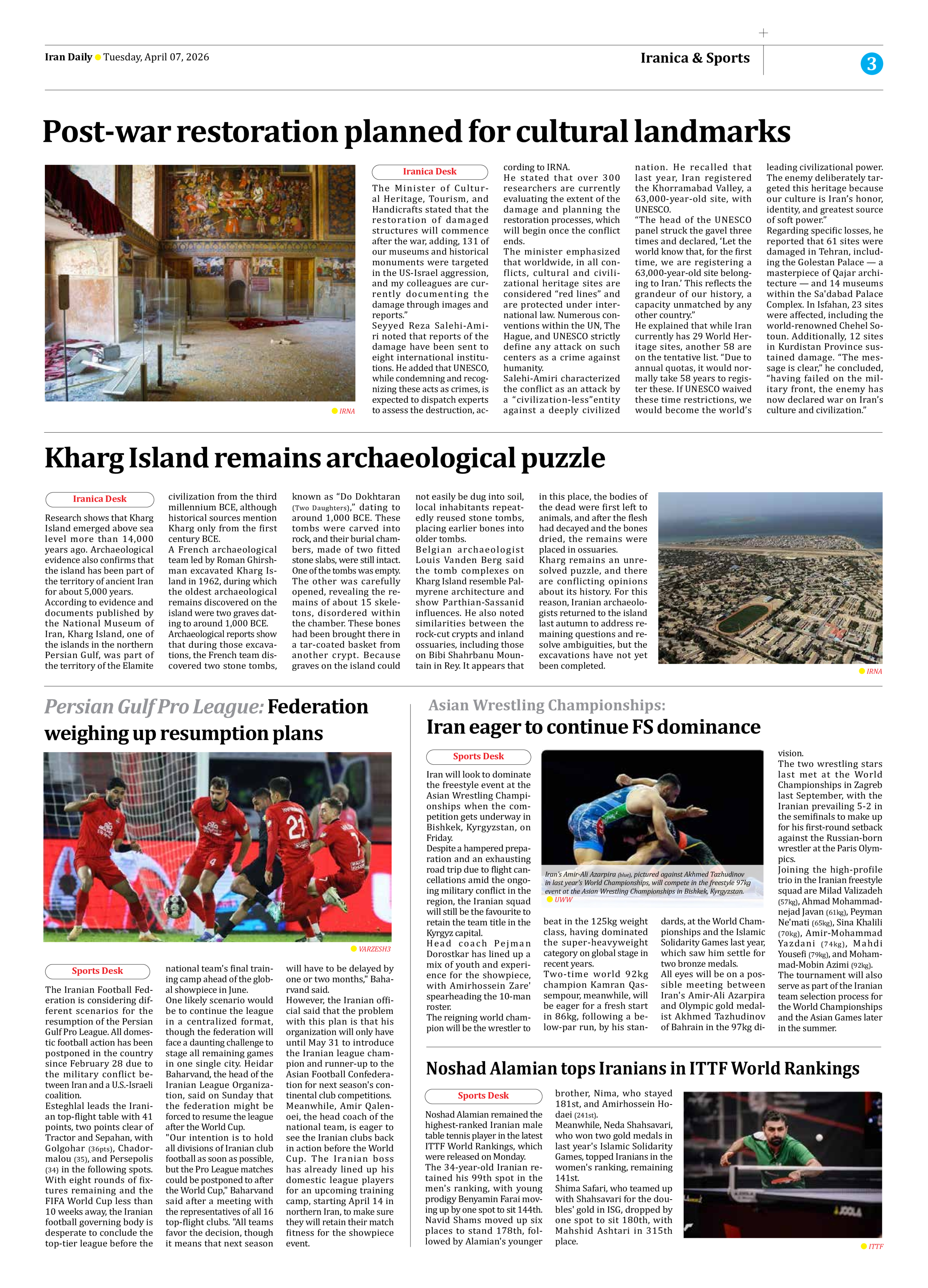
Regarding specific losses, he reported that 61 sites were damaged in Tehran, including the Golestan Palace — a masterpiece of Qajar architecture — and 14 museums within the Sa'dabad Palace Complex. In Isfahan, 23 sites were affected, including the world-renowned Chehel Sotoun. Additionally, 12 sites in Kurdistan Province sustained damage. “The message is clear,” he concluded, “having failed on the military front, the enemy has now declared war on Iran’s culture and civilization.”