







FM spox: Iran on peace acts as per mechanisms in Constitution
‘Global opposition to war bespeaks Iran’s legitimacy’
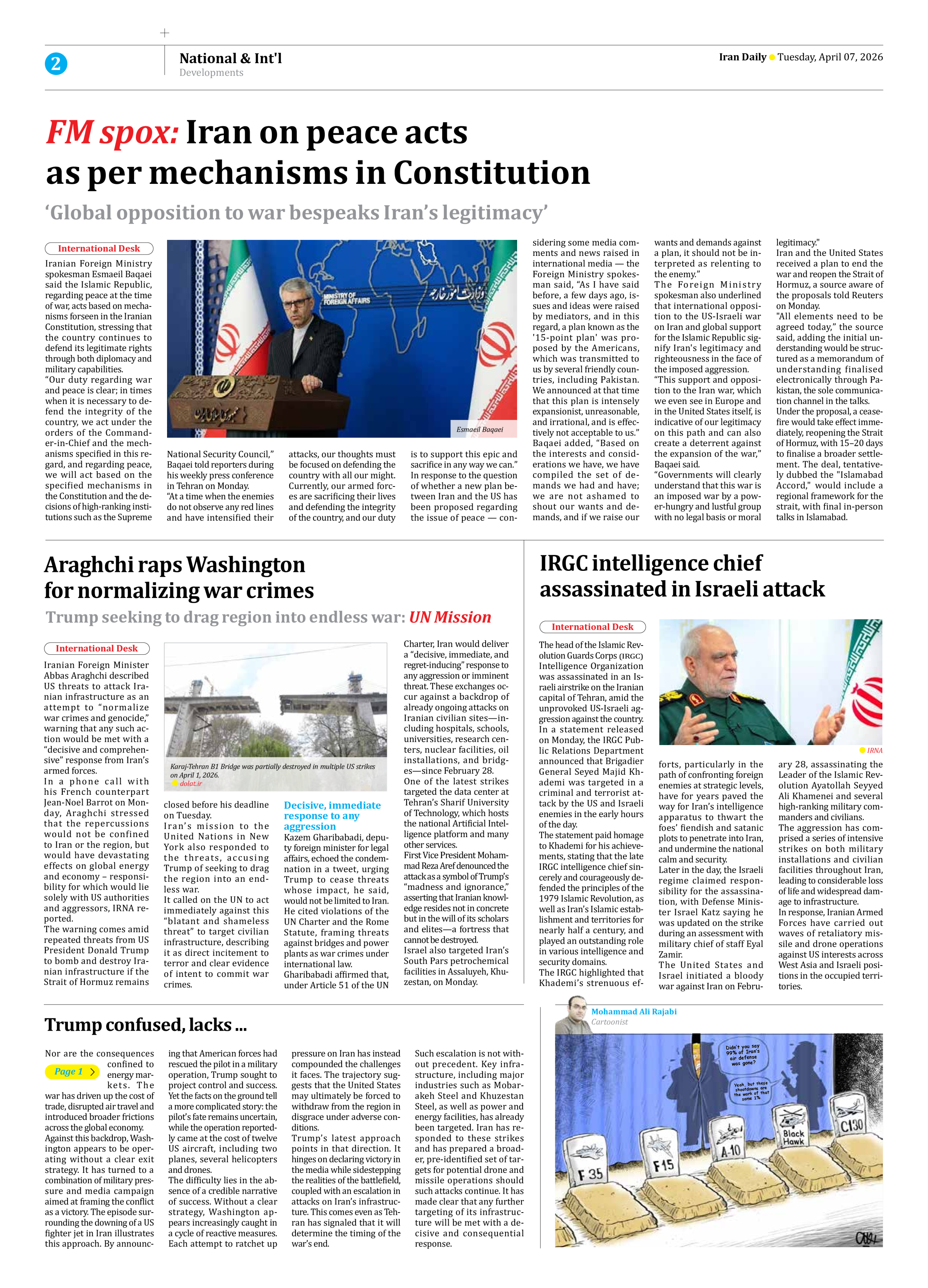
Iranian Foreign Ministry spokesman Esmaeil Baqaei said the Islamic Republic, regarding peace at the time of war, acts based on mechanisms forseen in the Iranian Constitution, stressing that the country continues to defend its legitimate rights through both diplomacy and military capabilities.
“Our duty regarding war and peace is clear; in times when it is necessary to defend the integrity of the country, we act under the orders of the Commander-in-Chief and the mechanisms specified in this regard, and regarding peace, we will act based on the specified mechanisms in the Constitution and the decisions of high-ranking institutions such as the Supreme National Security Council,” Baqaei told reporters during his weekly press conference in Tehran on Monday.
“At a time when the enemies do not observe any red lines and have intensified their attacks, our thoughts must be focused on defending the country with all our might. Currently, our armed forces are sacrificing their lives and defending the integrity of the country, and our duty is to support this epic and sacrifice in any way we can.”
In response to the question of whether a new plan between Iran and the US has been proposed regarding the issue of peace — considering some media comments and news raised in international media — the Foreign Ministry spokesman said, “As I have said before, a few days ago, issues and ideas were raised by mediators, and in this regard, a plan known as the '15-point plan' was proposed by the Americans, which was transmitted to us by several friendly countries, including Pakistan. We announced at that time that this plan is intensely expansionist, unreasonable, and irrational, and is effectively not acceptable to us.”
Baqaei added, “Based on the interests and considerations we have, we have compiled the set of demands we had and have; we are not ashamed to shout our wants and demands, and if we raise our wants and demands against a plan, it should not be interpreted as relenting to the enemy.”
The Foreign Ministry spokesman also underlined that international opposition to the US-Israeli war on Iran and global support for the Islamic Republic signify Iran's legitimacy and righteousness in the face of the imposed aggression.
“This support and opposition to the Iran war, which we even see in Europe and in the United States itself, is indicative of our legitimacy on this path and can also create a deterrent against the expansion of the war,” Baqaei said.
“Governments will clearly understand that this war is an imposed war by a power-hungry and lustful group with no legal basis or moral legitimacy."
Iran and the United States received a plan to end the war and reopen the Strait of Hormuz, a source aware of the proposals told Reuters on Monday.
"All elements need to be agreed today,” the source said, adding the initial understanding would be structured as a memorandum of understanding finalised electronically through Pakistan, the sole communication channel in the talks.
Under the proposal, a ceasefire would take effect immediately, reopening the Strait of Hormuz, with 15–20 days to finalise a broader settlement. The deal, tentatively dubbed the "Islamabad Accord," would include a regional framework for the strait, with final in-person talks in Islamabad.