







Industry group says steel output holds steady despite strikes
A spokesperson for Iran's House of Industry, Mining and Trade said the production process, including steel output, will continue despite damage to major industrial facilities in American-Zionist attacks, citing the proper distribution of production capacities across the country and the localization of industries.
Rouhollah Latifi, spokesperson for the Trade Promotion Commission, condemned the American-Zionist attacks on industrial and production infrastructure in an exclusive interview with IRNA, stating that significant capacities exist in steel, bridge construction, tunnels, petrochemicals, and other sectors.
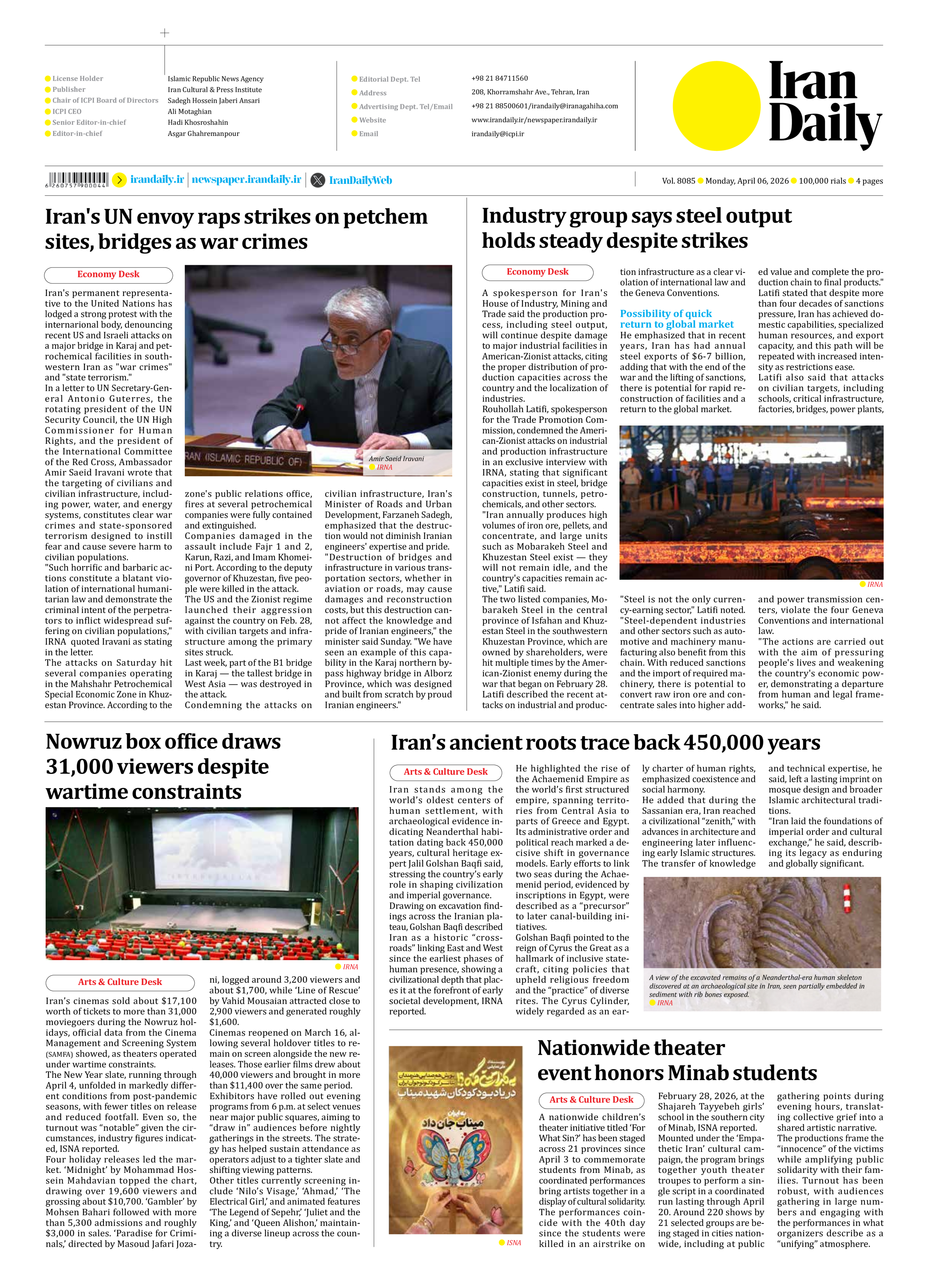
"Iran annually produces high volumes of iron ore, pellets, and concentrate, and large units such as Mobarakeh Steel and Khuzestan Steel exist — they will not remain idle, and the country's capacities remain active," Latifi said.
The two listed companies, Mobarakeh Steel in the central province of Isfahan and Khuzestan Steel in the southwestern Khuzestan Province, which are owned by shareholders, were hit multiple times by the American-Zionist enemy during the war that began on February 28.
Latifi described the recent attacks on industrial and production infrastructure as a clear violation of international law and the Geneva Conventions.
Possibility of quick return to global market
He emphasized that in recent years, Iran has had annual steel exports of $6-7 billion, adding that with the end of the war and the lifting of sanctions, there is potential for rapid reconstruction of facilities and a return to the global market.
"Steel is not the only currency-earning sector," Latifi noted. "Steel-dependent industries and other sectors such as automotive and machinery manufacturing also benefit from this chain. With reduced sanctions and the import of required machinery, there is potential to convert raw iron ore and concentrate sales into higher added value and complete the production chain to final products."
Latifi stated that despite more than four decades of sanctions pressure, Iran has achieved domestic capabilities, specialized human resources, and export capacity, and this path will be repeated with increased intensity as restrictions ease.
Latifi also said that attacks on civilian targets, including schools, critical infrastructure, factories, bridges, power plants, and power transmission centers, violate the four Geneva Conventions and international law.
"The actions are carried out with the aim of pressuring people's lives and weakening the country's economic power, demonstrating a departure from human and legal frameworks," he said.