





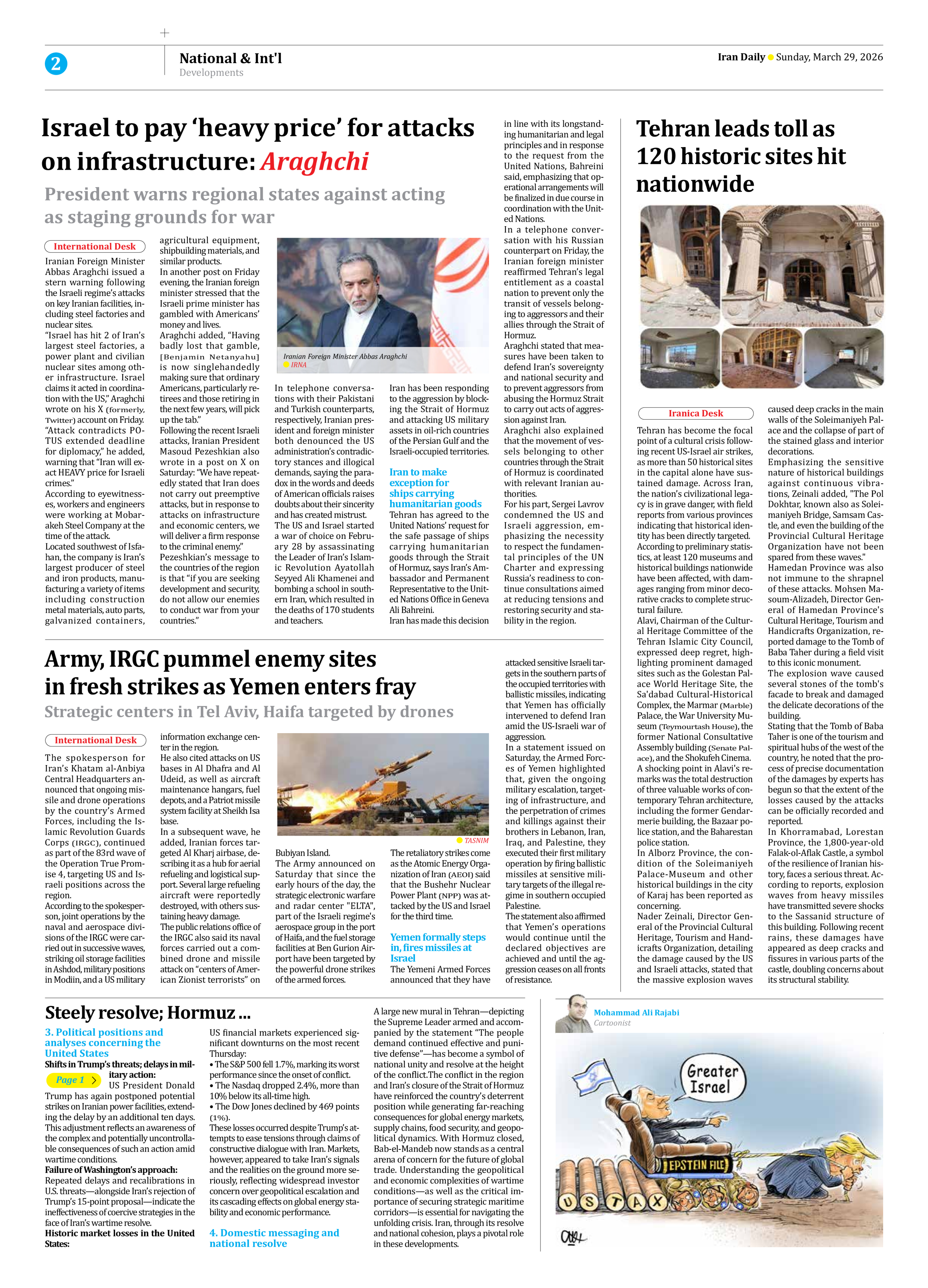


Tehran leads toll as 120 historic sites hit nationwide
Tehran has become the focal point of a cultural crisis following recent US-Israel air strikes, as more than 50 historical sites in the capital alone have sustained damage. Across Iran, the nation’s civilizational legacy is in grave danger, with field reports from various provinces indicating that historical identity has been directly targeted.
According to preliminary statistics, at least 120 museums and historical buildings nationwide have been affected, with damages ranging from minor decorative cracks to complete structural failure.
Alavi, Chairman of the Cultural Heritage Committee of the Tehran Islamic City Council, expressed deep regret, highlighting prominent damaged sites such as the Golestan Palace World Heritage Site, the Sa'dabad Cultural-Historical Complex, the Marmar (Marble) Palace, the War University Museum (Teymourtash House), the former National Consultative Assembly building (Senate Palace), and the Shokufeh Cinema.
A shocking point in Alavi's remarks was the total destruction of three valuable works of contemporary Tehran architecture, including the former Gendarmerie building, the Bazaar police station, and the Baharestan police station.
In Alborz Province, the condition of the Soleimaniyeh Palace-Museum and other historical buildings in the city of Karaj has been reported as concerning.
Nader Zeinali, Director General of the Provincial Cultural Heritage, Tourism and Handicrafts Organization, detailing the damage caused by the US and Israeli attacks, stated that the massive explosion waves caused deep cracks in the main walls of the Soleimaniyeh Palace and the collapse of part of the stained glass and interior decorations.
Emphasizing the sensitive nature of historical buildings against continuous vibrations, Zeinali added, "The Pol Dokhtar, known also as Soleimaniyeh Bridge, Samsam Castle, and even the building of the Provincial Cultural Heritage Organization have not been spared from these waves."
Hamedan Province was also not immune to the shrapnel of these attacks. Mohsen Masoum-Alizadeh, Director General of Hamedan Province's Cultural Heritage, Tourism and Handicrafts Organization, reported damage to the Tomb of Baba Taher during a field visit to this iconic monument.
The explosion wave caused several stones of the tomb's facade to break and damaged the delicate decorations of the building.
Stating that the Tomb of Baba Taher is one of the tourism and spiritual hubs of the west of the country, he noted that the process of precise documentation of the damages by experts has begun so that the extent of the losses caused by the attacks can be officially recorded and reported.
In Khorramabad, Lorestan Province, the 1,800-year-old Falak-ol-Aflak Castle, a symbol of the resilience of Iranian history, faces a serious threat. According to reports, explosion waves from heavy missiles have transmitted severe shocks to the Sassanid structure of this building. Following recent rains, these damages have appeared as deep cracks and fissures in various parts of the castle, doubling concerns about its structural stability.