





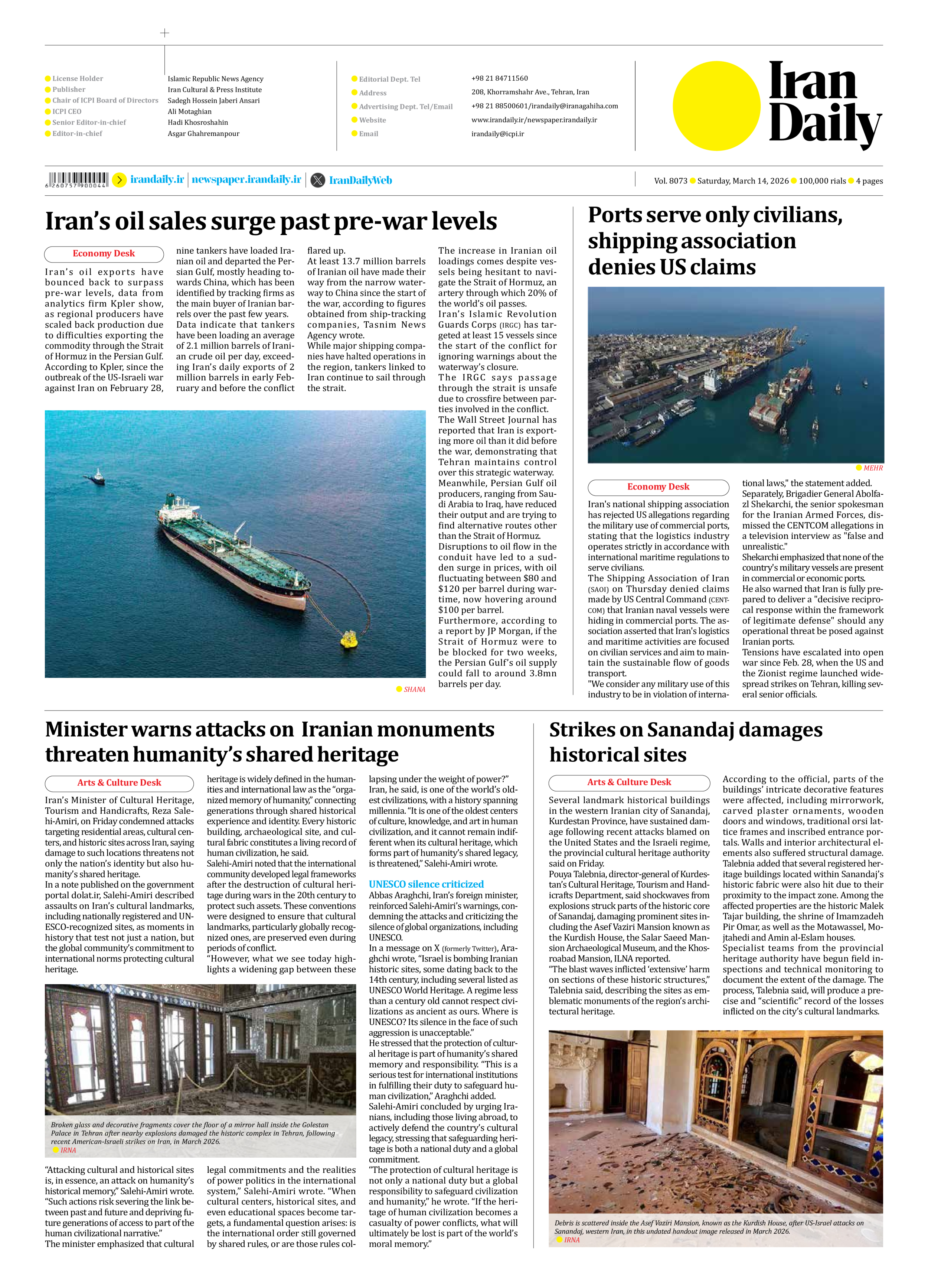


Minister warns attacks on Iranian monuments threaten humanity’s shared heritage
Iran’s Minister of Cultural Heritage, Tourism and Handicrafts, Reza Salehi-Amiri, on Friday condemned attacks targeting residential areas, cultural centers, and historic sites across Iran, saying damage to such locations threatens not only the nation’s identity but also humanity’s shared heritage.
In a note published on the government portal dolat.ir, Salehi-Amiri described assaults on Iran’s cultural landmarks, including nationally registered and UNESCO-recognized sites, as moments in history that test not just a nation, but the global community’s commitment to international norms protecting cultural heritage.
“Attacking cultural and historical sites is, in essence, an attack on humanity’s historical memory,” Salehi-Amiri wrote. “Such actions risk severing the link between past and future and depriving future generations of access to part of the human civilizational narrative.”
The minister emphasized that cultural heritage is widely defined in the humanities and international law as the “organized memory of humanity,” connecting generations through shared historical experience and identity. Every historic building, archaeological site, and cultural fabric constitutes a living record of human civilization, he said.
Salehi-Amiri noted that the international community developed legal frameworks after the destruction of cultural heritage during wars in the 20th century to protect such assets. These conventions were designed to ensure that cultural landmarks, particularly globally recognized ones, are preserved even during periods of conflict.
“However, what we see today highlights a widening gap between these legal commitments and the realities of power politics in the international system,” Salehi-Amiri wrote. “When cultural centers, historical sites, and even educational spaces become targets, a fundamental question arises: is the international order still governed by shared rules, or are those rules collapsing under the weight of power?”
Iran, he said, is one of the world’s oldest civilizations, with a history spanning millennia. “It is one of the oldest centers of culture, knowledge, and art in human civilization, and it cannot remain indifferent when its cultural heritage, which forms part of humanity’s shared legacy, is threatened,” Salehi-Amiri wrote.
UNESCO silence criticized
Abbas Araghchi, Iran’s foreign minister, reinforced Salehi-Amiri’s warnings, condemning the attacks and criticizing the silence of global organizations, including UNESCO.
In a message on X (formerly Twitter), Araghchi wrote, “Israel is bombing Iranian historic sites, some dating back to the 14th century, including several listed as UNESCO World Heritage. A regime less than a century old cannot respect civilizations as ancient as ours. Where is UNESCO? Its silence in the face of such aggression is unacceptable.”
He stressed that the protection of cultural heritage is part of humanity’s shared memory and responsibility. “This is a serious test for international institutions in fulfilling their duty to safeguard human civilization,” Araghchi added.
Salehi-Amiri concluded by urging Iranians, including those living abroad, to actively defend the country’s cultural legacy, stressing that safeguarding heritage is both a national duty and a global commitment.
“The protection of cultural heritage is not only a national duty but a global responsibility to safeguard civilization and humanity,” he wrote. “If the heritage of human civilization becomes a casualty of power conflicts, what will ultimately be lost is part of the world’s moral memory.”