







Strategic fortification for Persian civilizational assets
Jalil Golshan, a distinguished figure in Iran’s cultural heritage, former head of the Research Institute of Cultural Heritage and Tourism (RICHT), and a current member of the Strategic Council of the Ministry of Cultural Heritage, Tourism, and Handicrafts, has shared his expertise on the urgent necessity of protecting historical monuments during times of crisis.
Golshan, who managed the National Museum of Iran during the height of the eight-year Iran-Iraq War (1982–1987), spoke to ISNA regarding the emergency measures required to safeguard the nation’s civilizational legacy amid current regional tensions and the onset of conflict involving the United States and Israel against Iran.
"The historical assets in our possession are generally divided into two categories: movable and immovable properties," Golshan explained. "During wartime, there is practically very little that can be done for immovable sites, as they cannot be relocated. The only effective action in this regard is the creation and strengthening of international deterrent laws to strictly prohibit countries from damaging or destroying such structures."
Regarding movable artifacts, the archaeologist noted that conditions are significantly different. "Items held in museums must be transferred to secure centers as soon as a potential threat is perceived. During the Iraq-Iran war, secure vaults were constructed in several Iranian cities. Unfortunately, the process of building these repositories was not sustained. Now, with the current strikes against Iran, we face a situation where some regions lack any secure facilities to house their artifacts."
He emphasized that after experiencing multiple conflicts since the victory of the Islamic Revolution, it is essential for the state to establish a clear policy and build standardized, secure locations for historical objects during crises.
When asked about the role of international organizations, Golshan clarified that their contribution is primarily technical rather than financial. "Nations with specific expertise can assist us. For instance, Japan, due to its experience with earthquakes, has valuable knowledge in protecting movable heritage. They can provide expert consultation to help us create standardized repositories that meet necessary environmental and technical requirements."
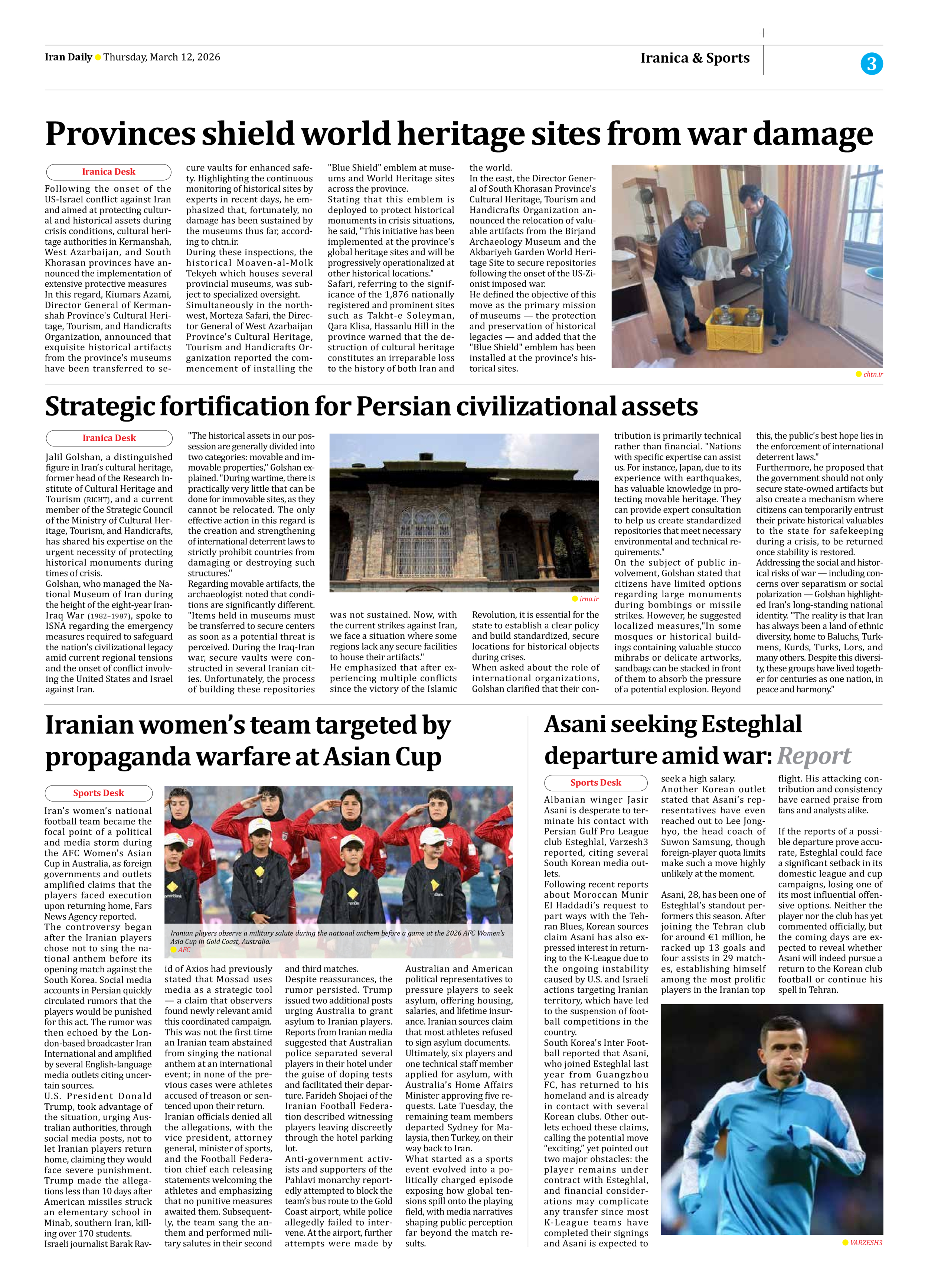
On the subject of public involvement, Golshan stated that citizens have limited options regarding large monuments during bombings or missile strikes. However, he suggested localized measures,"In some mosques or historical buildings containing valuable stucco mihrabs or delicate artworks, sandbags can be stacked in front of them to absorb the pressure of a potential explosion. Beyond this, the public’s best hope lies in the enforcement of international deterrent laws."
Furthermore, he proposed that the government should not only secure state-owned artifacts but also create a mechanism where citizens can temporarily entrust their private historical valuables to the state for safekeeping during a crisis, to be returned once stability is restored.
Addressing the social and historical risks of war — including concerns over separatism or social polarization — Golshan highlighted Iran’s long-standing national identity. "The reality is that Iran has always been a land of ethnic diversity, home to Baluchs, Turkmens, Kurds, Turks, Lors, and many others. Despite this diversity, these groups have lived together for centuries as one nation, in peace and harmony."