


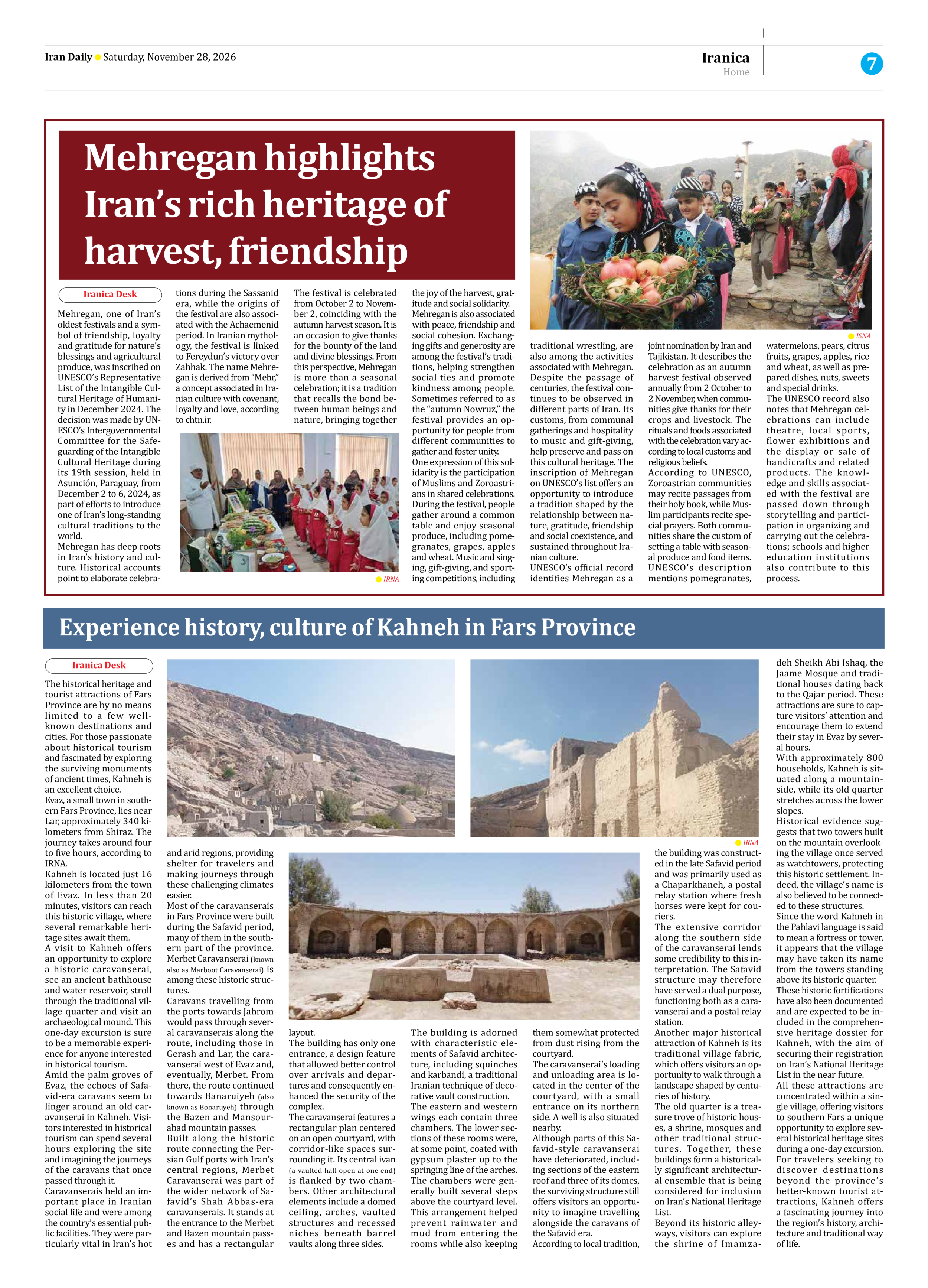


Experience history, culture of Kahneh in Fars Province
The historical heritage and tourist attractions of Fars Province are by no means limited to a few well-known destinations and cities. For those passionate about historical tourism and fascinated by exploring the surviving monuments of ancient times, Kahneh is an excellent choice.
Evaz, a small town in southern Fars Province, lies near Lar, approximately 340 kilometers from Shiraz. The journey takes around four to five hours, according to IRNA.
Kahneh is located just 16 kilometers from the town of Evaz. In less than 20 minutes, visitors can reach this historic village, where several remarkable heritage sites await them.
A visit to Kahneh offers an opportunity to explore a historic caravanserai, see an ancient bathhouse and water reservoir, stroll through the traditional village quarter and visit an archaeological mound. This one-day excursion is sure to be a memorable experience for anyone interested in historical tourism.
Amid the palm groves of Evaz, the echoes of Safavid-era caravans seem to linger around an old caravanserai in Kahneh. Visitors interested in historical tourism can spend several hours exploring the site and imagining the journeys of the caravans that once passed through it.
Caravanserais held an important place in Iranian social life and were among the country’s essential public facilities. They were particularly vital in Iran’s hot and arid regions, providing shelter for travelers and making journeys through these challenging climates easier.
Most of the caravanserais in Fars Province were built during the Safavid period, many of them in the southern part of the province. Merbet Caravanserai (known also as Marboot Caravanserai) is among these historic structures.
Caravans travelling from the ports towards Jahrom would pass through several caravanserais along the route, including those in Gerash and Lar, the caravanserai west of Evaz and, eventually, Merbet. From there, the route continued towards Banaruiyeh (also known as Bonaruyeh) through the Bazen and Mansourabad mountain passes.
Built along the historic route connecting the Persian Gulf ports with Iran’s central regions, Merbet Caravanserai was part of the wider network of Safavid’s Shah Abbas-era caravanserais. It stands at the entrance to the Merbet and Bazen mountain passes and has a rectangular layout.
The building has only one entrance, a design feature that allowed better control over arrivals and departures and consequently enhanced the security of the complex.
The caravanserai features a rectangular plan centered on an open courtyard, with corridor-like spaces surrounding it. Its central ivan (a vaulted hall open at one end) is flanked by two chambers. Other architectural elements include a domed ceiling, arches, vaulted structures and recessed niches beneath barrel vaults along three sides.
The building is adorned with characteristic elements of Safavid architecture, including squinches and karbandi, a traditional Iranian technique of decorative vault construction.
The eastern and western wings each contain three chambers. The lower sections of these rooms were, at some point, coated with gypsum plaster up to the springing line of the arches.
The chambers were generally built several steps above the courtyard level. This arrangement helped prevent rainwater and mud from entering the rooms while also keeping them somewhat protected from dust rising from the courtyard.
The caravanserai’s loading and unloading area is located in the center of the courtyard, with a small entrance on its northern side. A well is also situated nearby.
Although parts of this Safavid-style caravanserai have deteriorated, including sections of the eastern roof and three of its domes, the surviving structure still offers visitors an opportunity to imagine travelling alongside the caravans of the Safavid era.
According to local tradition, the building was constructed in the late Safavid period and was primarily used as a Chaparkhaneh, a postal relay station where fresh horses were kept for couriers.
The extensive corridor along the southern side of the caravanserai lends some credibility to this interpretation. The Safavid structure may therefore have served a dual purpose, functioning both as a caravanserai and a postal relay station.
Another major historical attraction of Kahneh is its traditional village fabric, which offers visitors an opportunity to walk through a landscape shaped by centuries of history.
The old quarter is a treasure trove of historic houses, a shrine, mosques and other traditional structures. Together, these buildings form a historically significant architectural ensemble that is being considered for inclusion on Iran’s National Heritage List.
Beyond its historic alleyways, visitors can explore the shrine of Imamzadeh Sheikh Abi Ishaq, the Jaame Mosque and traditional houses dating back to the Qajar period. These attractions are sure to capture visitors’ attention and encourage them to extend their stay in Evaz by several hours.
With approximately 800 households, Kahneh is situated along a mountainside, while its old quarter stretches across the lower slopes.
Historical evidence suggests that two towers built on the mountain overlooking the village once served as watchtowers, protecting this historic settlement. Indeed, the village’s name is also believed to be connected to these structures.
Since the word Kahneh in the Pahlavi language is said to mean a fortress or tower, it appears that the village may have taken its name from the towers standing above its historic quarter.
These historic fortifications have also been documented and are expected to be included in the comprehensive heritage dossier for Kahneh, with the aim of securing their registration on Iran’s National Heritage List in the near future.
All these attractions are concentrated within a single village, offering visitors to southern Fars a unique opportunity to explore several historical heritage sites during a one-day excursion.
For travelers seeking to discover destinations beyond the province’s better-known tourist attractions, Kahneh offers a fascinating journey into the region’s history, architecture and traditional way of life.