




Pezeshkian says Ferdowsi’s legacy can strengthen national unity
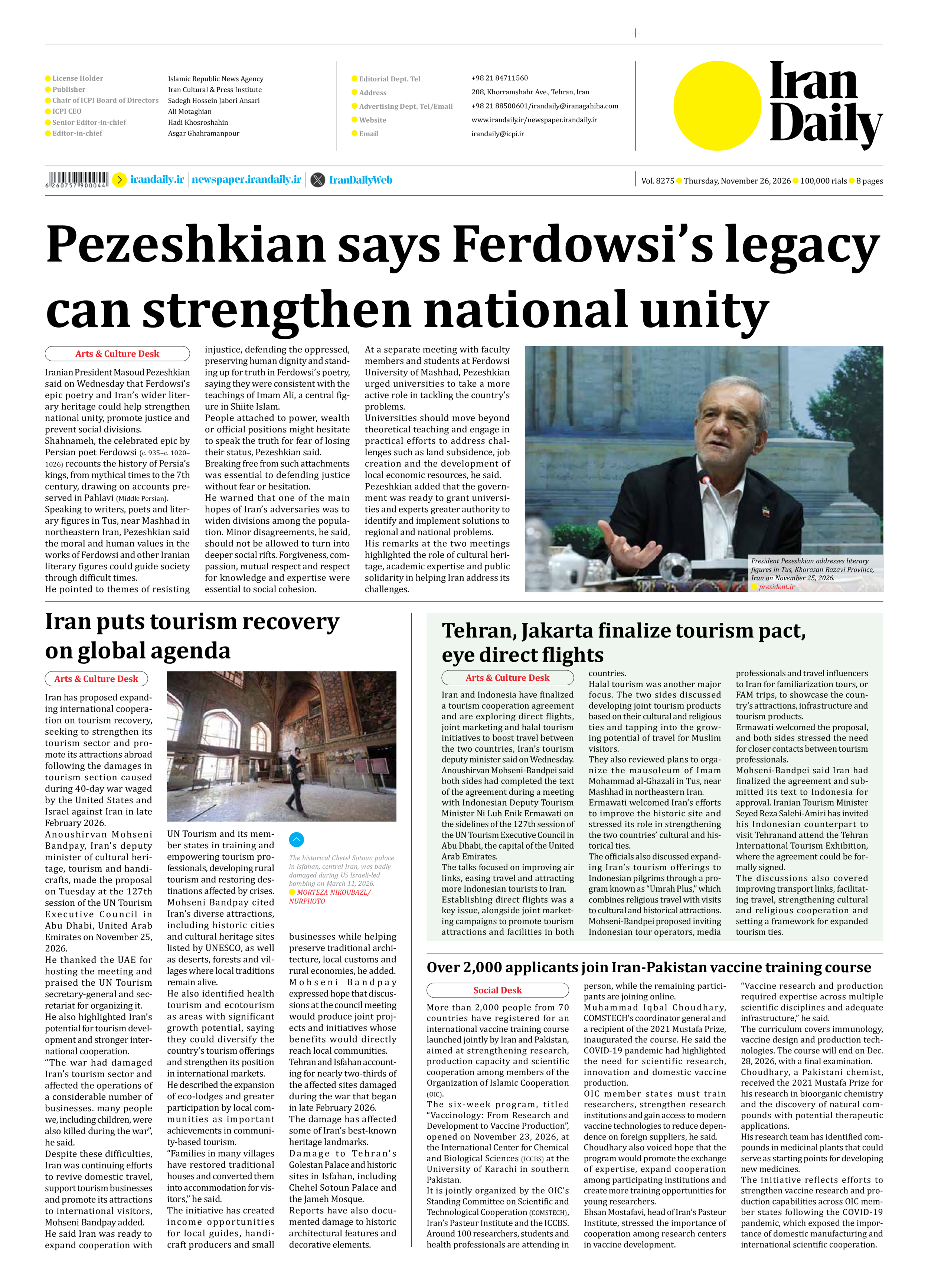
Iranian President Masoud Pezeshkian said on Wednesday that Ferdowsi’s epic poetry and Iran’s wider literary heritage could help strengthen national unity, promote justice and prevent social divisions.
Shahnameh, the celebrated epic by Persian poet Ferdowsi (c. 935–c. 1020–1026) recounts the history of Persia’s kings, from mythical times to the 7th century, drawing on accounts preserved in Pahlavi (Middle Persian).
Speaking to writers, poets and literary figures in Tus, near Mashhad in northeastern Iran, Pezeshkian said the moral and human values in the works of Ferdowsi and other Iranian literary figures could guide society through difficult times.
He pointed to themes of resisting injustice, defending the oppressed, preserving human dignity and standing up for truth in Ferdowsi’s poetry, saying they were consistent with the teachings of Imam Ali, a central figure in Shiite Islam.
People attached to power, wealth or official positions might hesitate to speak the truth for fear of losing their status, Pezeshkian said.
Breaking free from such attachments was essential to defending justice without fear or hesitation.
He warned that one of the main hopes of Iran’s adversaries was to widen divisions among the population. Minor disagreements, he said, should not be allowed to turn into deeper social rifts. Forgiveness, compassion, mutual respect and respect for knowledge and expertise were essential to social cohesion.
At a separate meeting with faculty members and students at Ferdowsi University of Mashhad, Pezeshkian urged universities to take a more active role in tackling the country’s problems.
Universities should move beyond theoretical teaching and engage in practical efforts to address challenges such as land subsidence, job creation and the development of local economic resources, he said.
Pezeshkian added that the government was ready to grant universities and experts greater authority to identify and implement solutions to regional and national problems.
His remarks at the two meetings highlighted the role of cultural heritage, academic expertise and public solidarity in helping Iran address its challenges.