




Stone and community earn Iranian guesthouse global award
A community-built guesthouse in southeastern Iran has won the Best Use of Stone award at the 2026 World Architecture Festival.
The Nedarag Guesthouse, in Kahnanikash village in Dashtiari County, Sistan and Baluchestan province, received the award for highlighting how traditional Baluch building techniques and local participation can shape contemporary tourism projects.
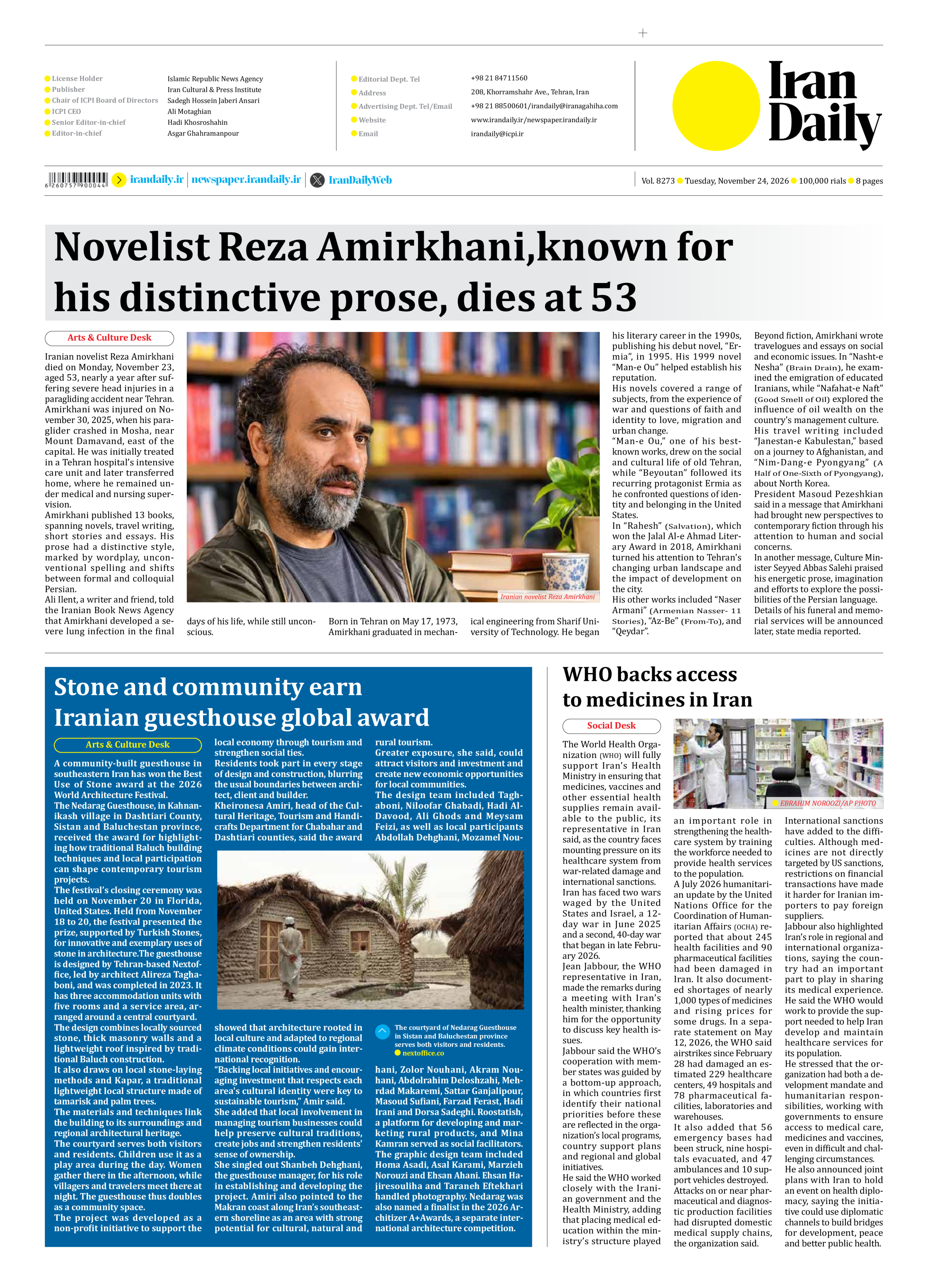
The festival’s closing ceremony was held on November 20 in Florida, United States. Held from November 18 to 20, the festival presented the prize, supported by Turkish Stones, for innovative and exemplary uses of stone in architecture.The guesthouse is designed by Tehran-based Nextoffice, led by architect Alireza Taghaboni, and was completed in 2023. It has three accommodation units with five rooms and a service area, arranged around a central courtyard.
The design combines locally sourced stone, thick masonry walls and a lightweight roof inspired by traditional Baluch construction.
It also draws on local stone-laying methods and Kapar, a traditional lightweight local structure made of tamarisk and palm trees.
The materials and techniques link the building to its surroundings and regional architectural heritage.
The courtyard serves both visitors and residents. Children use it as a play area during the day. Women gather there in the afternoon, while villagers and travelers meet there at night. The guesthouse thus doubles as a community space.
The project was developed as a non-profit initiative to support the local economy through tourism and strengthen social ties.
Residents took part in every stage of design and construction, blurring the usual boundaries between architect, client and builder.
Kheironesa Amiri, head of the Cultural Heritage, Tourism and Handicrafts Department for Chabahar and Dashtiari counties, said the award showed that architecture rooted in local culture and adapted to regional climate conditions could gain international recognition.
“Backing local initiatives and encouraging investment that respects each area's cultural identity were key to sustainable tourism,” Amir said.
She added that local involvement in managing tourism businesses could help preserve cultural traditions, create jobs and strengthen residents' sense of ownership.
She singled out Shanbeh Dehghani, the guesthouse manager, for his role in establishing and developing the project. Amiri also pointed to the Makran coast along Iran’s southeastern shoreline as an area with strong potential for cultural, natural and rural tourism.
Greater exposure, she said, could attract visitors and investment and create new economic opportunities for local communities.
The design team included Taghaboni, Niloofar Ghabadi, Hadi Al-Davood, Ali Ghods and Meysam Feizi, as well as local participants Abdollah Dehghani, Mozamel Nouhani, Zolor Nouhani, Akram Nouhani, Abdolrahim Deloshzahi, Mehrdad Makaremi, Sattar Ganjalipour, Masoud Sufiani, Farzad Ferast, Hadi Irani and Dorsa Sadeghi. Roostatish, a platform for developing and marketing rural products, and Mina Kamran served as social facilitators.
The graphic design team included Homa Asadi, Asal Karami, Marzieh Norouzi and Ehsan Ahani. Ehsan Hajiresouliha and Taraneh Eftekhari handled photography. Nedarag was also named a finalist in the 2026 Architizer A+Awards, a separate international architecture competition.