


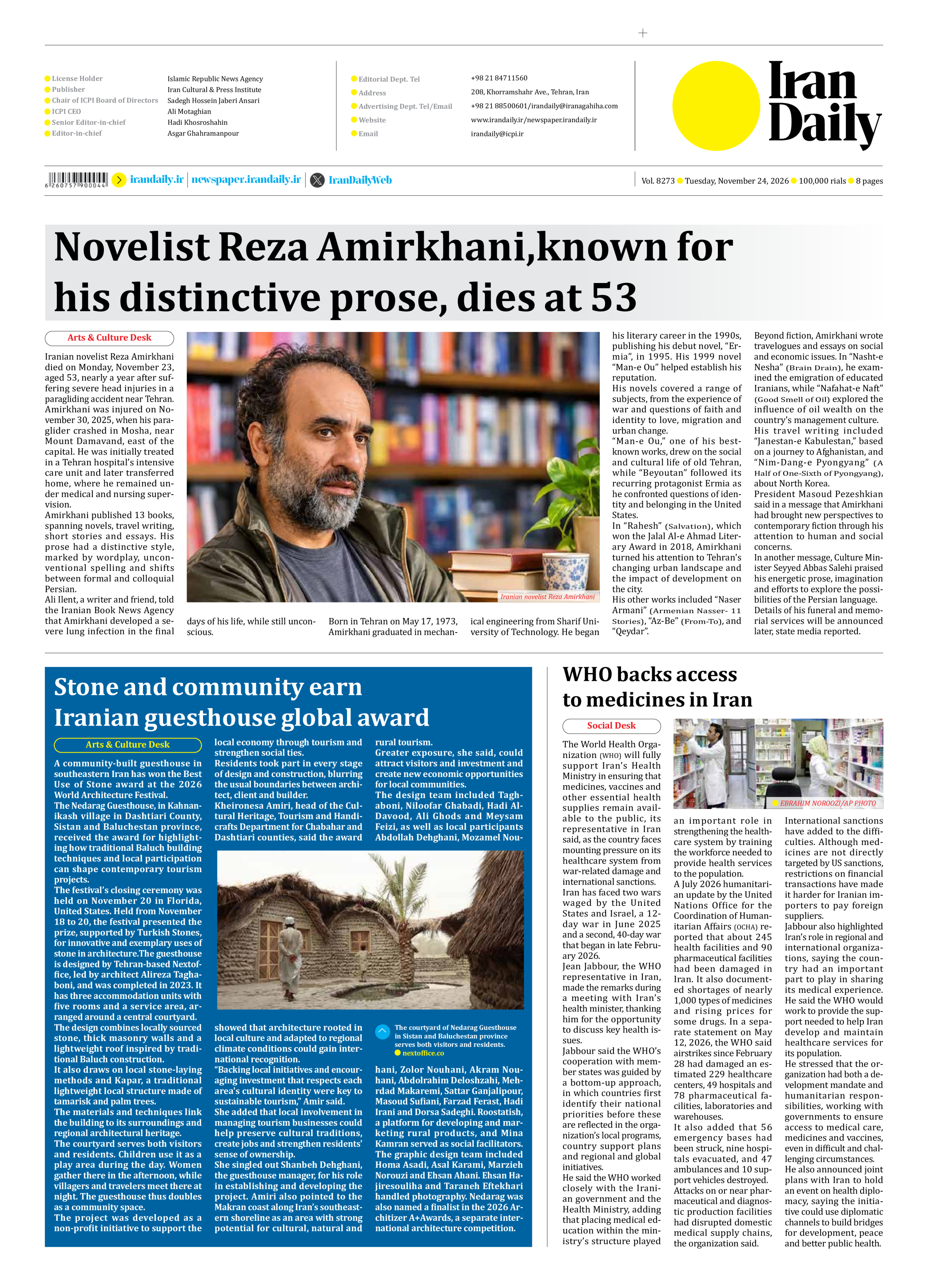


Novelist Reza Amirkhani,known for his distinctive prose, dies at 53
Iranian novelist Reza Amirkhani died on Monday, November 23, aged 53, nearly a year after suffering severe head injuries in a paragliding accident near Tehran.
Amirkhani was injured on November 30, 2025, when his paraglider crashed in Mosha, near Mount Damavand, east of the capital. He was initially treated in a Tehran hospital’s intensive care unit and later transferred home, where he remained under medical and nursing supervision.
Amirkhani published 13 books, spanning novels, travel writing, short stories and essays. His prose had a distinctive style, marked by wordplay, unconventional spelling and shifts between formal and colloquial Persian.
Ali Ilent, a writer and friend, told the Iranian Book News Agency that Amirkhani developed a severe lung infection in the final days of his life, while still unconscious.
Born in Tehran on May 17, 1973, Amirkhani graduated in mechanical engineering from Sharif University of Technology. He began his literary career in the 1990s, publishing his debut novel, “Ermia”, in 1995. His 1999 novel “Man-e Ou” helped establish his reputation.
His novels covered a range of subjects, from the experience of war and questions of faith and identity to love, migration and urban change.
“Man-e Ou,” one of his best-known works, drew on the social and cultural life of old Tehran, while “Beyoutan” followed its recurring protagonist Ermia as he confronted questions of identity and belonging in the United States.
In “Rahesh” (Salvation), which won the Jalal Al-e Ahmad Literary Award in 2018, Amirkhani turned his attention to Tehran's changing urban landscape and the impact of development on the city.
His other works included “Naser Armani” (Armenian Nasser- 11 Stories), “Az-Be” (From-To), and “Qeydar”.
Beyond fiction, Amirkhani wrote travelogues and essays on social and economic issues. In “Nasht-e Nesha” (Brain Drain), he examined the emigration of educated Iranians, while “Nafahat-e Naft” (Good Smell of Oil) explored the influence of oil wealth on the country's management culture.
His travel writing included “Janestan-e Kabulestan,” based on a journey to Afghanistan, and “Nim-Dang-e Pyongyang” (A Half of One-Sixth of Pyongyang), about North Korea.
President Masoud Pezeshkian said in a message that Amirkhani had brought new perspectives to contemporary fiction through his attention to human and social concerns.
In another message, Culture Minister Seyyed Abbas Salehi praised his energetic prose, imagination and efforts to explore the possibilities of the Persian language.
Details of his funeral and memorial services will be announced later, state media reported.