




Copy in clipboard...
Reading Room
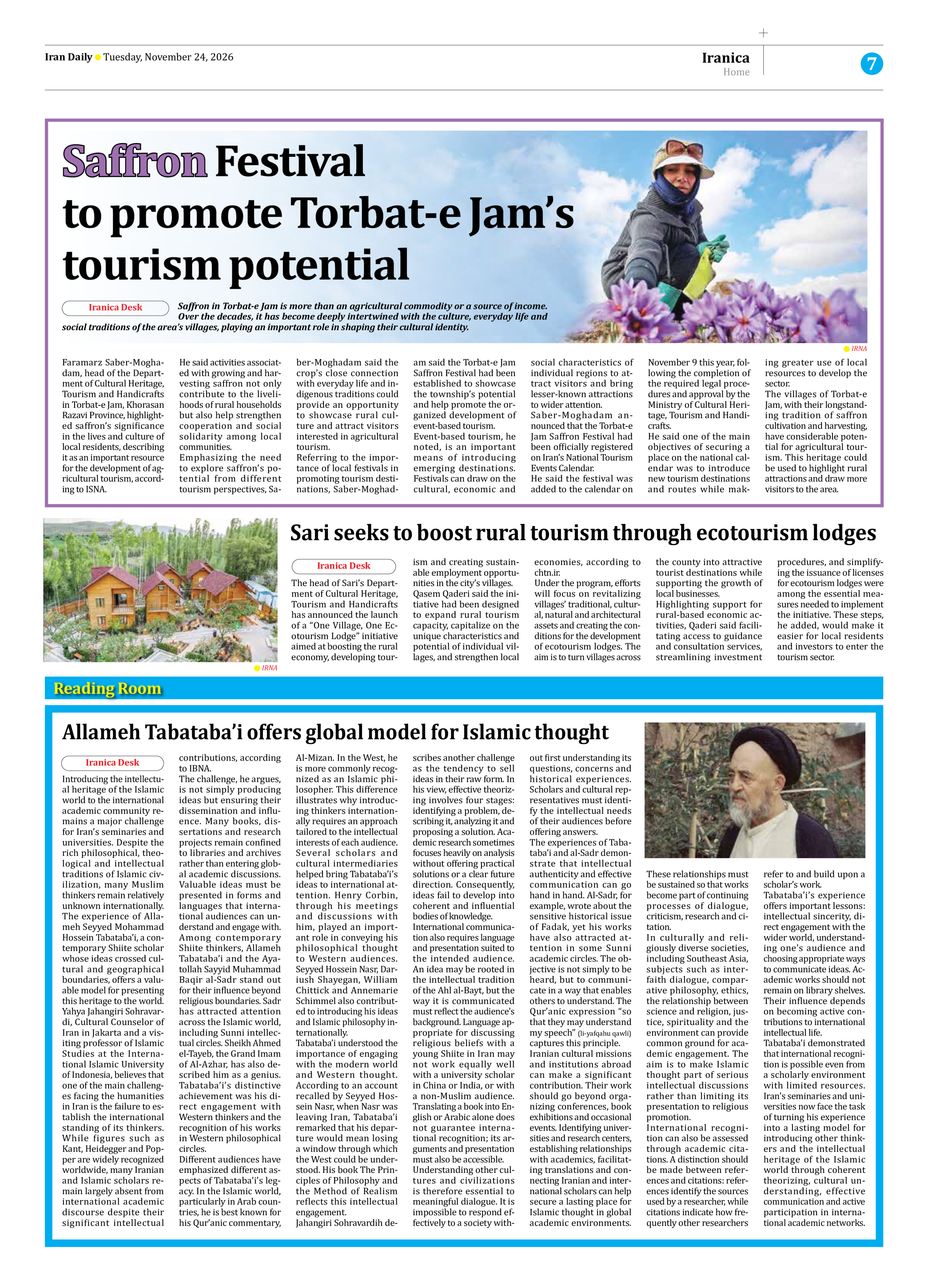
Allameh Tabataba’i offers global model for Islamic thought
Yahya Jahangiri Sohravardi, Cultural Counselor of Iran in Jakarta and a visiting professor of Islamic Studies at the International Islamic University of Indonesia, believes that one of the main challenges facing the humanities in Iran is the failure to establish the international standing of its thinkers. While figures such as Kant, Heidegger and Popper are widely recognized worldwide, many Iranian and Islamic scholars remain largely absent from international academic discourse despite their significant intellectual contributions, according to IBNA.
The challenge, he argues, is not simply producing ideas but ensuring their dissemination and influence. Many books, dissertations and research projects remain confined to libraries and archives rather than entering global academic discussions. Valuable ideas must be presented in forms and languages that international audiences can understand and engage with.
Among contemporary Shiite thinkers, Allameh Tabataba’i and the Ayatollah Sayyid Muhammad Baqir al-Sadr stand out for their influence beyond religious boundaries. Sadr has attracted attention across the Islamic world, including Sunni intellectual circles. Sheikh Ahmed el-Tayeb, the Grand Imam of Al-Azhar, has also described him as a genius. Tabataba’i’s distinctive achievement was his direct engagement with Western thinkers and the recognition of his works in Western philosophical circles.
Different audiences have emphasized different aspects of Tabataba’i’s legacy. In the Islamic world, particularly in Arab countries, he is best known for his Qur’anic commentary, Al-Mizan. In the West, he is more commonly recognized as an Islamic philosopher. This difference illustrates why introducing thinkers internationally requires an approach tailored to the intellectual interests of each audience.
Several scholars and cultural intermediaries helped bring Tabataba’i’s ideas to international attention. Henry Corbin, through his meetings and discussions with him, played an important role in conveying his philosophical thought to Western audiences. Seyyed Hossein Nasr, Dariush Shayegan, William Chittick and Annemarie Schimmel also contributed to introducing his ideas and Islamic philosophy internationally.
Tabataba’i understood the importance of engaging with the modern world and Western thought. According to an account recalled by Seyyed Hossein Nasr, when Nasr was leaving Iran, Tabataba’i remarked that his departure would mean losing a window through which the West could be understood. His book The Principles of Philosophy and the Method of Realism reflects this intellectual engagement.
Jahangiri Sohravardih describes another challenge as the tendency to sell ideas in their raw form. In his view, effective theorizing involves four stages: identifying a problem, describing it, analyzing it and proposing a solution. Academic research sometimes focuses heavily on analysis without offering practical solutions or a clear future direction. Consequently, ideas fail to develop into coherent and influential bodies of knowledge.
International communication also requires language and presentation suited to the intended audience. An idea may be rooted in the intellectual tradition of the Ahl al-Bayt, but the way it is communicated must reflect the audience’s background. Language appropriate for discussing religious beliefs with a young Shiite in Iran may not work equally well with a university scholar in China or India, or with a non-Muslim audience. Translating a book into English or Arabic alone does not guarantee international recognition; its arguments and presentation must also be accessible.
Understanding other cultures and civilizations is therefore essential to meaningful dialogue. It is impossible to respond effectively to a society without first understanding its questions, concerns and historical experiences. Scholars and cultural representatives must identify the intellectual needs of their audiences before offering answers.
The experiences of Tabataba’i and al-Sadr demonstrate that intellectual authenticity and effective communication can go hand in hand. Al-Sadr, for example, wrote about the sensitive historical issue of Fadak, yet his works have also attracted attention in some Sunni academic circles. The objective is not simply to be heard, but to communicate in a way that enables others to understand. The Qur’anic expression “so that they may understand my speech” (li-yafqahu qawli) captures this principle.
Iranian cultural missions and institutions abroad can make a significant contribution. Their work should go beyond organizing conferences, book exhibitions and occasional events. Identifying universities and research centers, establishing relationships with academics, facilitating translations and connecting Iranian and international scholars can help secure a lasting place for Islamic thought in global academic environments. These relationships must be sustained so that works become part of continuing processes of dialogue, criticism, research and citation.
In culturally and religiously diverse societies, including Southeast Asia, subjects such as interfaith dialogue, comparative philosophy, ethics, the relationship between science and religion, justice, spirituality and the environment can provide common ground for academic engagement. The aim is to make Islamic thought part of serious intellectual discussions rather than limiting its presentation to religious promotion.
International recognition can also be assessed through academic citations. A distinction should be made between references and citations: references identify the sources used by a researcher, while citations indicate how frequently other researchers refer to and build upon a scholar’s work.
Tabataba’i’s experience offers important lessons: intellectual sincerity, direct engagement with the wider world, understanding one’s audience and choosing appropriate ways to communicate ideas. Academic works should not remain on library shelves. Their influence depends on becoming active contributions to international intellectual life.
Tabataba’i demonstrated that international recognition is possible even from a scholarly environment with limited resources. Iran’s seminaries and universities now face the task of turning his experience into a lasting model for introducing other thinkers and the intellectual heritage of the Islamic world through coherent theorizing, cultural understanding, effective communication and active participation in international academic networks.