




Iran proposes SCO network to preserve historical manuscripts
Iran has proposed a regional network to preserve and digitize historical manuscripts across the Shanghai Cooperation Organization (SCO), putting forward three initiatives to expand cultural cooperation among member states at a forum in the Indian capital.
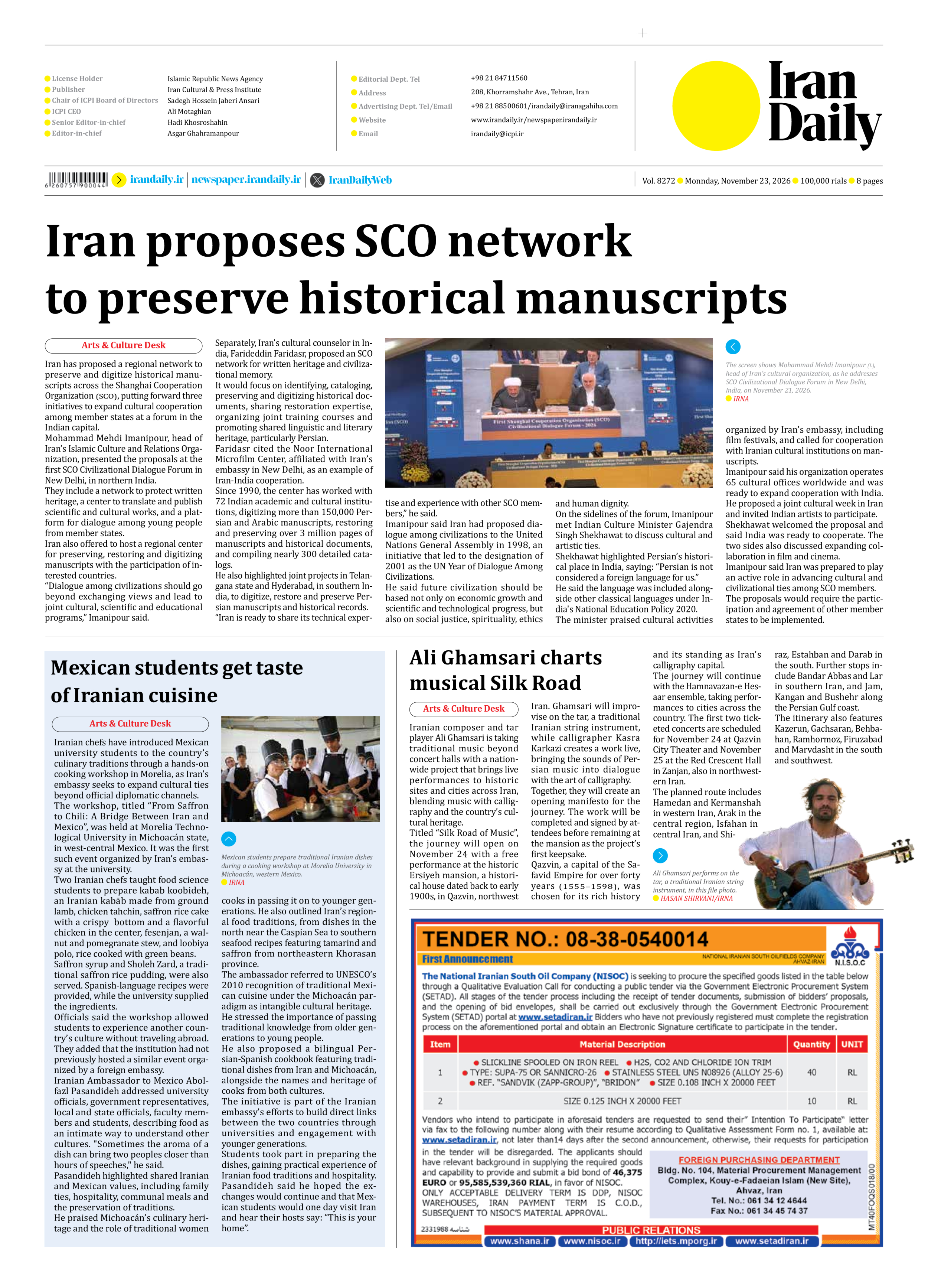
Mohammad Mehdi Imanipour, head of Iran’s Islamic Culture and Relations Organization, presented the proposals at the first SCO Civilizational Dialogue Forum in New Delhi, in northern India.
They include a network to protect written heritage, a center to translate and publish scientific and cultural works, and a platform for dialogue among young people from member states.
Iran also offered to host a regional center for preserving, restoring and digitizing manuscripts with the participation of interested countries.
“Dialogue among civilizations should go beyond exchanging views and lead to joint cultural, scientific and educational programs,” Imanipour said.
Separately, Iran’s cultural counselor in India, Farideddin Faridasr, proposed an SCO network for written heritage and civilizational memory.
It would focus on identifying, cataloging, preserving and digitizing historical documents, sharing restoration expertise, organizing joint training courses and promoting shared linguistic and literary heritage, particularly Persian.
Faridasr cited the Noor International Microfilm Center, affiliated with Iran’s embassy in New Delhi, as an example of Iran-India cooperation.
Since 1990, the center has worked with 72 Indian academic and cultural institutions, digitizing more than 150,000 Persian and Arabic manuscripts, restoring and preserving over 3 million pages of manuscripts and historical documents, and compiling nearly 300 detailed catalogs.
He also highlighted joint projects in Telangana state and Hyderabad, in southern India, to digitize, restore and preserve Persian manuscripts and historical records.
“Iran is ready to share its technical expertise and experience with other SCO members,” he said.
Imanipour said Iran had proposed dialogue among civilizations to the United Nations General Assembly in 1998, an initiative that led to the designation of 2001 as the UN Year of Dialogue Among Civilizations.
He said future civilization should be based not only on economic growth and scientific and technological progress, but also on social justice, spirituality, ethics and human dignity.
On the sidelines of the forum, Imanipour met Indian Culture Minister Gajendra Singh Shekhawat to discuss cultural and artistic ties.
Shekhawat highlighted Persian’s historical place in India, saying: “Persian is not considered a foreign language for us.”
He said the language was included alongside other classical languages under India's National Education Policy 2020.
The minister praised cultural activities organized by Iran’s embassy, including film festivals, and called for cooperation with Iranian cultural institutions on manuscripts.
Imanipour said his organization operates 65 cultural offices worldwide and was ready to expand cooperation with India. He proposed a joint cultural week in Iran and invited Indian artists to participate.
Shekhawat welcomed the proposal and said India was ready to cooperate. The two sides also discussed expanding collaboration in film and cinema.
Imanipour said Iran was prepared to play an active role in advancing cultural and civilizational ties among SCO members.
The proposals would require the participation and agreement of other member states to be implemented.