




Jajarmi Husseinieh preserves Bojnurd’s Qajar-era heritage
North Khorasan Province is best known for its pristine nature, Hyrcanian forests, summer resorts and the diverse cultures of its ethnic communities. Alongside its natural attractions, however, the province is home to valuable historic buildings, each of which tells part of the story of the region’s past.
Among the old lanes of Bojnurd are buildings that preserve different aspects of the city’s historical identity. The Jajarmi Husseinieh holds a special place among these sites. It is recognized not only as a valuable national heritage monument but also as a destination for visitors interested in cultural tourism.
The building is located on East Taleqani Street in the city’s historic district, where traces of traditional Bojnurd architecture can still be seen among old houses and narrow lanes. Its location means that a visit to the Husseinieh is more than an opportunity to see a historic building; it also provides a chance to explore part of the historic fabric of North Khorasan’s provincial capital.
Historical studies indicate that the building was constructed in the late Qajar period. An inscription above the entrance to one section of the building bears the date 1325 AH. Construction is attributed to master builder Gholamreza Bana-ye Yazdi, while its first owner was Haj Ali-Akbar Jajarmi, a well-known merchant of Bojnurd. The house was later endowed for holding mourning ceremonies for Imam Hussein (PBUH), after which it became known as the Jajarmi Husseinieh.
The endowment not only changed the building’s function but also turned it into one of the city’s important religious and social centers. For years, residents of Bojnurd gathered at the Husseinieh during Muharram and Safar to hold traditional mourning ceremonies. These rituals became part of the city’s collective memory.
For this reason, cultural heritage experts regard the Jajarmi Husseinieh as more than simply a historic house. They describe it as an example of the connection between architecture, culture and religious traditions in northeastern Iran. This has given the building significance beyond its age, with its social and cultural role also attracting the attention of researchers.
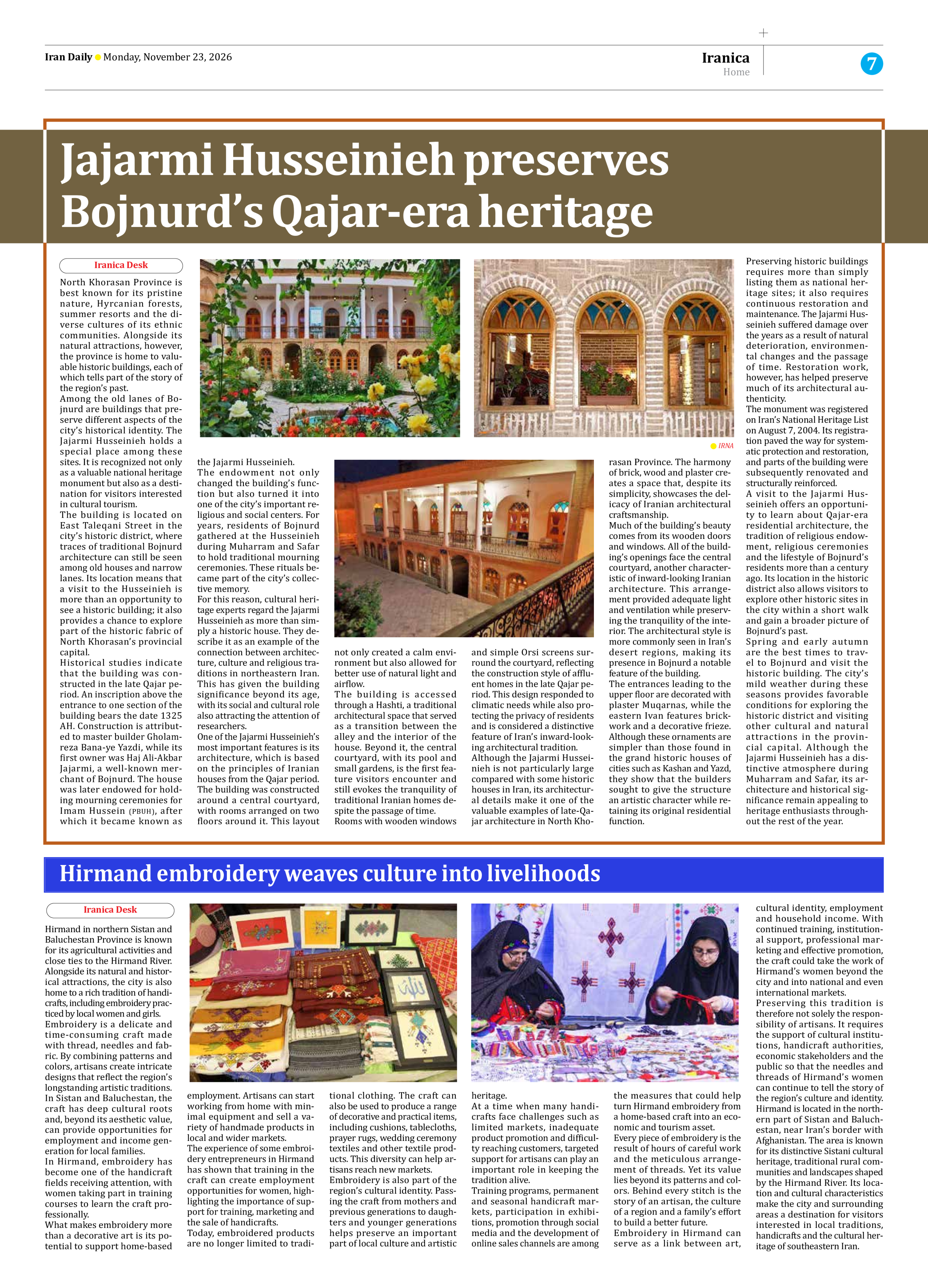
One of the Jajarmi Husseinieh’s most important features is its architecture, which is based on the principles of Iranian houses from the Qajar period. The building was constructed around a central courtyard, with rooms arranged on two floors around it. This layout not only created a calm environment but also allowed for better use of natural light and airflow.
The building is accessed through a Hashti, a traditional architectural space that served as a transition between the alley and the interior of the house. Beyond it, the central courtyard, with its pool and small gardens, is the first feature visitors encounter and still evokes the tranquility of traditional Iranian homes despite the passage of time.
Rooms with wooden windows and simple Orsi screens surround the courtyard, reflecting the construction style of affluent homes in the late Qajar period. This design responded to climatic needs while also protecting the privacy of residents and is considered a distinctive feature of Iran’s inward-looking architectural tradition.
Although the Jajarmi Husseinieh is not particularly large compared with some historic houses in Iran, its architectural details make it one of the valuable examples of late-Qajar architecture in North Khorasan Province. The harmony of brick, wood and plaster creates a space that, despite its simplicity, showcases the delicacy of Iranian architectural craftsmanship.
Much of the building’s beauty comes from its wooden doors and windows. All of the building’s openings face the central courtyard, another characteristic of inward-looking Iranian architecture. This arrangement provided adequate light and ventilation while preserving the tranquility of the interior. The architectural style is more commonly seen in Iran’s desert regions, making its presence in Bojnurd a notable feature of the building.
The entrances leading to the upper floor are decorated with plaster Muqarnas, while the eastern Ivan features brickwork and a decorative frieze. Although these ornaments are simpler than those found in the grand historic houses of cities such as Kashan and Yazd, they show that the builders sought to give the structure an artistic character while retaining its original residential function.
Preserving historic buildings requires more than simply listing them as national heritage sites; it also requires continuous restoration and maintenance. The Jajarmi Husseinieh suffered damage over the years as a result of natural deterioration, environmental changes and the passage of time. Restoration work, however, has helped preserve much of its architectural authenticity.
The monument was registered on Iran’s National Heritage List on August 7, 2004. Its registration paved the way for systematic protection and restoration, and parts of the building were subsequently renovated and structurally reinforced.
A visit to the Jajarmi Husseinieh offers an opportunity to learn about Qajar-era residential architecture, the tradition of religious endowment, religious ceremonies and the lifestyle of Bojnurd’s residents more than a century ago. Its location in the historic district also allows visitors to explore other historic sites in the city within a short walk and gain a broader picture of Bojnurd’s past.
Spring and early autumn are the best times to travel to Bojnurd and visit the historic building. The city’s mild weather during these seasons provides favorable conditions for exploring the historic district and visiting other cultural and natural attractions in the provincial capital. Although the Jajarmi Husseinieh has a distinctive atmosphere during Muharram and Safar, its architecture and historical significance remain appealing to heritage enthusiasts throughout the rest of the year.