




Italian composer finds bridge between cultures in Iran’s music
By Neda Sijani
Staff Writer
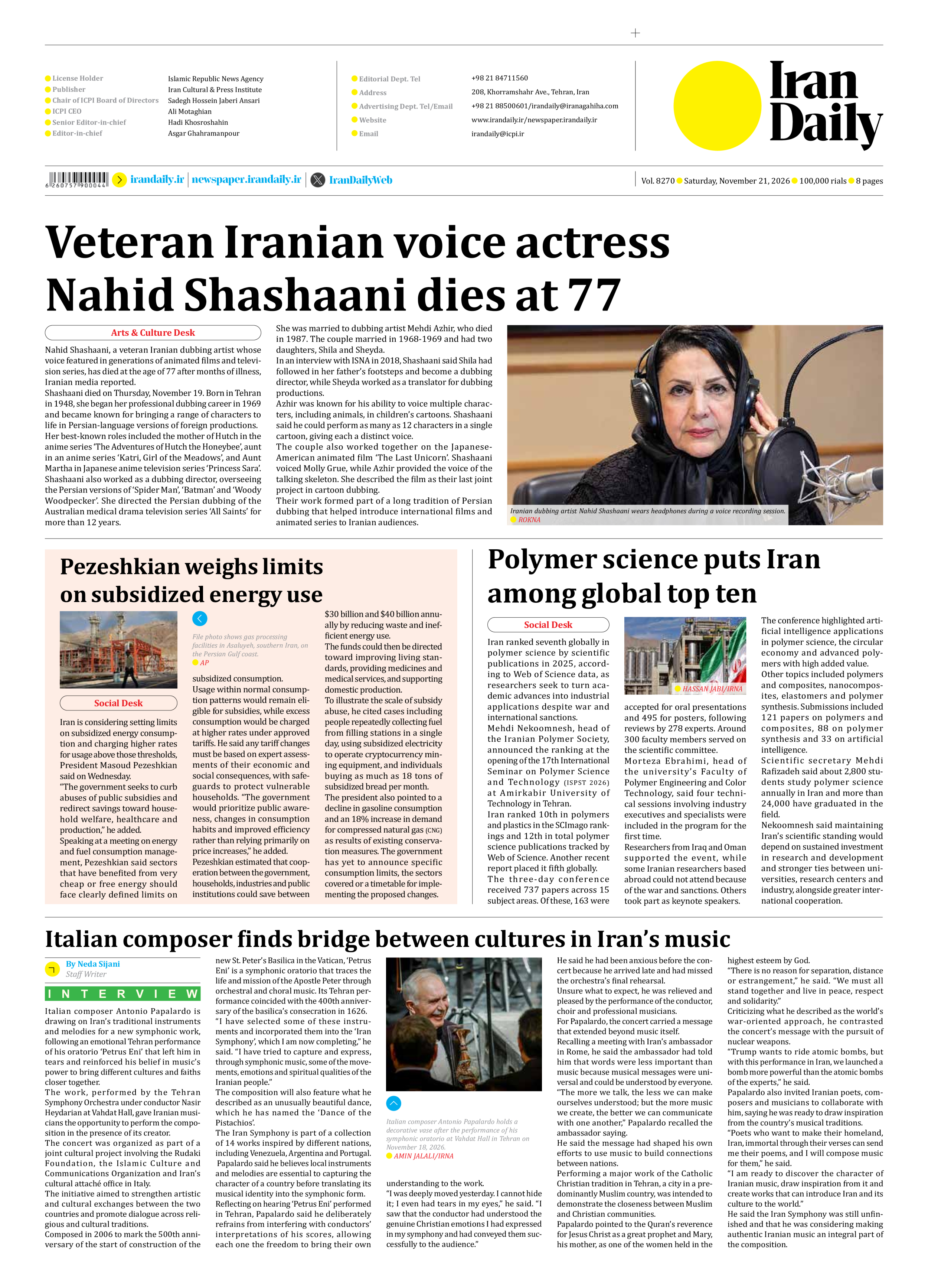
Italian composer Antonio Papalardo is drawing on Iran’s traditional instruments and melodies for a new symphonic work, following an emotional Tehran performance of his oratorio ‘Petrus Eni’ that left him in tears and reinforced his belief in music’s power to bring different cultures and faiths closer together.
The work, performed by the Tehran Symphony Orchestra under conductor Nasir Heydarian at Vahdat Hall, gave Iranian musicians the opportunity to perform the composition in the presence of its creator.
The concert was organized as part of a joint cultural project involving the Rudaki Foundation, the Islamic Culture and Communications Organization and Iran’s cultural attaché office in Italy.
The initiative aimed to strengthen artistic and cultural exchanges between the two countries and promote dialogue across religious and cultural traditions.
Composed in 2006 to mark the 500th anniversary of the start of construction of the new St. Peter’s Basilica in the Vatican, ‘Petrus Eni’ is a symphonic oratorio that traces the life and mission of the Apostle Peter through orchestral and choral music. Its Tehran performance coincided with the 400th anniversary of the basilica’s consecration in 1626.
“I have selected some of these instruments and incorporated them into the ‘Iran Symphony’, which I am now completing,” he said. “I have tried to capture and express, through symphonic music, some of the movements, emotions and spiritual qualities of the Iranian people.”
The composition will also feature what he described as an unusually beautiful dance, which he has named the ‘Dance of the Pistachios’.
The Iran Symphony is part of a collection of 14 works inspired by different nations, including Venezuela, Argentina and Portugal.
Papalardo said he believes local instruments and melodies are essential to capturing the character of a country before translating its musical identity into the symphonic form.
Reflecting on hearing ‘Petrus Eni’ performed in Tehran, Papalardo said he deliberately refrains from interfering with conductors’ interpretations of his scores, allowing each one the freedom to bring their own understanding to the work.
“I was deeply moved yesterday. I cannot hide it; I even had tears in my eyes,” he said. “I saw that the conductor had understood the genuine Christian emotions I had expressed in my symphony and had conveyed them successfully to the audience.”
He said he had been anxious before the concert because he arrived late and had missed the orchestra’s final rehearsal.
Unsure what to expect, he was relieved and pleased by the performance of the conductor, choir and professional musicians.
For Papalardo, the concert carried a message that extended beyond music itself.
Recalling a meeting with Iran’s ambassador in Rome, he said the ambassador had told him that words were less important than music because musical messages were universal and could be understood by everyone.
“The more we talk, the less we can make ourselves understood; but the more music we create, the better we can communicate with one another,” Papalardo recalled the ambassador saying.
He said the message had shaped his own efforts to use music to build connections between nations.
Performing a major work of the Catholic Christian tradition in Tehran, a city in a predominantly Muslim country, was intended to demonstrate the closeness between Muslim and Christian communities.
Papalardo pointed to the Quran’s reverence for Jesus Christ as a great prophet and Mary, his mother, as one of the women held in the highest esteem by God.
“There is no reason for separation, distance or estrangement,” he said. “We must all stand together and live in peace, respect and solidarity.”
Criticizing what he described as the world’s war-oriented approach, he contrasted the concert’s message with the pursuit of nuclear weapons.
“Trump wants to ride atomic bombs, but with this performance in Iran, we launched a bomb more powerful than the atomic bombs of the experts,” he said.
Papalardo also invited Iranian poets, composers and musicians to collaborate with him, saying he was ready to draw inspiration from the country’s musical traditions.
“Poets who want to make their homeland, Iran, immortal through their verses can send me their poems, and I will compose music for them,” he said.
“I am ready to discover the character of Iranian music, draw inspiration from it and create works that can introduce Iran and its culture to the world.”
He said the Iran Symphony was still unfinished and that he was considering making authentic Iranian music an integral part of the composition.