




China casts trilateral meeting as a summit for peace
By Delaram Ahmadi
Staff writer
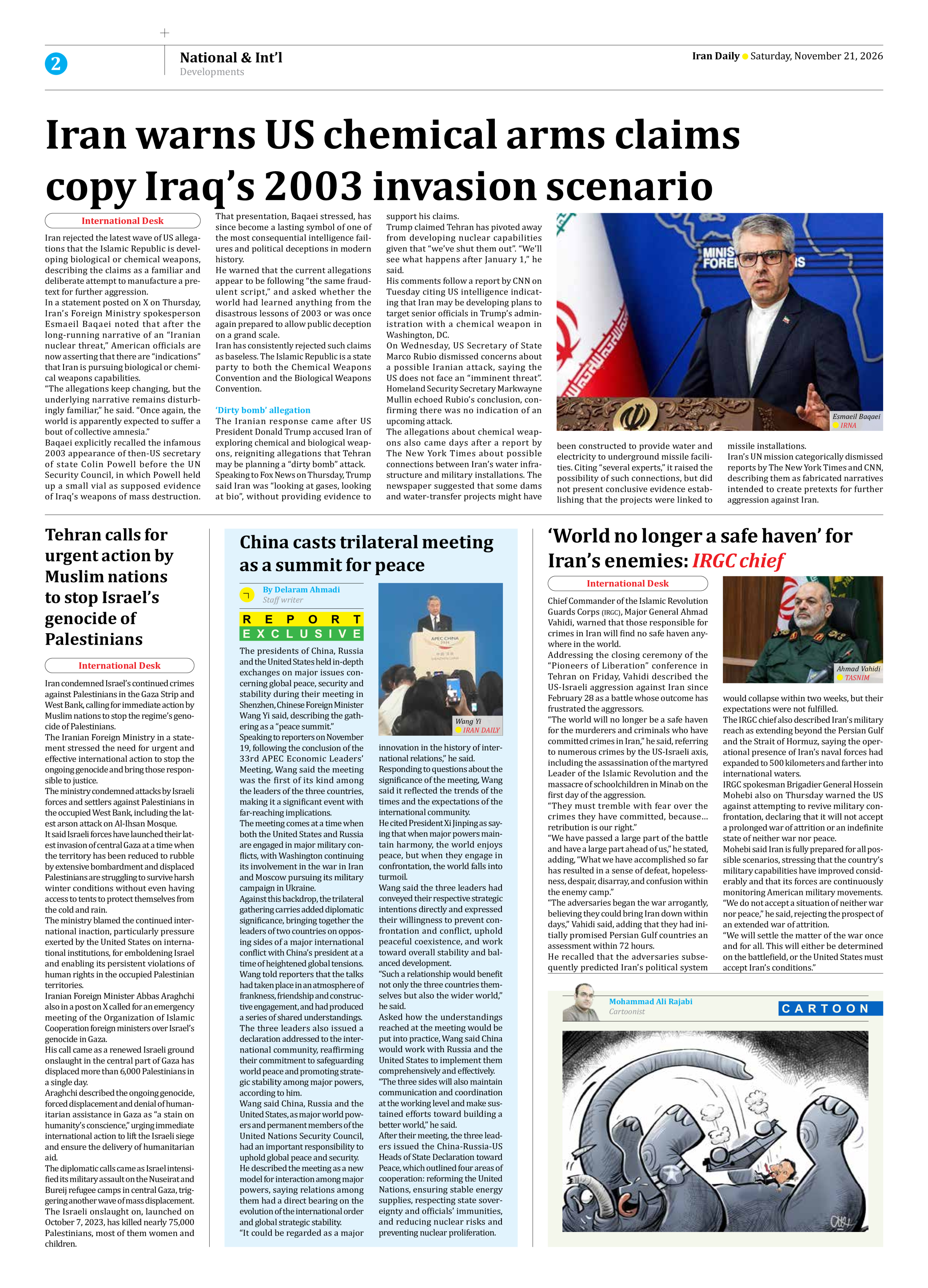
The presidents of China, Russia and the United States held in-depth exchanges on major issues concerning global peace, security and stability during their meeting in Shenzhen, Chinese Foreign Minister Wang Yi said, describing the gathering as a “peace summit.”
Speaking to reporters on November 19, following the conclusion of the 33rd APEC Economic Leaders’ Meeting, Wang said the meeting was the first of its kind among the leaders of the three countries, making it a significant event with far-reaching implications.
The meeting comes at a time when both the United States and Russia are engaged in major military conflicts, with Washington continuing its involvement in the war in Iran and Moscow pursuing its military campaign in Ukraine.
Against this backdrop, the trilateral gathering carries added diplomatic significance, bringing together the leaders of two countries on opposing sides of a major international conflict with China’s president at a time of heightened global tensions.
Wang told reporters that the talks had taken place in an atmosphere of frankness, friendship and constructive engagement, and had produced a series of shared understandings.
The three leaders also issued a declaration addressed to the international community, reaffirming their commitment to safeguarding world peace and promoting strategic stability among major powers, according to him.
Wang said China, Russia and the United States, as major world powers and permanent members of the United Nations Security Council, had an important responsibility to uphold global peace and security.
He described the meeting as a new model for interaction among major powers, saying relations among them had a direct bearing on the evolution of the international order and global strategic stability.
“It could be regarded as a major innovation in the history of international relations,” he said.
Responding to questions about the significance of the meeting, Wang said it reflected the trends of the times and the expectations of the international community.
He cited President Xi Jinping as saying that when major powers maintain harmony, the world enjoys peace, but when they engage in confrontation, the world falls into turmoil.
Wang said the three leaders had conveyed their respective strategic intentions directly and expressed their willingness to prevent confrontation and conflict, uphold peaceful coexistence, and work toward overall stability and balanced development.
“Such a relationship would benefit not only the three countries themselves but also the wider world,” he said.
Asked how the understandings reached at the meeting would be put into practice, Wang said China would work with Russia and the United States to implement them comprehensively and effectively.
“The three sides will also maintain communication and coordination at the working level and make sustained efforts toward building a better world,” he said.
After their meeting, the three leaders issued the China-Russia-US Heads of State Declaration toward Peace, which outlined four areas of cooperation: reforming the United Nations, ensuring stable energy supplies, respecting state sovereignty and officials’ immunities, and reducing nuclear risks and preventing nuclear proliferation.