




Iran warns US chemical arms claims copy Iraq’s 2003 invasion scenario
Iran rejected the latest wave of US allegations that the Islamic Republic is developing biological or chemical weapons, describing the claims as a familiar and deliberate attempt to manufacture a pretext for further aggression.
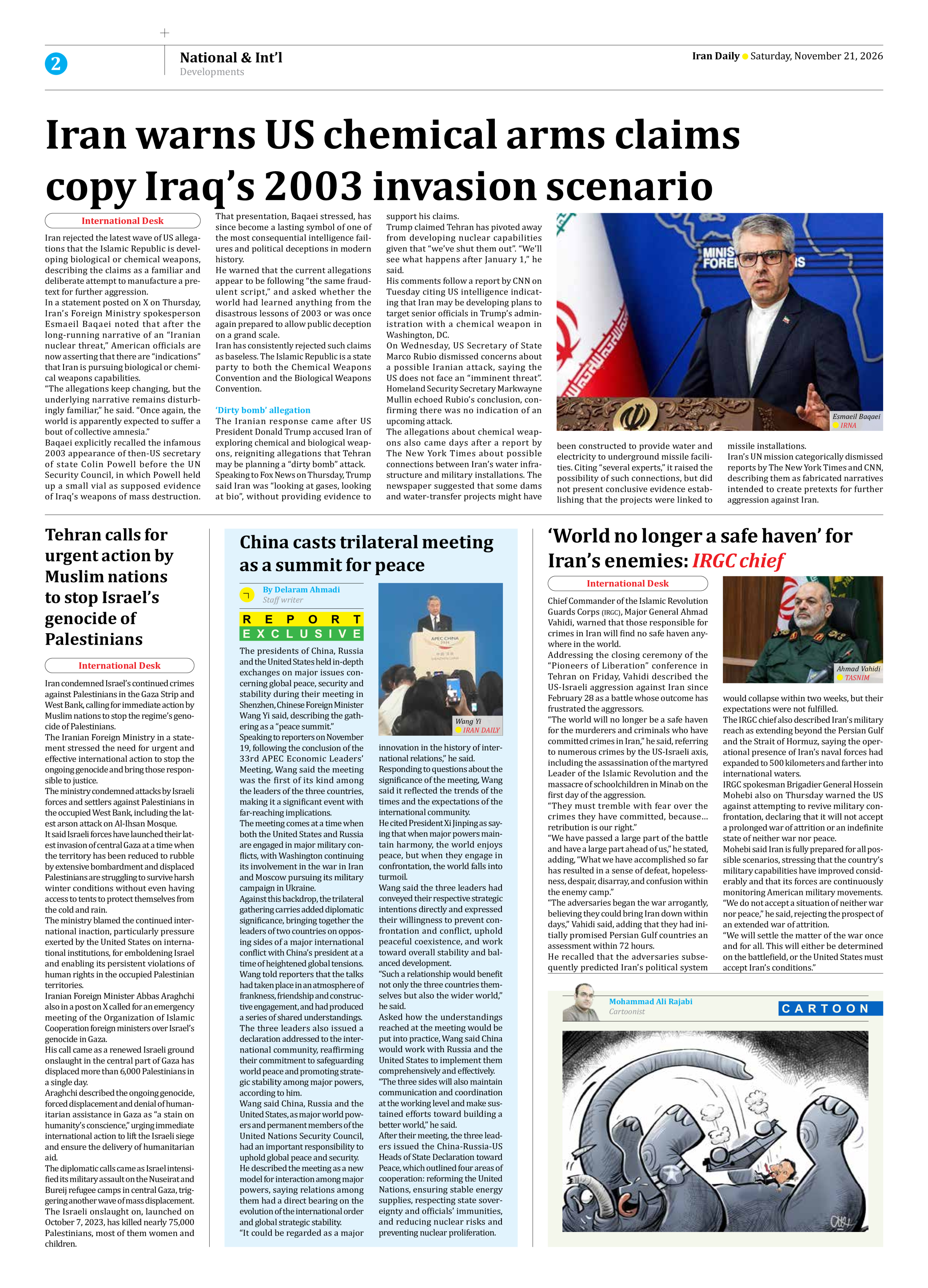
In a statement posted on X on Thursday, Iran’s Foreign Ministry spokesperson Esmaeil Baqaei noted that after the long-running narrative of an “Iranian nuclear threat,” American officials are now asserting that there are “indications” that Iran is pursuing biological or chemical weapons capabilities.
“The allegations keep changing, but the underlying narrative remains disturbingly familiar,” he said. “Once again, the world is apparently expected to suffer a bout of collective amnesia.”
Baqaei explicitly recalled the infamous 2003 appearance of then-US secretary of state Colin Powell before the UN Security Council, in which Powell held up a small vial as supposed evidence of Iraq’s weapons of mass destruction. That presentation, Baqaei stressed, has since become a lasting symbol of one of the most consequential intelligence failures and political deceptions in modern history.
He warned that the current allegations appear to be following “the same fraudulent script,” and asked whether the world had learned anything from the disastrous lessons of 2003 or was once again prepared to allow public deception on a grand scale.
Iran has consistently rejected such claims as baseless. The Islamic Republic is a state party to both the Chemical Weapons Convention and the Biological Weapons Convention.
‘Dirty bomb’ allegation
The Iranian response came after US President Donald Trump accused Iran of exploring chemical and biological weapons, reigniting allegations that Tehran may be planning a “dirty bomb” attack.
Speaking to Fox News on Thursday, Trump said Iran was “looking at gases, looking at bio”, without providing evidence to support his claims.
Trump claimed Tehran has pivoted away from developing nuclear capabilities given that “we’ve shut them out”. “We’ll see what happens after January 1,” he said.
His comments follow a report by CNN on Tuesday citing US intelligence indicating that Iran may be developing plans to target senior officials in Trump’s administration with a chemical weapon in Washington, DC.
On Wednesday, US Secretary of State Marco Rubio dismissed concerns about a possible Iranian attack, saying the US does not face an “imminent threat”. Homeland Security Secretary Markwayne Mullin echoed Rubio’s conclusion, confirming there was no indication of an upcoming attack.
The allegations about chemical weapons also came days after a report by The New York Times about possible connections between Iran’s water infrastructure and military installations. The newspaper suggested that some dams and water-transfer projects might have been constructed to provide water and electricity to underground missile facilities. Citing “several experts,” it raised the possibility of such connections, but did not present conclusive evidence establishing that the projects were linked to missile installations.
Iran’s UN mission categorically dismissed reports by The New York Times and CNN, describing them as fabricated narratives intended to create pretexts for further aggression against Iran.