




Qaleh Geli sheds light on Iran’s ancient past
Located in Qaleh Afghan Village on the Khanmirza Plain, the ancient archaeological site of Qaleh Geli (lit. Mud Castle), known also as Qaleh-ye Afghan, preserves evidence of several historical periods, including prehistoric times, the Middle Elamite period and the Islamic era.
Historical sites are far more than collections of mounds, artefacts and surviving remnants of the past. They form an essential part of the cultural and historical identity of a region, telling the story of the way of life, civilization and heritage of the people who inhabited the land centuries ago, according to ISNA.
Across Chaharmahal and Bakhtiari Province, numerous archaeological sites offer valuable opportunities to explore the region’s past. These remarkable remains deserve protection not only to preserve the heritage of previous generations but also to pass on the region’s historical identity to future generations.
The ancient archaeological complex of Qaleh Geli is one such historical treasure, containing evidence of different periods of human occupation. Archaeological finds and evidence from the site date back to prehistoric times, the Middle Elamite period and the Islamic era, making it an important part of the province’s archaeological heritage.
Its preservation requires serious attention, continuous protection and effective measures to prevent encroachment and destruction. The importance of safeguarding such sites becomes particularly clear when we consider that any damage could result in the permanent loss of irreplaceable evidence about the region’s history. The site has also been officially listed as a national heritage monument.
Speaking to reporters on the sidelines of a visit to the archaeological site, Ali Asghar Norouzi, an archaeologist, highlighted the historical significance of Qaleh Geli in Chaharmahal and Bakhtiari Province.
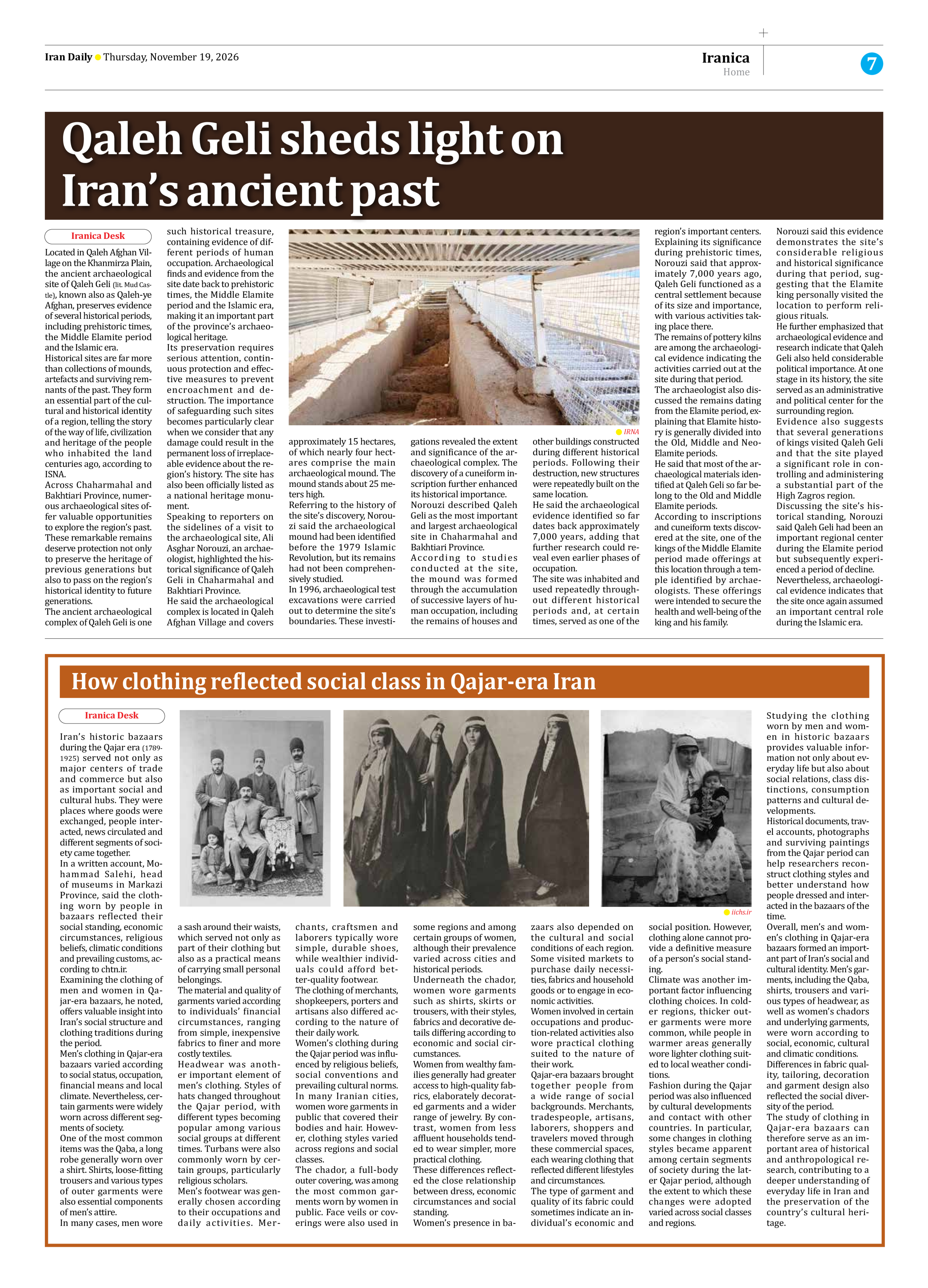
He said the archaeological complex is located in Qaleh Afghan Village and covers approximately 15 hectares, of which nearly four hectares comprise the main archaeological mound. The mound stands about 25 meters high.
Referring to the history of the site’s discovery, Norouzi said the archaeological mound had been identified before the 1979 Islamic Revolution, but its remains had not been comprehensively studied.
In 1996, archaeological test excavations were carried out to determine the site’s boundaries. These investigations revealed the extent and significance of the archaeological complex. The discovery of a cuneiform inscription further enhanced its historical importance.
Norouzi described Qaleh Geli as the most important and largest archaeological site in Chaharmahal and Bakhtiari Province.
According to studies conducted at the site, the mound was formed through the accumulation of successive layers of human occupation, including the remains of houses and other buildings constructed during different historical periods. Following their destruction, new structures were repeatedly built on the same location.
He said the archaeological evidence identified so far dates back approximately 7,000 years, adding that further research could reveal even earlier phases of occupation.
The site was inhabited and used repeatedly throughout different historical periods and, at certain times, served as one of the region’s important centers.
Explaining its significance during prehistoric times, Norouzi said that approximately 7,000 years ago, Qaleh Geli functioned as a central settlement because of its size and importance, with various activities taking place there.
The remains of pottery kilns are among the archaeological evidence indicating the activities carried out at the site during that period.
The archaeologist also discussed the remains dating from the Elamite period, explaining that Elamite history is generally divided into the Old, Middle and Neo-Elamite periods.
He said that most of the archaeological materials identified at Qaleh Geli so far belong to the Old and Middle Elamite periods.
According to inscriptions and cuneiform texts discovered at the site, one of the kings of the Middle Elamite period made offerings at this location through a temple identified by archaeologists. These offerings were intended to secure the health and well-being of the king and his family.
Norouzi said this evidence demonstrates the site’s considerable religious and historical significance during that period, suggesting that the Elamite king personally visited the location to perform religious rituals.
He further emphasized that archaeological evidence and research indicate that Qaleh Geli also held considerable political importance. At one stage in its history, the site served as an administrative and political center for the surrounding region.
Evidence also suggests that several generations of kings visited Qaleh Geli and that the site played a significant role in controlling and administering a substantial part of the High Zagros region.
Discussing the site’s historical standing, Norouzi said Qaleh Geli had been an important regional center during the Elamite period but subsequently experienced a period of decline.
Nevertheless, archaeological evidence indicates that the site once again assumed an important central role during the Islamic era.