


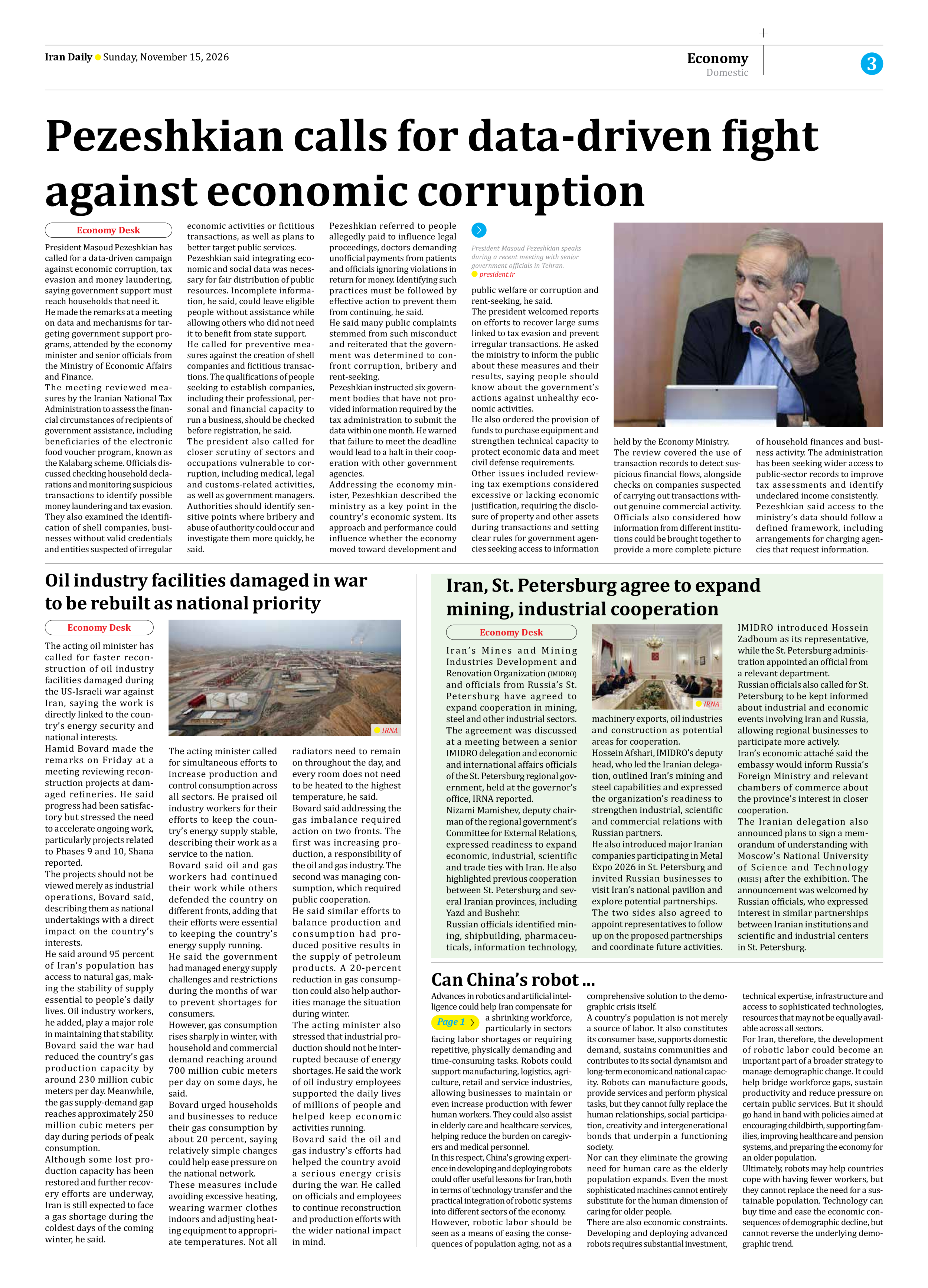


Oil industry facilities damaged in war to be rebuilt as national priority
The acting oil minister has called for faster reconstruction of oil industry facilities damaged during the US-Israeli war against Iran, saying the work is directly linked to the country’s energy security and national interests.
Hamid Bovard made the remarks on Friday at a meeting reviewing reconstruction projects at damaged refineries. He said progress had been satisfactory but stressed the need to accelerate ongoing work, particularly projects related to Phases 9 and 10, Shana reported.
The projects should not be viewed merely as industrial operations, Bovard said, describing them as national undertakings with a direct impact on the country’s interests.
He said around 95 percent of Iran’s population has access to natural gas, making the stability of supply essential to people’s daily lives. Oil industry workers, he added, play a major role in maintaining that stability.
Bovard said the war had reduced the country’s gas production capacity by around 230 million cubic meters per day. Meanwhile, the gas supply-demand gap reaches approximately 250 million cubic meters per day during periods of peak consumption.
Although some lost production capacity has been restored and further recovery efforts are underway, Iran is still expected to face a gas shortage during the coldest days of the coming winter, he said.
The acting minister called for simultaneous efforts to increase production and control consumption across all sectors. He praised oil industry workers for their efforts to keep the country’s energy supply stable, describing their work as a service to the nation.
Bovard said oil and gas workers had continued their work while others defended the country on different fronts, adding that their efforts were essential to keeping the country’s energy supply running.
He said the government had managed energy supply challenges and restrictions during the months of war to prevent shortages for consumers.
However, gas consumption rises sharply in winter, with household and commercial demand reaching around 700 million cubic meters per day on some days, he said.
Bovard urged households and businesses to reduce their gas consumption by about 20 percent, saying relatively simple changes could help ease pressure on the national network.
These measures include avoiding excessive heating, wearing warmer clothes indoors and adjusting heating equipment to appropriate temperatures. Not all radiators need to remain on throughout the day, and every room does not need to be heated to the highest temperature, he said.
Bovard said addressing the gas imbalance required action on two fronts. The first was increasing production, a responsibility of the oil and gas industry. The second was managing consumption, which required public cooperation.
He said similar efforts to balance production and consumption had produced positive results in the supply of petroleum products. A 20-percent reduction in gas consumption could also help authorities manage the situation
during winter.
The acting minister also stressed that industrial production should not be interrupted because of energy shortages. He said the work of oil industry employees supported the daily lives of millions of people and helped keep economic activities running.
Bovard said the oil and gas industry’s efforts had helped the country avoid a serious energy crisis during the war. He called on officials and employees to continue reconstruction and production efforts with the wider national impact in mind.