


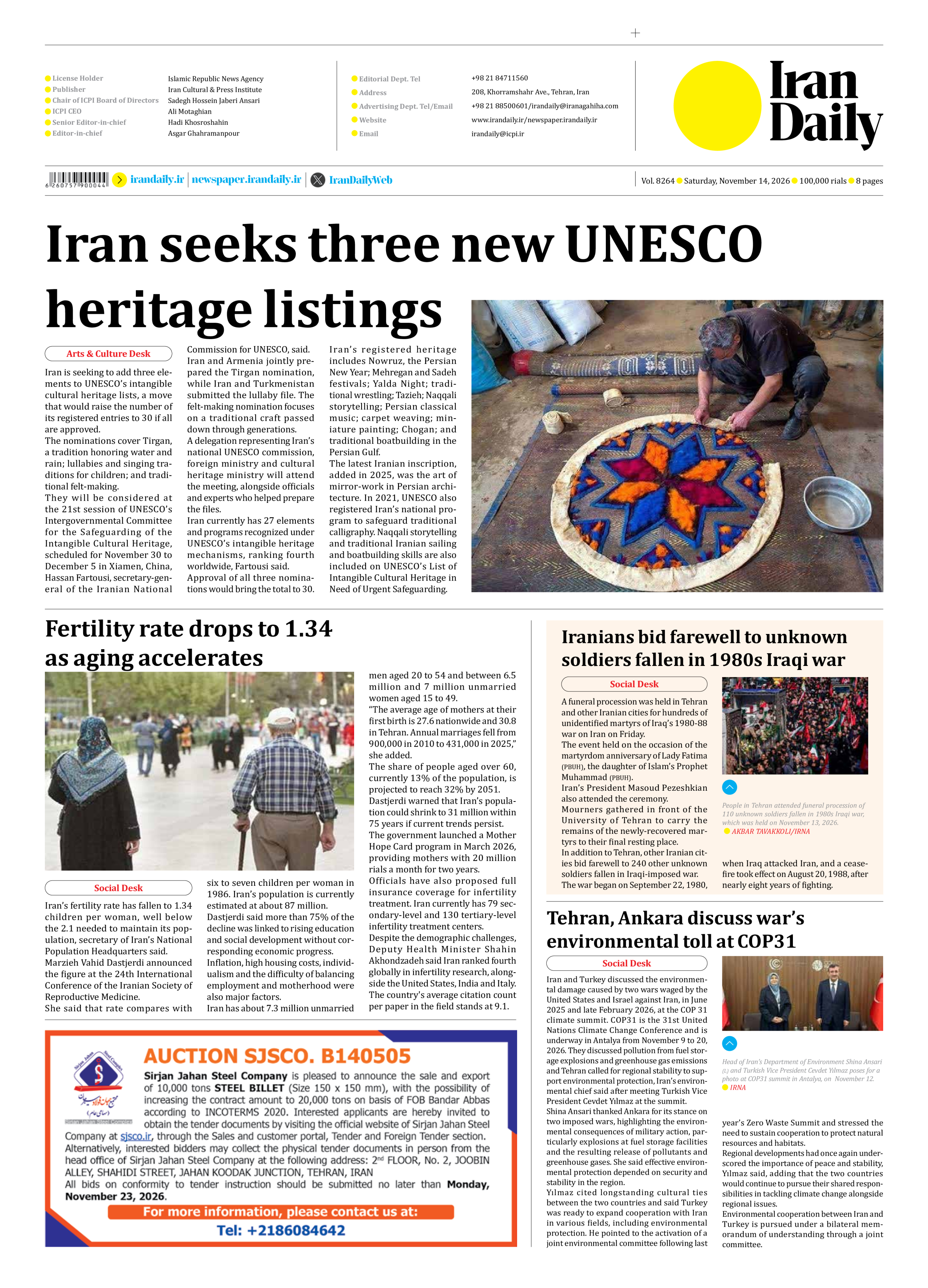


Fertility rate drops to 1.34 as aging accelerates
Iran’s fertility rate has fallen to 1.34 children per woman, well below the 2.1 needed to maintain its population, secretary of Iran’s National Population Headquarters said.
Marzieh Vahid Dastjerdi announced the figure at the 24th International Conference of the Iranian Society of Reproductive Medicine.
She said that rate compares with six to seven children per woman in 1986. Iran’s population is currently estimated at about 87 million.
Dastjerdi said more than 75% of the decline was linked to rising education and social development without corresponding economic progress.
Inflation, high housing costs, individualism and the difficulty of balancing employment and motherhood were also major factors.
Iran has about 7.3 million unmarried men aged 20 to 54 and between 6.5 million and 7 million unmarried women aged 15 to 49.
“The average age of mothers at their first birth is 27.6 nationwide and 30.8 in Tehran. Annual marriages fell from 900,000 in 2010 to 431,000 in 2025,” she added.
The share of people aged over 60, currently 13% of the population, is projected to reach 32% by 2051.
Dastjerdi warned that Iran’s population could shrink to 31 million within 75 years if current trends persist.
The government launched a Mother Hope Card program in March 2026, providing mothers with 20 million rials a month for two years.
Officials have also proposed full insurance coverage for infertility treatment. Iran currently has 79 secondary-level and 130 tertiary-level infertility treatment centers.
Despite the demographic challenges, Deputy Health Minister Shahin Akhondzadeh said Iran ranked fourth globally in infertility research, alongside the United States, India and Italy. The country's average citation count per paper in the field stands at 9.1.