




Handicraft houses offer new opportunities for artisans in Kerman
Kerman is stepping up efforts to preserve its traditional arts and turn handicrafts into a driver of employment and tourism growth through the expansion of dedicated handicraft houses.
Moving beyond the conventional model of production workshops and handicraft shops, these centers are intended to serve as multifunctional spaces for production, training, direct sales and interaction between artisans and younger generations. More than 10 handicraft houses have so far been established across the province, with plans to increase the number to between 30 and 40 high-quality centers in the provincial capital.
Under the emerging model, handicraft houses are more than places where traditional products are made or displayed. They are multifunctional centers designed to safeguard traditional crafts, pass on the skills of master artisans, support local craftspeople and create markets for locally made products. Visitors can observe the creative process firsthand and learn about the techniques and cultural heritage behind the region’s traditional arts.
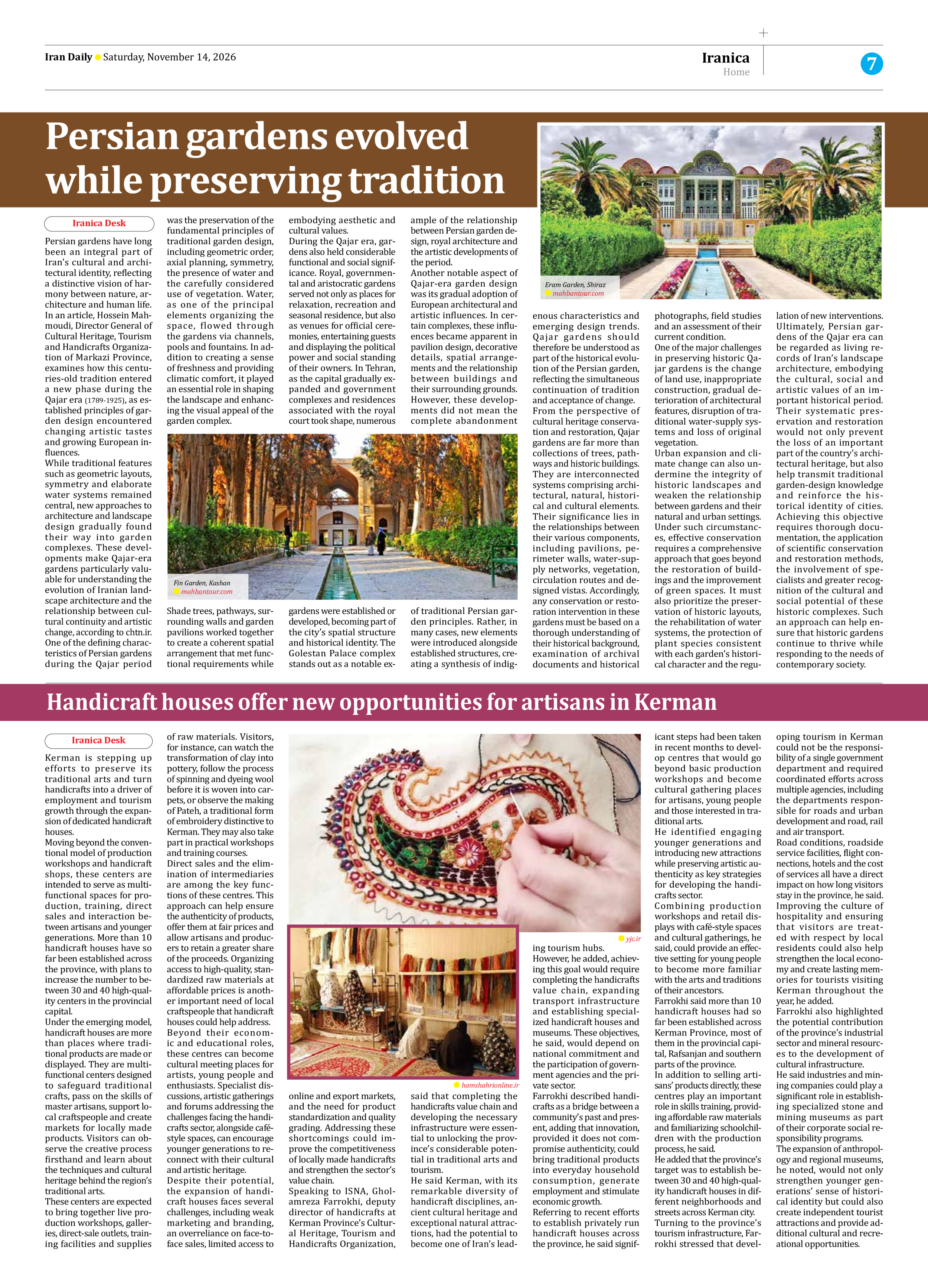
These centers are expected to bring together live production workshops, galleries, direct-sale outlets, training facilities and supplies of raw materials. Visitors, for instance, can watch the transformation of clay into pottery, follow the process of spinning and dyeing wool before it is woven into carpets, or observe the making of Pateh, a traditional form of embroidery distinctive to Kerman. They may also take part in practical workshops and training courses.
Direct sales and the elimination of intermediaries are among the key functions of these centres. This approach can help ensure the authenticity of products, offer them at fair prices and allow artisans and producers to retain a greater share of the proceeds. Organizing access to high-quality, standardized raw materials at affordable prices is another important need of local craftspeople that handicraft houses could help address.
Beyond their economic and educational roles, these centres can become cultural meeting places for artists, young people and enthusiasts. Specialist discussions, artistic gatherings and forums addressing the challenges facing the handicrafts sector, alongside café-style spaces, can encourage younger generations to reconnect with their cultural and artistic heritage.
Despite their potential, the expansion of handicraft houses faces several challenges, including weak marketing and branding, an overreliance on face-to-face sales, limited access to online and export markets, and the need for product standardization and quality grading. Addressing these shortcomings could improve the competitiveness of locally made handicrafts and strengthen the sector’s value chain.
Speaking to ISNA, Gholamreza Farrokhi, deputy director of handicrafts at Kerman Province’s Cultural Heritage, Tourism and Handicrafts Organization, said that completing the handicrafts value chain and developing the necessary infrastructure were essential to unlocking the province’s considerable potential in traditional arts and tourism.
He said Kerman, with its remarkable diversity of handicraft disciplines, ancient cultural heritage and exceptional natural attractions, had the potential to become one of Iran’s leading tourism hubs.
However, he added, achieving this goal would require completing the handicrafts value chain, expanding transport infrastructure and establishing specialized handicraft houses and museums. These objectives, he said, would depend on national commitment and the participation of government agencies and the private sector.
Farrokhi described handicrafts as a bridge between a community’s past and present, adding that innovation, provided it does not compromise authenticity, could bring traditional products into everyday household consumption, generate employment and stimulate economic growth.
Referring to recent efforts to establish privately run handicraft houses across the province, he said significant steps had been taken in recent months to develop centres that would go beyond basic production workshops and become cultural gathering places for artisans, young people and those interested in traditional arts.
He identified engaging younger generations and introducing new attractions while preserving artistic authenticity as key strategies for developing the handicrafts sector.
Combining production workshops and retail displays with café-style spaces and cultural gatherings, he said, could provide an effective setting for young people to become more familiar with the arts and traditions of their ancestors.
Farrokhi said more than 10 handicraft houses had so far been established across Kerman Province, most of them in the provincial capital, Rafsanjan and southern parts of the province.
In addition to selling artisans’ products directly, these centres play an important role in skills training, providing affordable raw materials and familiarizing schoolchildren with the production process, he said.
He added that the province’s target was to establish between 30 and 40 high-quality handicraft houses in different neighborhoods and streets across Kerman city.
Turning to the province’s tourism infrastructure, Farrokhi stressed that developing tourism in Kerman could not be the responsibility of a single government department and required coordinated efforts across multiple agencies, including the departments responsible for roads and urban development and road, rail and air transport.
Road conditions, roadside service facilities, flight connections, hotels and the cost of services all have a direct impact on how long visitors stay in the province, he said.
Improving the culture of hospitality and ensuring that visitors are treated with respect by local residents could also help strengthen the local economy and create lasting memories for tourists visiting Kerman throughout the year, he added.
Farrokhi also highlighted the potential contribution of the province’s industrial sector and mineral resources to the development of cultural infrastructure.
He said industries and mining companies could play a significant role in establishing specialized stone and mining museums as part of their corporate social responsibility programs.
The expansion of anthropology and regional museums, he noted, would not only strengthen younger generations’ sense of historical identity but could also create independent tourist attractions and provide additional cultural and recreational opportunities.