




Persian gardens evolved while preserving tradition
Persian gardens have long been an integral part of Iran’s cultural and architectural identity, reflecting a distinctive vision of harmony between nature, architecture and human life. In an article, Hossein Mahmoudi, Director General of Cultural Heritage, Tourism and Handicrafts Organization of Markazi Province, examines how this centuries-old tradition entered a new phase during the Qajar era (1789-1925), as established principles of garden design encountered changing artistic tastes and growing European influences.
While traditional features such as geometric layouts, symmetry and elaborate water systems remained central, new approaches to architecture and landscape design gradually found their way into garden complexes. These developments make Qajar-era gardens particularly valuable for understanding the evolution of Iranian landscape architecture and the relationship between cultural continuity and artistic change, according to chtn.ir.
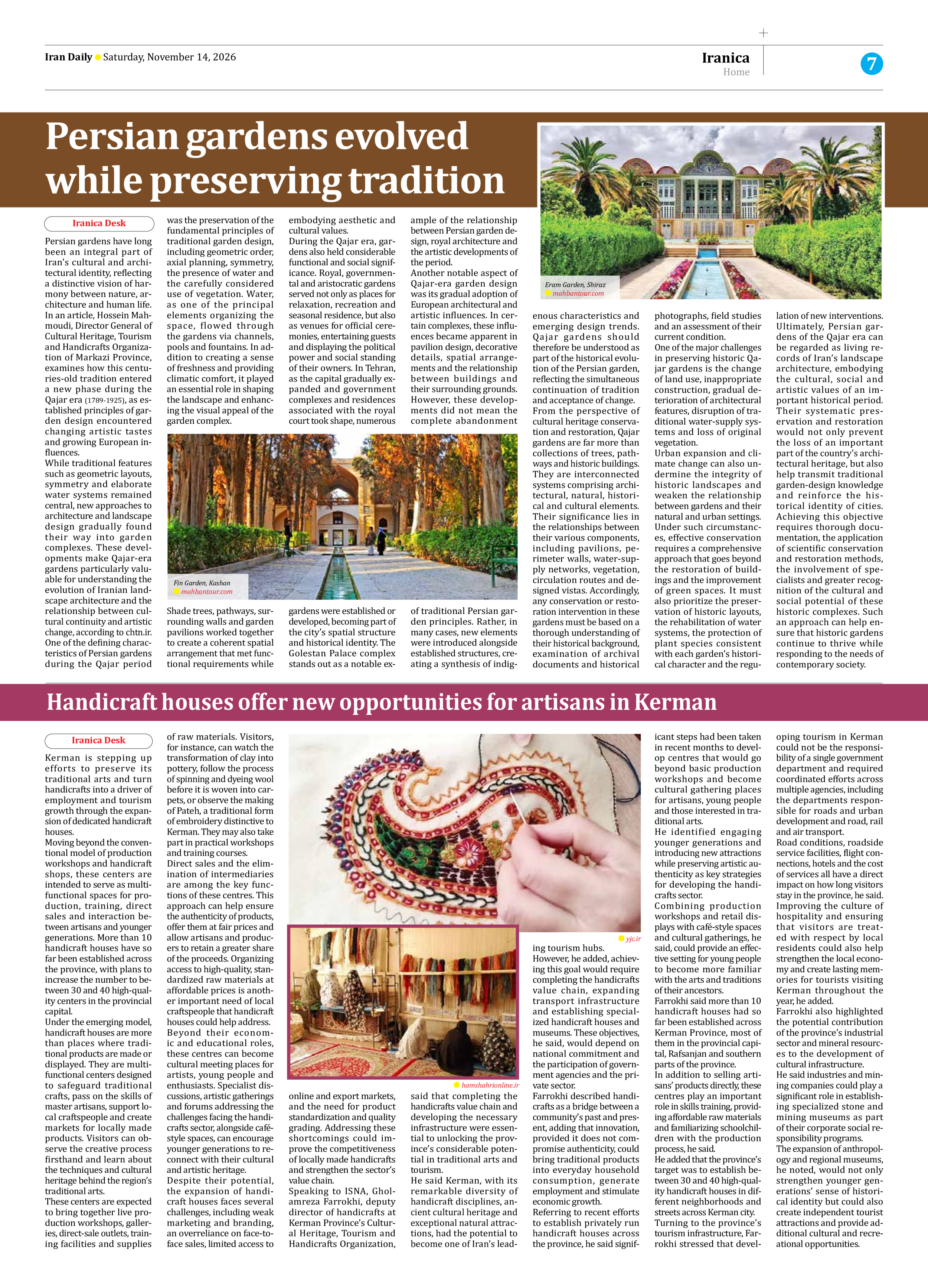
One of the defining characteristics of Persian gardens during the Qajar period was the preservation of the fundamental principles of traditional garden design, including geometric order, axial planning, symmetry, the presence of water and the carefully considered use of vegetation. Water, as one of the principal elements organizing the space, flowed through the gardens via channels, pools and fountains. In addition to creating a sense of freshness and providing climatic comfort, it played an essential role in shaping the landscape and enhancing the visual appeal of the garden complex.
Shade trees, pathways, surrounding walls and garden pavilions worked together to create a coherent spatial arrangement that met functional requirements while embodying aesthetic and cultural values.
During the Qajar era, gardens also held considerable functional and social significance. Royal, governmental and aristocratic gardens served not only as places for relaxation, recreation and seasonal residence, but also as venues for official ceremonies, entertaining guests and displaying the political power and social standing of their owners. In Tehran, as the capital gradually expanded and government complexes and residences associated with the royal court took shape, numerous gardens were established or developed, becoming part of the city’s spatial structure and historical identity. The Golestan Palace complex stands out as a notable example of the relationship between Persian garden design, royal architecture and the artistic developments of the period.
Another notable aspect of Qajar-era garden design was its gradual adoption of European architectural and artistic influences. In certain complexes, these influences became apparent in pavilion design, decorative details, spatial arrangements and the relationship between buildings and their surrounding grounds. However, these developments did not mean the complete abandonment of traditional Persian garden principles. Rather, in many cases, new elements were introduced alongside established structures, creating a synthesis of indigenous characteristics and emerging design trends. Qajar gardens should therefore be understood as part of the historical evolution of the Persian garden, reflecting the simultaneous continuation of tradition and acceptance of change.
From the perspective of cultural heritage conservation and restoration, Qajar gardens are far more than collections of trees, pathways and historic buildings. They are interconnected systems comprising architectural, natural, historical and cultural elements. Their significance lies in the relationships between their various components, including pavilions, perimeter walls, water-supply networks, vegetation, circulation routes and designed vistas. Accordingly, any conservation or restoration intervention in these gardens must be based on a thorough understanding of their historical background, examination of archival documents and historical photographs, field studies and an assessment of their current condition.
One of the major challenges in preserving historic Qajar gardens is the change of land use, inappropriate construction, gradual deterioration of architectural features, disruption of traditional water-supply systems and loss of original vegetation.
Urban expansion and climate change can also undermine the integrity of historic landscapes and weaken the relationship between gardens and their natural and urban settings. Under such circumstances, effective conservation requires a comprehensive approach that goes beyond the restoration of buildings and the improvement of green spaces. It must also prioritize the preservation of historic layouts, the rehabilitation of water systems, the protection of plant species consistent with each garden’s historical character and the regulation of new interventions.
Ultimately, Persian gardens of the Qajar era can be regarded as living records of Iran’s landscape architecture, embodying the cultural, social and artistic values of an important historical period. Their systematic preservation and restoration would not only prevent the loss of an important part of the country’s architectural heritage, but also help transmit traditional garden-design knowledge and reinforce the historical identity of cities. Achieving this objective requires thorough documentation, the application of scientific conservation and restoration methods, the involvement of specialists and greater recognition of the cultural and social potential of these historic complexes. Such an approach can help ensure that historic gardens continue to thrive while responding to the needs of contemporary society.