


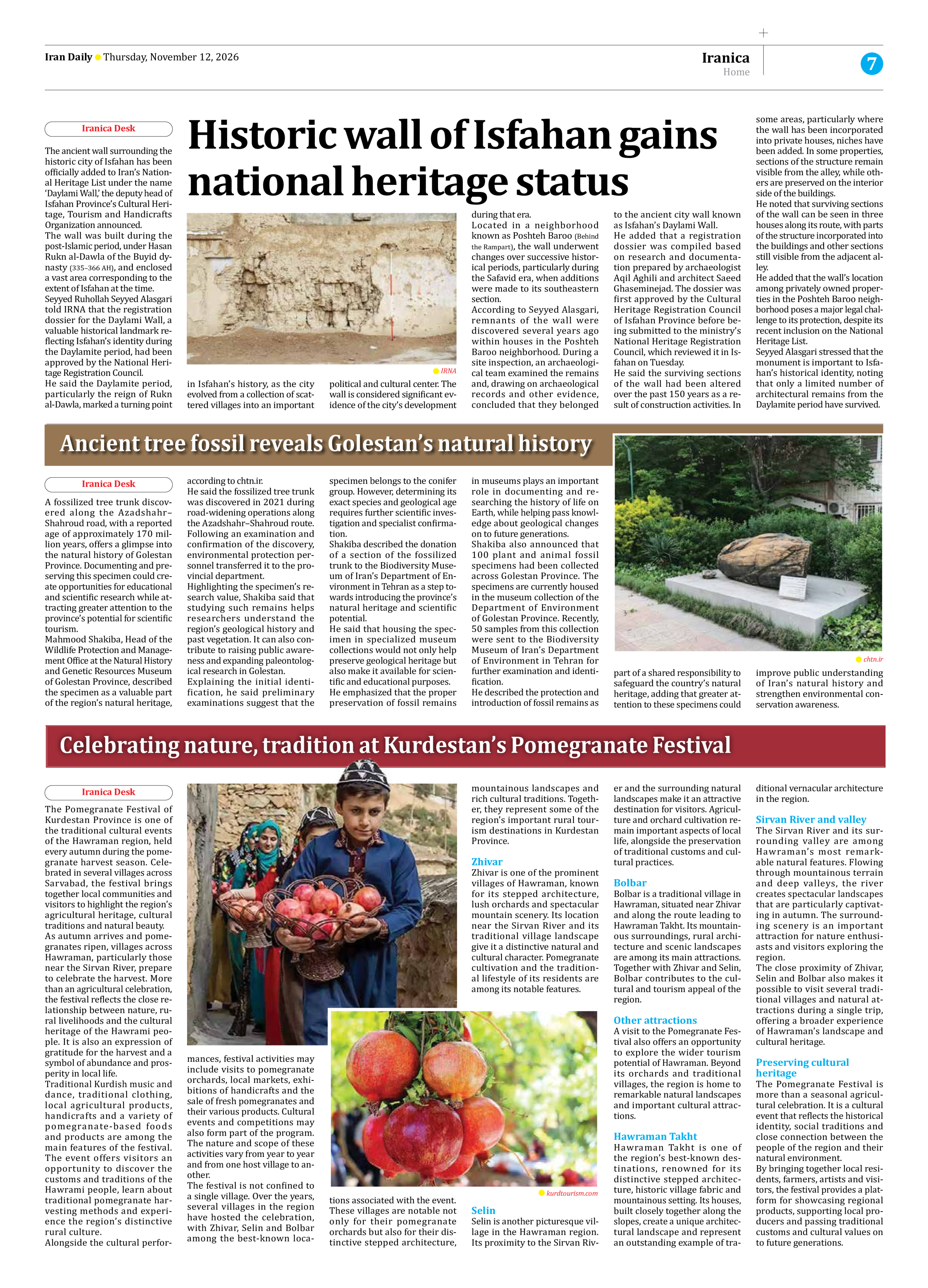


Ancient tree fossil reveals Golestan’s natural history
A fossilized tree trunk discovered along the Azadshahr–Shahroud road, with a reported age of approximately 170 million years, offers a glimpse into the natural history of Golestan Province. Documenting and preserving this specimen could create opportunities for educational and scientific research while attracting greater attention to the province’s potential for scientific tourism.
Mahmood Shakiba, Head of the Wildlife Protection and Management Office at the Natural History and Genetic Resources Museum of Golestan Province, described the specimen as a valuable part of the region’s natural heritage, according to chtn.ir.
He said the fossilized tree trunk was discovered in 2021 during road-widening operations along the Azadshahr–Shahroud route. Following an examination and confirmation of the discovery, environmental protection personnel transferred it to the provincial department.
Highlighting the specimen’s research value, Shakiba said that studying such remains helps researchers understand the region’s geological history and past vegetation. It can also contribute to raising public awareness and expanding paleontological research in Golestan.
Explaining the initial identification, he said preliminary examinations suggest that the specimen belongs to the conifer group. However, determining its exact species and geological age requires further scientific investigation and specialist confirmation.
Shakiba described the donation of a section of the fossilized trunk to the Biodiversity Museum of Iran’s Department of Environment in Tehran as a step towards introducing the province’s natural heritage and scientific potential.
He said that housing the specimen in specialized museum collections would not only help preserve geological heritage but also make it available for scientific and educational purposes.
He emphasized that the proper preservation of fossil remains in museums plays an important role in documenting and researching the history of life on Earth, while helping pass knowledge about geological changes on to future generations.
Shakiba also announced that 100 plant and animal fossil specimens had been collected across Golestan Province. The specimens are currently housed in the museum collection of the Department of Environment of Golestan Province. Recently, 50 samples from this collection were sent to the Biodiversity Museum of Iran’s Department of Environment in Tehran for further examination and identification.
He described the protection and introduction of fossil remains as part of a shared responsibility to safeguard the country’s natural heritage, adding that greater attention to these specimens could improve public understanding of Iran’s natural history and strengthen environmental conservation awareness.