




Italian-made Shahnameh facsimile arrives in Iran
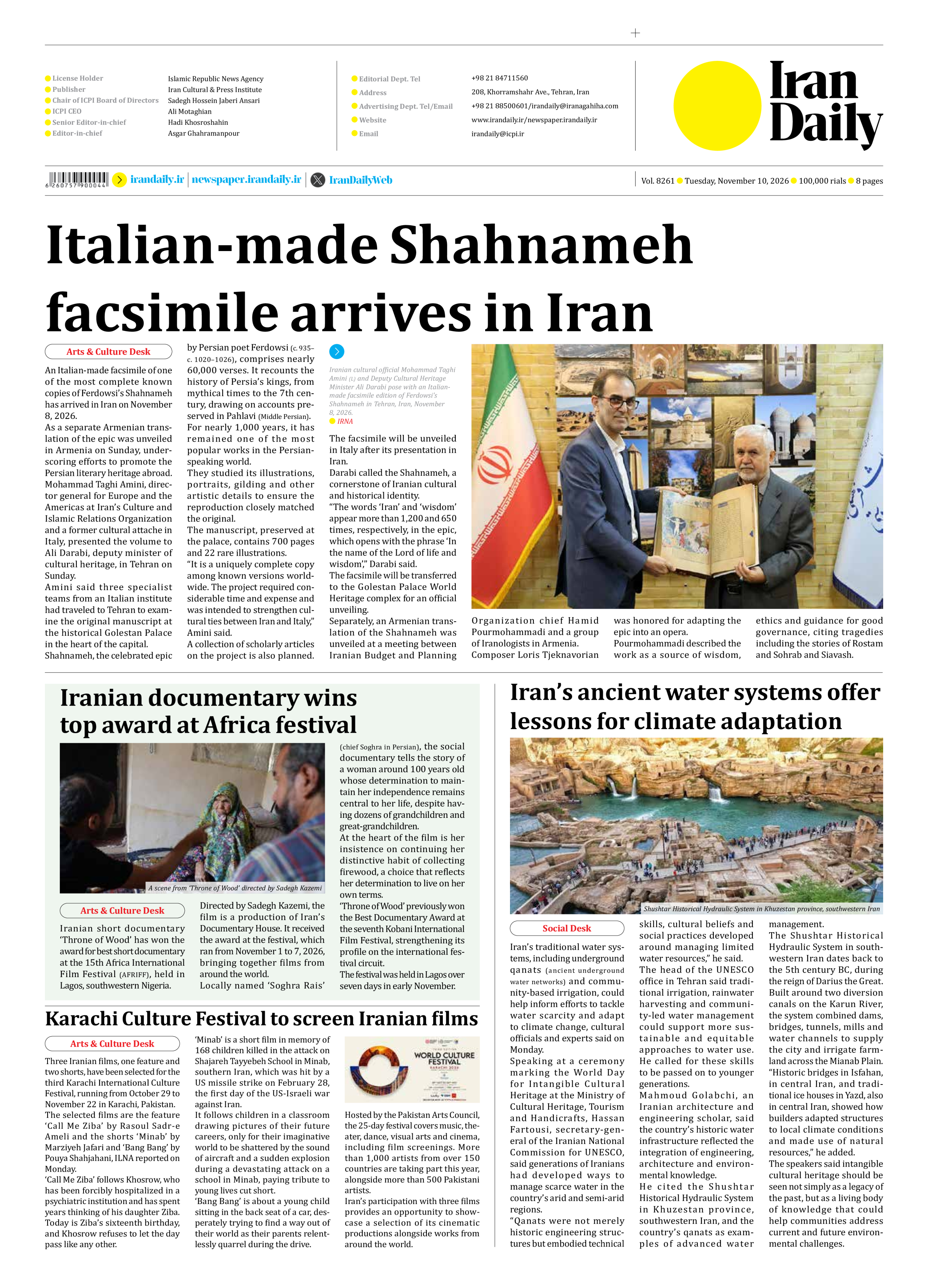
An Italian-made facsimile of one of the most complete known copies of Ferdowsi’s Shahnameh has arrived in Iran on November 8, 2026.
As a separate Armenian translation of the epic was unveiled in Armenia on Sunday, underscoring efforts to promote the Persian literary heritage abroad.
Mohammad Taghi Amini, director general for Europe and the Americas at Iran’s Culture and Islamic Relations Organization and a former cultural attache in Italy, presented the volume to Ali Darabi, deputy minister of cultural heritage, in Tehran on Sunday.
Amini said three specialist teams from an Italian institute had traveled to Tehran to examine the original manuscript at the historical Golestan Palace in the heart of the capital.
Shahnameh, the celebrated epic by Persian poet Ferdowsi (c. 935–c. 1020–1026), comprises nearly 60,000 verses. It recounts the history of Persia’s kings, from mythical times to the 7th century, drawing on accounts preserved in Pahlavi (Middle Persian).
For nearly 1,000 years, it has remained one of the most popular works in the Persian-speaking world.
They studied its illustrations, portraits, gilding and other artistic details to ensure the reproduction closely matched the original.
The manuscript, preserved at the palace, contains 700 pages and 22 rare illustrations.
“It is a uniquely complete copy among known versions worldwide. The project required considerable time and expense and was intended to strengthen cultural ties between Iran and Italy,” Amini said.
A collection of scholarly articles on the project is also planned. The facsimile will be unveiled in Italy after its presentation in Iran.
Darabi called the Shahnameh, a cornerstone of Iranian cultural and historical identity.
“The words ‘Iran’ and ‘wisdom’ appear more than 1,200 and 650 times, respectively, in the epic, which opens with the phrase ‘In the name of the Lord of life and wisdom’,” Darabi said.
The facsimile will be transferred to the Golestan Palace World Heritage complex for an official unveiling.
Separately, an Armenian translation of the Shahnameh was unveiled at a meeting between Iranian Budget and Planning Organization chief Hamid Pourmohammadi and a group of Iranologists in Armenia.
Composer Loris Tjeknavorian was honored for adapting the epic into an opera.
Pourmohammadi described the work as a source of wisdom, ethics and guidance for good governance, citing tragedies including the stories of Rostam and Sohrab and Siavash.