




Reading Room
Two books uncover forgotten chapter in northern Iran’s history
Two newly unveiled books by Iranian contemporary history researcher Mostafa Nouri explore a turbulent and often overlooked chapter in the history of northern Iran, documenting the Soviet occupation of Mazandaran and Gorgan during World War II and the political and social developments that followed in the years leading up to the August 1953 coup.
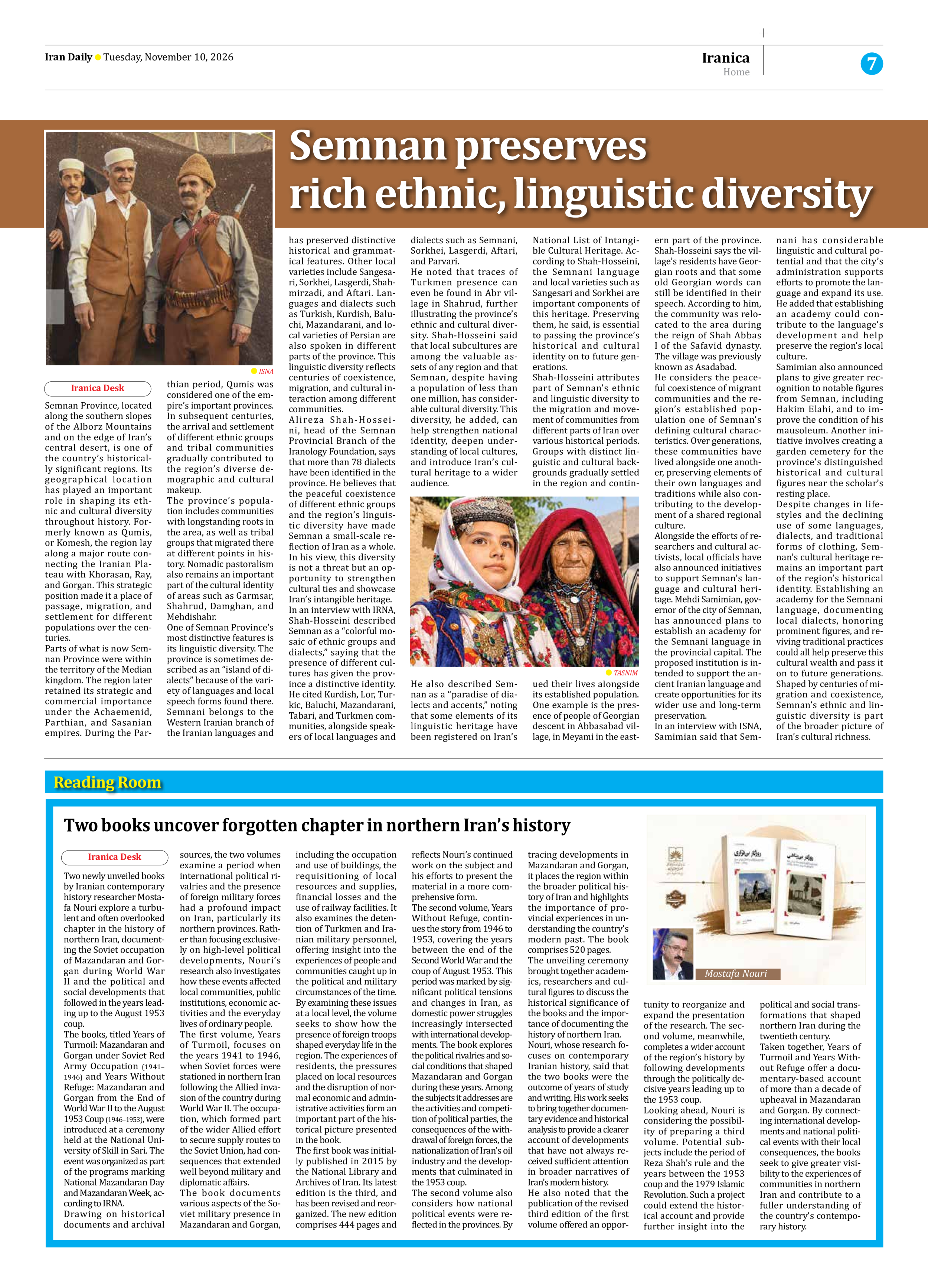
The books, titled Years of Turmoil: Mazandaran and Gorgan under Soviet Red Army Occupation (1941–1946) and Years Without Refuge: Mazandaran and Gorgan from the End of World War II to the August 1953 Coup (1946–1953), were introduced at a ceremony held at the National University of Skill in Sari. The event was organized as part of the programs marking National Mazandaran Day and Mazandaran Week, according to IRNA.
Drawing on historical documents and archival sources, the two volumes examine a period when international political rivalries and the presence of foreign military forces had a profound impact on Iran, particularly its northern provinces. Rather than focusing exclusively on high-level political developments, Nouri’s research also investigates how these events affected local communities, public institutions, economic activities and the everyday lives of ordinary people.
The first volume, Years of Turmoil, focuses on the years 1941 to 1946, when Soviet forces were stationed in northern Iran following the Allied invasion of the country during World War II. The occupation, which formed part of the wider Allied effort to secure supply routes to the Soviet Union, had consequences that extended well beyond military and diplomatic affairs.
The book documents various aspects of the Soviet military presence in Mazandaran and Gorgan, including the occupation and use of buildings, the requisitioning of local resources and supplies, financial losses and the use of railway facilities. It also examines the detention of Turkmen and Iranian military personnel, offering insight into the experiences of people and communities caught up in the political and military circumstances of the time.
By examining these issues at a local level, the volume seeks to show how the presence of foreign troops shaped everyday life in the region. The experiences of residents, the pressures placed on local resources and the disruption of normal economic and administrative activities form an important part of the historical picture presented in the book.
The first book was initially published in 2015 by the National Library and Archives of Iran. Its latest edition is the third, and has been revised and reorganized. The new edition comprises 444 pages and reflects Nouri’s continued work on the subject and his efforts to present the material in a more comprehensive form.
The second volume, Years Without Refuge, continues the story from 1946 to 1953, covering the years between the end of the Second World War and the coup of August 1953. This period was marked by significant political tensions and changes in Iran, as domestic power struggles increasingly intersected with international developments. The book explores the political rivalries and social conditions that shaped Mazandaran and Gorgan during these years. Among the subjects it addresses are the activities and competition of political parties, the consequences of the withdrawal of foreign forces, the nationalization of Iran’s oil industry and the developments that culminated in the 1953 coup.
The second volume also considers how national political events were reflected in the provinces. By tracing developments in Mazandaran and Gorgan, it places the region within the broader political history of Iran and highlights the importance of provincial experiences in understanding the country’s modern past. The book comprises 520 pages.
The unveiling ceremony brought together academics, researchers and cultural figures to discuss the historical significance of the books and the importance of documenting the history of northern Iran.
Nouri, whose research focuses on contemporary Iranian history, said that the two books were the outcome of years of study and writing. His work seeks to bring together documentary evidence and historical analysis to provide a clearer account of developments that have not always received sufficient attention in broader narratives of Iran’s modern history.
He also noted that the publication of the revised third edition of the first volume offered an opportunity to reorganize and expand the presentation of the research. The second volume, meanwhile, completes a wider account of the region’s history by following developments through the politically decisive years leading up to the 1953 coup.
Looking ahead, Nouri is considering the possibility of preparing a third volume. Potential subjects include the period of Reza Shah’s rule and the years between the 1953 coup and the 1979 Islamic Revolution. Such a project could extend the historical account and provide further insight into the political and social transformations that shaped northern Iran during the twentieth century.
Taken together, Years of Turmoil and Years Without Refuge offer a documentary-based account of more than a decade of upheaval in Mazandaran and Gorgan. By connecting international developments and national political events with their local consequences, the books seek to give greater visibility to the experiences of communities in northern Iran and contribute to a fuller understanding of the country’s contemporary history.