


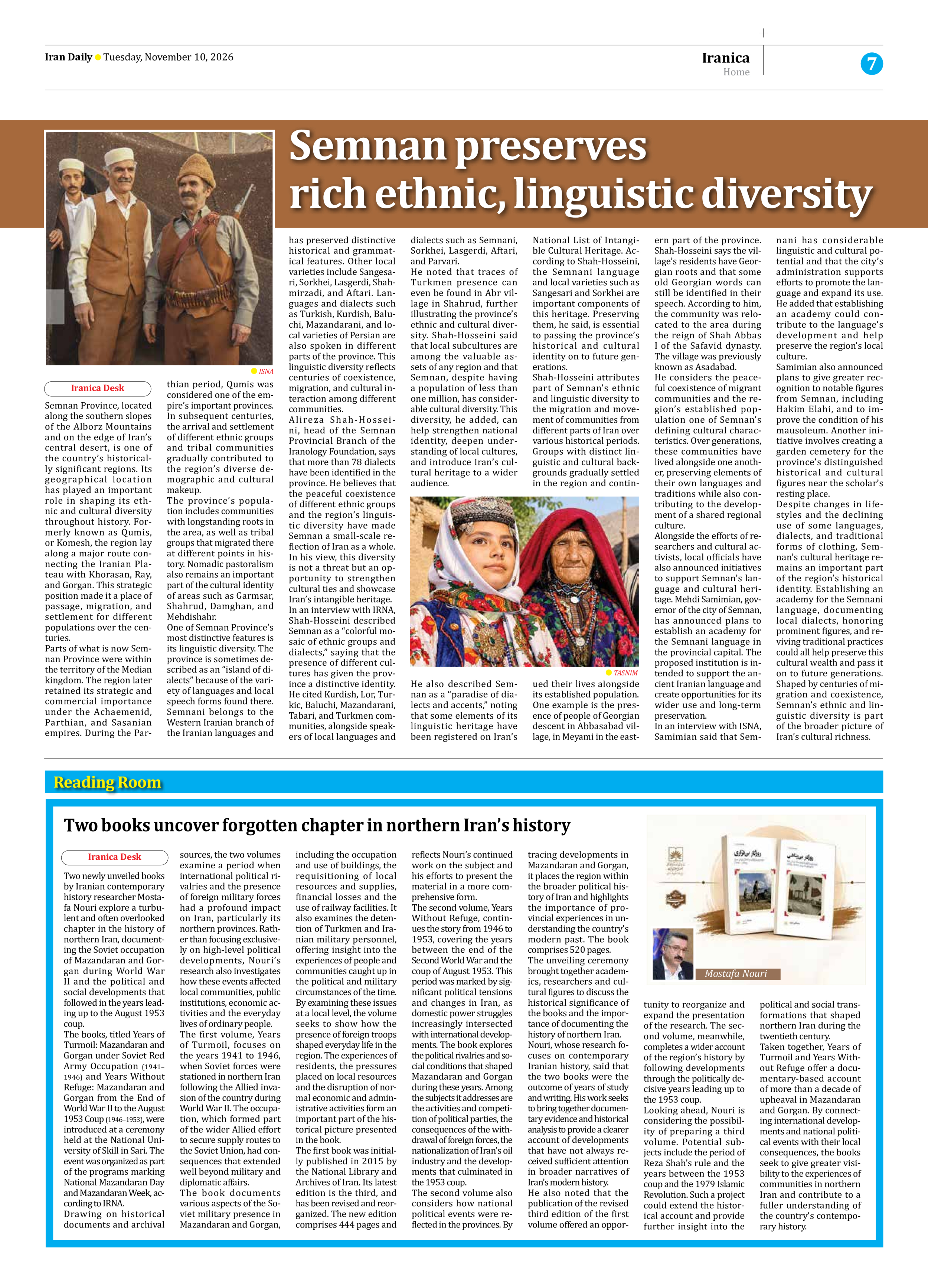


Semnan preserves rich ethnic, linguistic diversity
Semnan Province, located along the southern slopes of the Alborz Mountains and on the edge of Iran’s central desert, is one of the country’s historically significant regions. Its geographical location has played an important role in shaping its ethnic and cultural diversity throughout history. Formerly known as Qumis, or Komesh, the region lay along a major route connecting the Iranian Plateau with Khorasan, Ray, and Gorgan. This strategic position made it a place of passage, migration, and settlement for different populations over the centuries.
Parts of what is now Semnan Province were within the territory of the Median kingdom. The region later retained its strategic and commercial importance under the Achaemenid, Parthian, and Sasanian empires. During the Parthian period, Qumis was considered one of the empire’s important provinces. In subsequent centuries, the arrival and settlement of different ethnic groups and tribal communities gradually contributed to the region’s diverse demographic and cultural makeup.
The province’s population includes communities with longstanding roots in the area, as well as tribal groups that migrated there at different points in history. Nomadic pastoralism also remains an important part of the cultural identity of areas such as Garmsar, Shahrud, Damghan, and Mehdishahr.
One of Semnan Province’s most distinctive features is its linguistic diversity. The province is sometimes described as an “island of dialects” because of the variety of languages and local speech forms found there. Semnani belongs to the Western Iranian branch of the Iranian languages and has preserved distinctive historical and grammatical features. Other local varieties include Sangesari, Sorkhei, Lasgerdi, Shahmirzadi, and Aftari. Languages and dialects such as Turkish, Kurdish, Baluchi, Mazandarani, and local varieties of Persian are also spoken in different parts of the province. This linguistic diversity reflects centuries of coexistence, migration, and cultural interaction among different communities.
Alireza Shah-Hosseini, head of the Semnan Provincial Branch of the Iranology Foundation, says that more than 78 dialects have been identified in the province. He believes that the peaceful coexistence of different ethnic groups and the region’s linguistic diversity have made Semnan a small-scale reflection of Iran as a whole. In his view, this diversity is not a threat but an opportunity to strengthen cultural ties and showcase Iran’s intangible heritage.
In an interview with IRNA, Shah-Hosseini described Semnan as a “colorful mosaic of ethnic groups and dialects,” saying that the presence of different cultures has given the province a distinctive identity. He cited Kurdish, Lor, Turkic, Baluchi, Mazandarani, Tabari, and Turkmen communities, alongside speakers of local languages and dialects such as Semnani, Sorkhei, Lasgerdi, Aftari, and Parvari.
He noted that traces of Turkmen presence can even be found in Abr village in Shahrud, further illustrating the province’s ethnic and cultural diversity. Shah-Hosseini said that local subcultures are among the valuable assets of any region and that Semnan, despite having a population of less than one million, has considerable cultural diversity. This diversity, he added, can help strengthen national identity, deepen understanding of local cultures, and introduce Iran’s cultural heritage to a wider audience.
He also described Semnan as a “paradise of dialects and accents,” noting that some elements of its linguistic heritage have been registered on Iran’s National List of Intangible Cultural Heritage. According to Shah-Hosseini, the Semnani language and local varieties such as Sangesari and Sorkhei are important components of this heritage. Preserving them, he said, is essential to passing the province’s historical and cultural identity on to future generations.
Shah-Hosseini attributes part of Semnan’s ethnic and linguistic diversity to the migration and movement of communities from different parts of Iran over various historical periods. Groups with distinct linguistic and cultural backgrounds gradually settled in the region and continued their lives alongside its established population.
One example is the presence of people of Georgian descent in Abbasabad village, in Meyami in the eastern part of the province. Shah-Hosseini says the village’s residents have Georgian roots and that some old Georgian words can still be identified in their speech. According to him, the community was relocated to the area during the reign of Shah Abbas I of the Safavid dynasty. The village was previously known as Asadabad.
He considers the peaceful coexistence of migrant communities and the region’s established population one of Semnan’s defining cultural characteristics. Over generations, these communities have lived alongside one another, preserving elements of their own languages and traditions while also contributing to the development of a shared regional culture.
Alongside the efforts of researchers and cultural activists, local officials have also announced initiatives to support Semnan’s language and cultural heritage. Mehdi Samimian, governor of the city of Semnan, has announced plans to establish an academy for the Semnani language in the provincial capital. The proposed institution is intended to support the ancient Iranian language and create opportunities for its wider use and long-term preservation.
In an interview with ISNA, Samimian said that Semnani has considerable linguistic and cultural potential and that the city’s administration supports efforts to promote the language and expand its use. He added that establishing an academy could contribute to the language’s development and help preserve the region’s local culture.
Samimian also announced plans to give greater recognition to notable figures from Semnan, including Hakim Elahi, and to improve the condition of his mausoleum. Another initiative involves creating a garden cemetery for the province’s distinguished historical and cultural figures near the scholar’s resting place.
Despite changes in lifestyles and the declining use of some languages, dialects, and traditional forms of clothing, Semnan’s cultural heritage remains an important part of the region’s historical identity. Establishing an academy for the Semnani language, documenting local dialects, honoring prominent figures, and reviving traditional practices could all help preserve this cultural wealth and pass it on to future generations. Shaped by centuries of migration and coexistence, Semnan’s ethnic and linguistic diversity is part of the broader picture of Iran’s cultural richness.