




What does this result mean for left, right in Latin America?
Rubio Marquez
Former Mexican senator and deputy minister
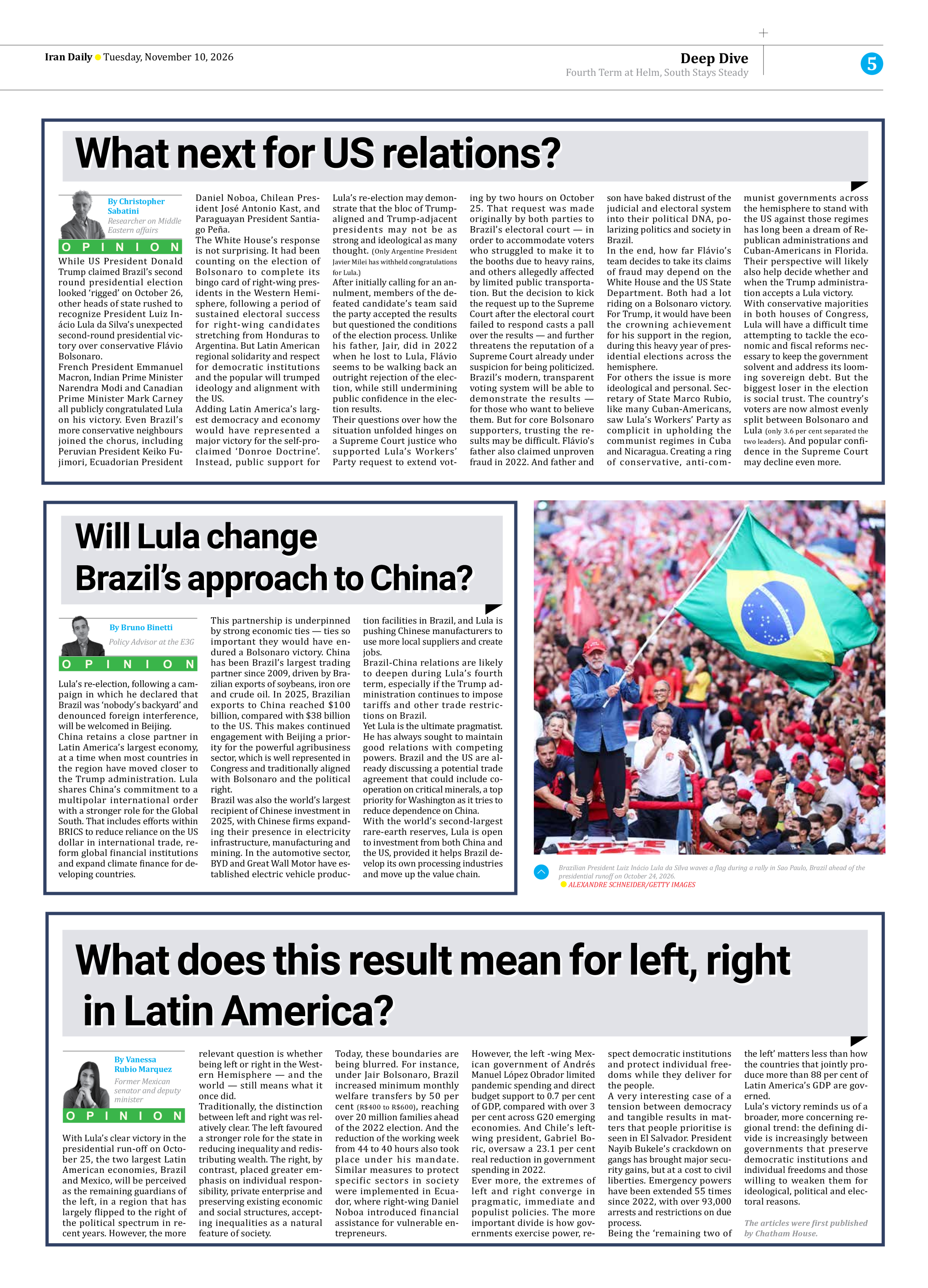
With Lula’s clear victory in the presidential run-off on October 25, the two largest Latin American economies, Brazil and Mexico, will be perceived as the remaining guardians of the left, in a region that has largely flipped to the right of the political spectrum in recent years. However, the more relevant question is whether being left or right in the Western Hemisphere — and the world — still means what it once did.
Traditionally, the distinction between left and right was relatively clear. The left favoured a stronger role for the state in reducing inequality and redistributing wealth. The right, by contrast, placed greater emphasis on individual responsibility, private enterprise and preserving existing economic and social structures, accepting inequalities as a natural feature of society.
Today, these boundaries are being blurred. For instance, under Jair Bolsonaro, Brazil increased minimum monthly welfare transfers by 50 per cent (R$400 to R$600), reaching over 20 million families ahead of the 2022 election. And the reduction of the working week from 44 to 40 hours also took place under his mandate. Similar measures to protect specific sectors in society were implemented in Ecuador, where right-wing Daniel Noboa introduced financial assistance for vulnerable entrepreneurs.
However, the left -wing Mexican government of Andrés Manuel López Obrador limited pandemic spending and direct budget support to 0.7 per cent of GDP, compared with over 3 per cent across G20 emerging economies. And Chile’s left-wing president, Gabriel Boric, oversaw a 23.1 per cent real reduction in government spending in 2022.
Ever more, the extremes of left and right converge in pragmatic, immediate and populist policies. The more important divide is how governments exercise power, respect democratic institutions and protect individual freedoms while they deliver for the people.
A very interesting case of a tension between democracy and tangible results in matters that people prioritise is seen in El Salvador. President Nayib Bukele’s crackdown on gangs has brought major security gains, but at a cost to civil liberties. Emergency powers have been extended 55 times since 2022, with over 93,000 arrests and restrictions on due process.
Being the ‘remaining two of the left’ matters less than how the countries that jointly produce more than 88 per cent of Latin America’s GDP are governed.
Lula’s victory reminds us of a broader, more concerning regional trend: the defining divide is increasingly between governments that preserve democratic institutions and individual freedoms and those willing to weaken them for ideological, political and electoral reasons.
The articles were first published by Chatham House.