




South Pars fifth refinery unit expected to resume operations by December
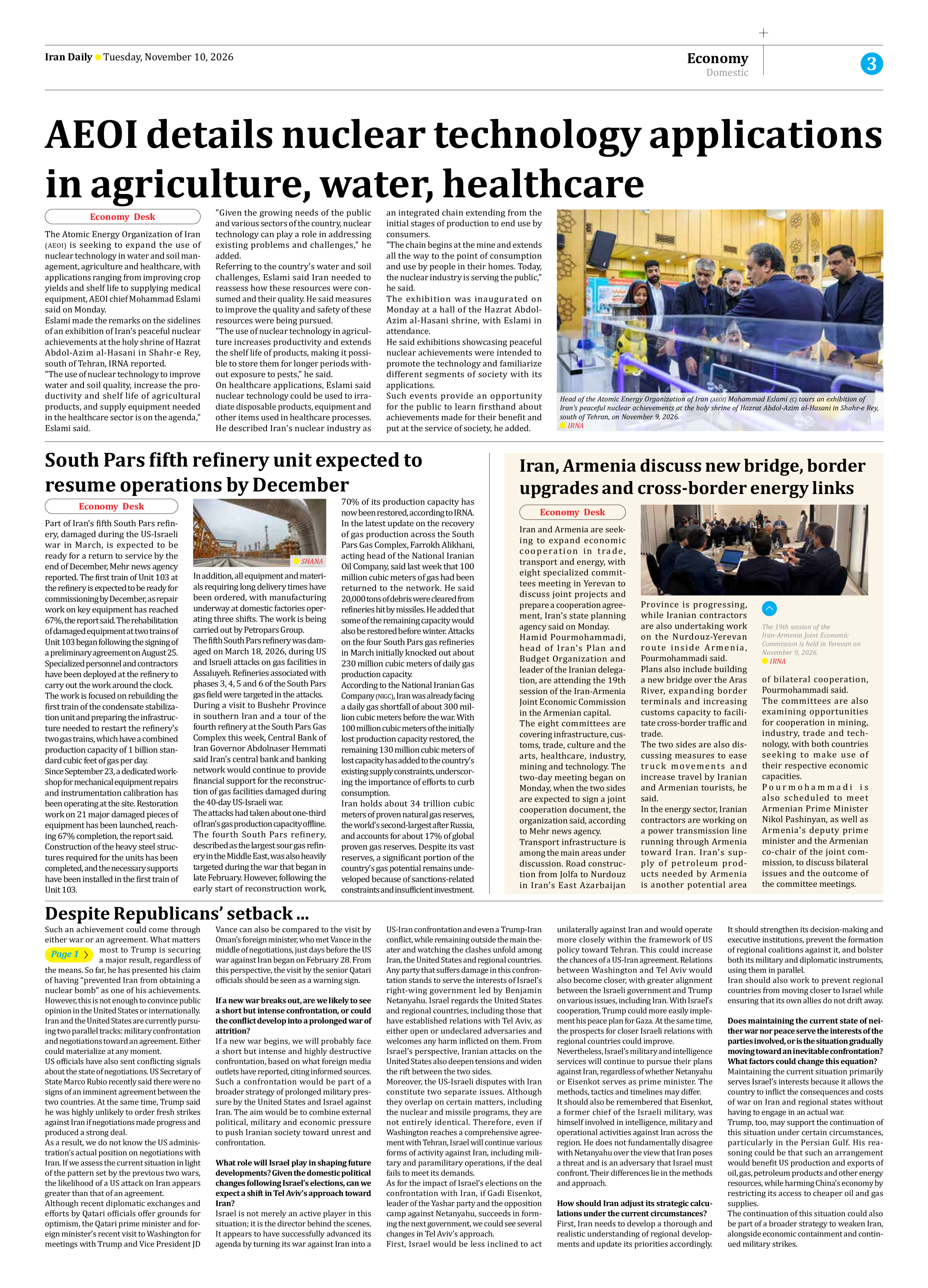
Part of Iran's fifth South Pars refinery, damaged during the US-Israeli war in March, is expected to be ready for a return to service by the end of December, Mehr news agency reported. The first train of Unit 103 at the refinery is expected to be ready for commissioning by December, as repair work on key equipment has reached 67%, the report said. The rehabilitation of damaged equipment at two trains of Unit 103 began following the signing of a preliminary agreement on August 25. Specialized personnel and contractors have been deployed at the refinery to carry out the work around the clock.
The work is focused on rebuilding the first train of the condensate stabilization unit and preparing the infrastructure needed to restart the refinery's two gas trains, which have a combined production capacity of 1 billion standard cubic feet of gas per day.
Since September 23, a dedicated workshop for mechanical equipment repairs and instrumentation calibration has been operating at the site. Restoration work on 21 major damaged pieces of equipment has been launched, reaching 67% completion, the report said.
Construction of the heavy steel structures required for the units has been completed, and the necessary supports have been installed in the first train of Unit 103.
In addition, all equipment and materials requiring long delivery times have been ordered, with manufacturing underway at domestic factories operating three shifts. The work is being carried out by Petropars Group.
The fifth South Pars refinery was damaged on March 18, 2026, during US and Israeli attacks on gas facilities in Assaluyeh. Refineries associated with phases 3, 4, 5 and 6 of the South Pars gas field were targeted in the attacks.
During a visit to Bushehr Province in southern Iran and a tour of the fourth refinery at the South Pars Gas Complex this week, Central Bank of Iran Governor Abdolnaser Hemmati said Iran's central bank and banking network would continue to provide financial support for the reconstruction of gas facilities damaged during the 40-day US-Israeli war.
The attacks had taken about one-third of Iran's gas production capacity offline.
The fourth South Pars refinery, described as the largest sour gas refinery in the Middle East, was also heavily targeted during the war that began in late February. However, following the early start of reconstruction work, 70% of its production capacity has now been restored, according to IRNA.
In the latest update on the recovery of gas production across the South Pars Gas Complex, Farrokh Alikhani, acting head of the National Iranian Oil Company, said last week that 100 million cubic meters of gas had been returned to the network. He said 20,000 tons of debris were cleared from refineries hit by missiles. He added that some of the remaining capacity would also be restored before winter. Attacks on the four South Pars gas refineries in March initially knocked out about 230 million cubic meters of daily gas production capacity.
According to the National Iranian Gas Company (NIGC), Iran was already facing a daily gas shortfall of about 300 million cubic meters before the war. With 100 million cubic meters of the initially lost production capacity restored, the remaining 130 million cubic meters of lost capacity has added to the country's existing supply constraints, underscoring the importance of efforts to curb consumption.
Iran holds about 34 trillion cubic meters of proven natural gas reserves, the world's second-largest after Russia, and accounts for about 17% of global proven gas reserves. Despite its vast reserves, a significant portion of the country's gas potential remains undeveloped because of sanctions-related constraints and insufficient investment.