


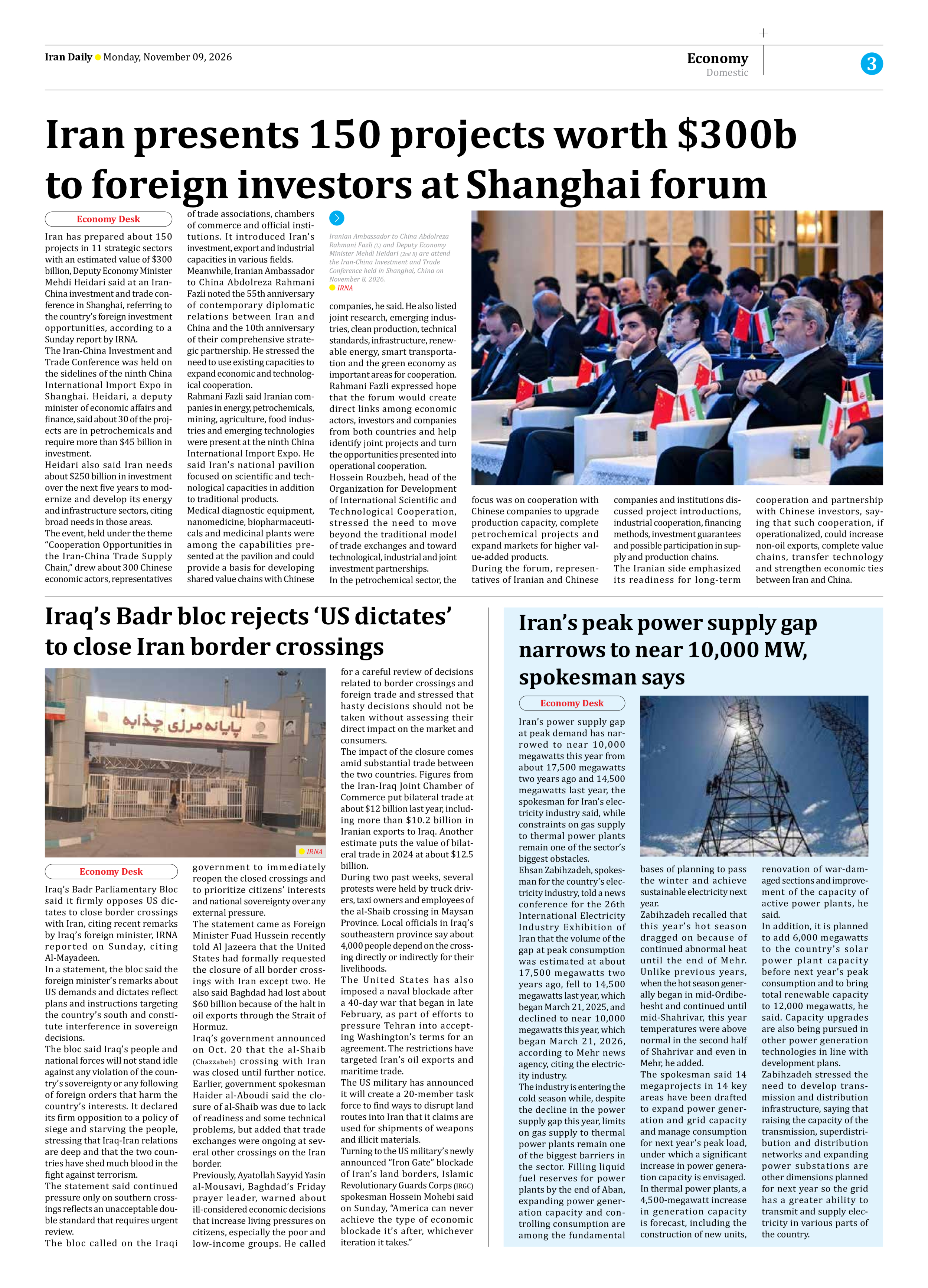


Iran’s peak power supply gap narrows to near 10,000 MW, spokesman says
Iran’s power supply gap at peak demand has narrowed to near 10,000 megawatts this year from about 17,500 megawatts two years ago and 14,500 megawatts last year, the spokesman for Iran’s electricity industry said, while constraints on gas supply to thermal power plants remain one of the sector’s biggest obstacles.
Ehsan Zabihzadeh, spokesman for the country’s electricity industry, told a news conference for the 26th International Electricity Industry Exhibition of Iran that the volume of the gap at peak consumption was estimated at about 17,500 megawatts two years ago, fell to 14,500 megawatts last year, which began March 21, 2025, and declined to near 10,000 megawatts this year, which began March 21, 2026, according to Mehr news agency, citing the electricity industry.
The industry is entering the cold season while, despite the decline in the power supply gap this year, limits on gas supply to thermal power plants remain one of the biggest barriers in the sector. Filling liquid fuel reserves for power plants by the end of Aban, expanding power generation capacity and controlling consumption are among the fundamental bases of planning to pass the winter and achieve sustainable electricity next year.
Zabihzadeh recalled that this year’s hot season dragged on because of continued abnormal heat until the end of Mehr. Unlike previous years, when the hot season generally began in mid-Ordibehesht and continued until mid-Shahrivar, this year temperatures were above normal in the second half of Shahrivar and even in Mehr, he added.
The spokesman said 14 megaprojects in 14 key areas have been drafted to expand power generation and grid capacity and manage consumption for next year’s peak load, under which a significant increase in power generation capacity is envisaged.
In thermal power plants, a 4,500-megawatt increase in generation capacity is forecast, including the construction of new units, renovation of war-damaged sections and improvement of the capacity of active power plants, he said.
In addition, it is planned to add 6,000 megawatts to the country’s solar power plant capacity before next year’s peak consumption and to bring total renewable capacity to 12,000 megawatts, he said. Capacity upgrades are also being pursued in other power generation technologies in line with development plans.
Zabihzadeh stressed the need to develop transmission and distribution infrastructure, saying that raising the capacity of the transmission, superdistribution and distribution networks and expanding power substations are other dimensions planned for next year so the grid has a greater ability to transmit and supply electricity in various parts of the country.