




Iraq’s Badr bloc rejects ‘US dictates’ to close Iran border crossings
Iraq’s Badr Parliamentary Bloc said it firmly opposes US dictates to close border crossings with Iran, citing recent remarks by Iraq’s foreign minister, IRNA reported on Sunday, citing Al-Mayadeen.
In a statement, the bloc said the foreign minister’s remarks about US demands and dictates reflect plans and instructions targeting the country’s south and constitute interference in sovereign decisions.
The bloc said Iraq’s people and national forces will not stand idle against any violation of the country’s sovereignty or any following of foreign orders that harm the country’s interests. It declared its firm opposition to a policy of siege and starving the people, stressing that Iraq-Iran relations are deep and that the two countries have shed much blood in the fight against terrorism.
The statement said continued pressure only on southern crossings reflects an unacceptable double standard that requires urgent review.
The bloc called on the Iraqi government to immediately reopen the closed crossings and to prioritize citizens’ interests and national sovereignty over any external pressure.
The statement came as Foreign Minister Fuad Hussein recently told Al Jazeera that the United States had formally requested the closure of all border crossings with Iran except two. He also said Baghdad had lost about $60 billion because of the halt in oil exports through the Strait of Hormuz.
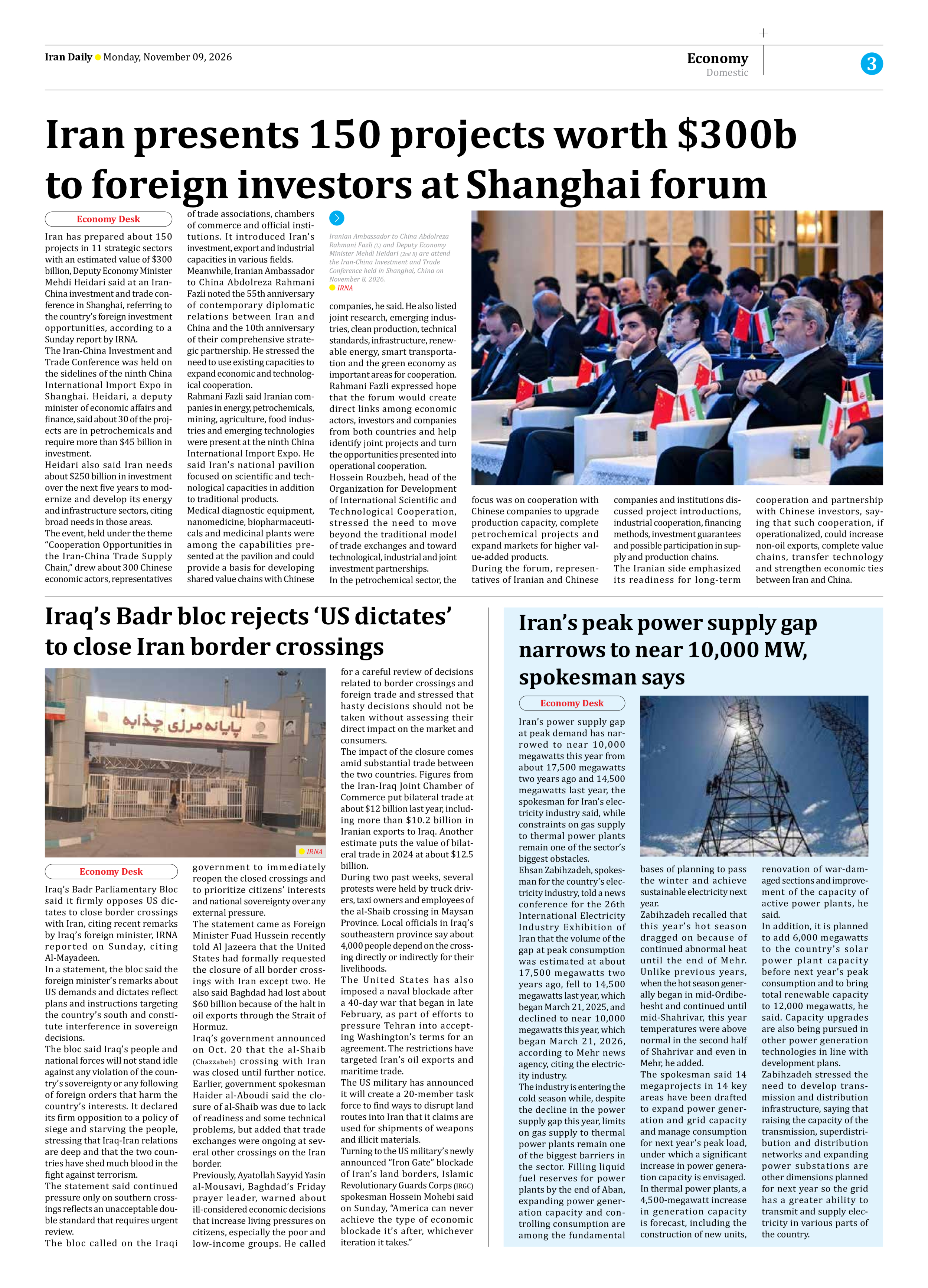
Iraq’s government announced on Oct. 20 that the al-Shaib (Chazzabeh) crossing with Iran was closed until further notice. Earlier, government spokesman Haider al-Aboudi said the closure of al-Shaib was due to lack of readiness and some technical problems, but added that trade exchanges were ongoing at several other crossings on the Iran border.
Previously, Ayatollah Sayyid Yasin al-Mousavi, Baghdad’s Friday prayer leader, warned about ill-considered economic decisions that increase living pressures on citizens, especially the poor and low-income groups. He called for a careful review of decisions related to border crossings and foreign trade and stressed that hasty decisions should not be taken without assessing their direct impact on the market and consumers.
The impact of the closure comes amid substantial trade between the two countries. Figures from the Iran-Iraq Joint Chamber of Commerce put bilateral trade at about $12 billion last year, including more than $10.2 billion in Iranian exports to Iraq. Another estimate puts the value of bilateral trade in 2024 at about $12.5 billion.
During two past weeks, several protests were held by truck drivers, taxi owners and employees of the al-Shaib crossing in Maysan Province. Local officials in Iraq’s southeastern province say about 4,000 people depend on the crossing directly or indirectly for their livelihoods.
The United States has also imposed a naval blockade after a 40-day war that began in late February, as part of efforts to pressure Tehran into accepting Washington’s terms for an agreement. The restrictions have targeted Iran’s oil exports and maritime trade.
The US military has announced it will create a 20-member task force to find ways to disrupt land routes into Iran that it claims are used for shipments of weapons and illicit materials.
Turning to the US military’s newly announced “Iron Gate” blockade of Iran’s land borders, Islamic Revolutionary Guards Corps (IRGC) spokesman Hossein Mohebi said on Sunday, “America can never achieve the type of economic blockade it’s after, whichever iteration it takes.”