




Chabahar transit surges tenfold as rail link nearas operation
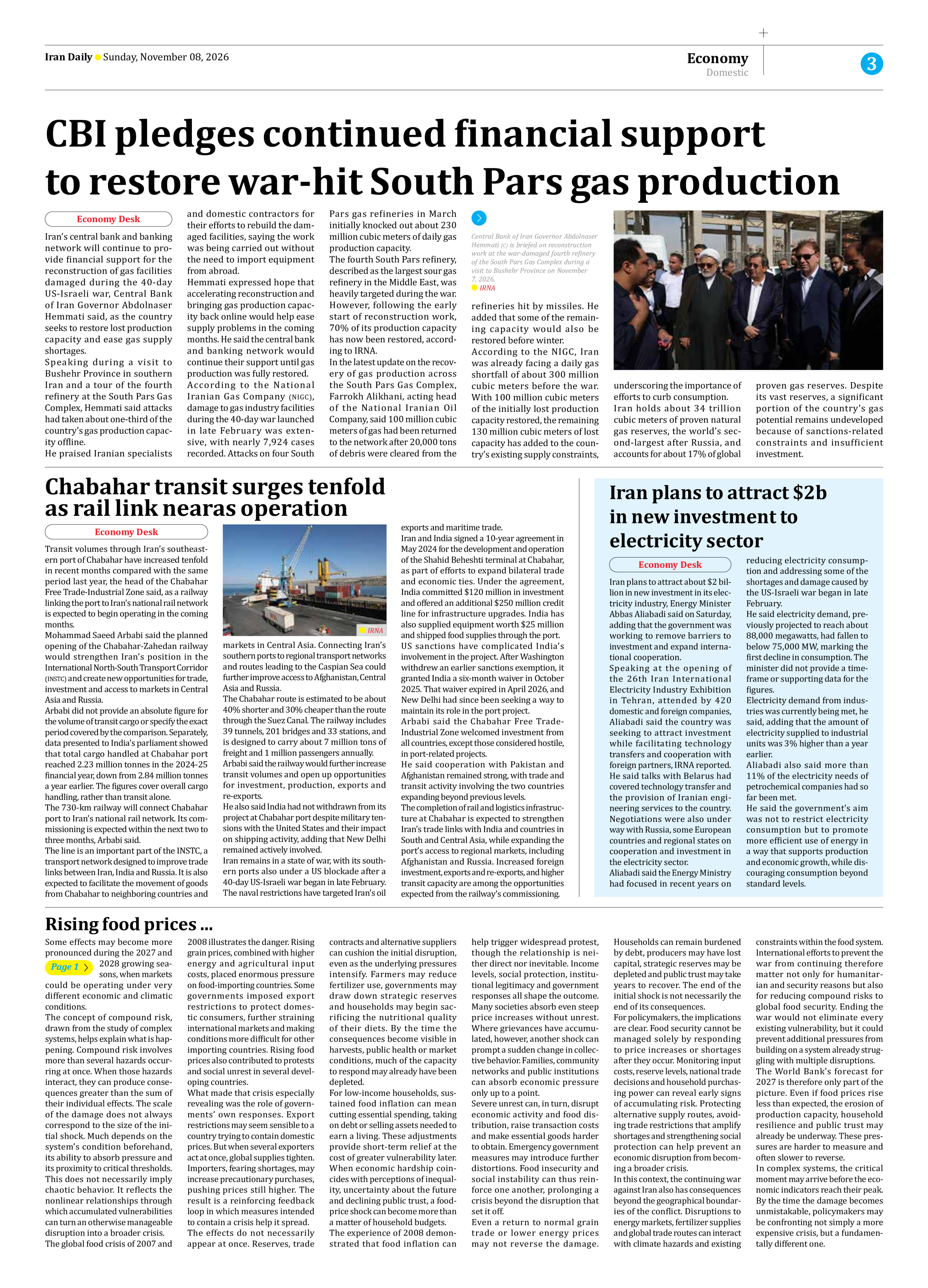
Transit volumes through Iran’s southeastern port of Chabahar have increased tenfold in recent months compared with the same period last year, the head of the Chabahar Free Trade-Industrial Zone said, as a railway linking the port to Iran’s national rail network is expected to begin operating in the coming months.
Mohammad Saeed Arbabi said the planned opening of the Chabahar-Zahedan railway would strengthen Iran’s position in the International North-South Transport Corridor (INSTC) and create new opportunities for trade, investment and access to markets in Central Asia and Russia.
Arbabi did not provide an absolute figure for the volume of transit cargo or specify the exact period covered by the comparison. Separately, data presented to India’s parliament showed that total cargo handled at Chabahar port reached 2.23 million tonnes in the 2024-25 financial year, down from 2.84 million tonnes a year earlier. The figures cover overall cargo handling, rather than transit alone.
The 730-km railway will connect Chabahar port to Iran’s national rail network. Its commissioning is expected within the next two to three months, Arbabi said.
The line is an important part of the INSTC, a transport network designed to improve trade links between Iran, India and Russia. It is also expected to facilitate the movement of goods from Chabahar to neighboring countries and markets in Central Asia. Connecting Iran’s southern ports to regional transport networks and routes leading to the Caspian Sea could further improve access to Afghanistan, Central Asia and Russia.
The Chabahar route is estimated to be about 40% shorter and 30% cheaper than the route through the Suez Canal. The railway includes 39 tunnels, 201 bridges and 33 stations, and is designed to carry about 7 million tons of freight and 1 million passengers annually.
Arbabi said the railway would further increase transit volumes and open up opportunities for investment, production, exports and re-exports.
He also said India had not withdrawn from its project at Chabahar port despite military tensions with the United States and their impact on shipping activity, adding that New Delhi remained actively involved.
Iran remains in a state of war, with its southern ports also under a US blockade after a 40-day US-Israeli war began in late February. The naval restrictions have targeted Iran’s oil exports and maritime trade.
Iran and India signed a 10-year agreement in May 2024 for the development and operation of the Shahid Beheshti terminal at Chabahar, as part of efforts to expand bilateral trade and economic ties. Under the agreement, India committed $120 million in investment and offered an additional $250 million credit line for infrastructure upgrades. India has also supplied equipment worth $25 million and shipped food supplies through the port.
US sanctions have complicated India’s involvement in the project. After Washington withdrew an earlier sanctions exemption, it granted India a six-month waiver in October 2025. That waiver expired in April 2026, and New Delhi had since been seeking a way to maintain its role in the port project.
Arbabi said the Chabahar Free Trade-Industrial Zone welcomed investment from all countries, except those considered hostile, in port-related projects.
He said cooperation with Pakistan and Afghanistan remained strong, with trade and transit activity involving the two countries expanding beyond previous levels.
The completion of rail and logistics infrastructure at Chabahar is expected to strengthen Iran’s trade links with India and countries in South and Central Asia, while expanding the port’s access to regional markets, including Afghanistan and Russia. Increased foreign investment, exports and re-exports, and higher transit capacity are among the opportunities expected from the railway’s commissioning.