




CBI pledges continued financial support to restore war-hit South Pars gas production
Iran’s central bank and banking network will continue to provide financial support for the reconstruction of gas facilities damaged during the 40-day US-Israeli war, Central Bank of Iran Governor Abdolnaser Hemmati said, as the country seeks to restore lost production capacity and ease gas supply shortages.
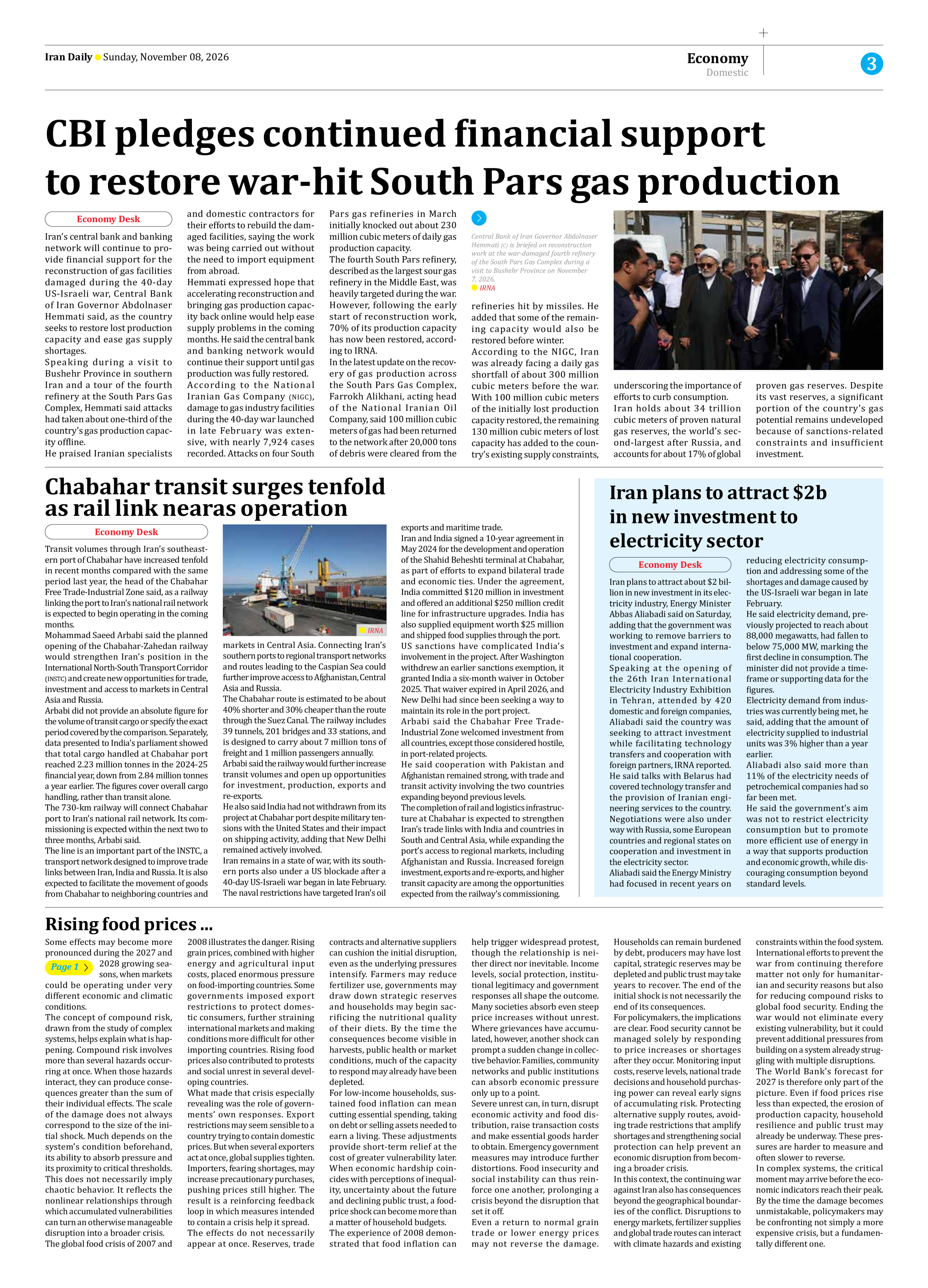
Speaking during a visit to Bushehr Province in southern Iran and a tour of the fourth refinery at the South Pars Gas Complex, Hemmati said attacks had taken about one-third of the country’s gas production capacity offline.
He praised Iranian specialists and domestic contractors for their efforts to rebuild the damaged facilities, saying the work was being carried out without the need to import equipment from abroad.
Hemmati expressed hope that accelerating reconstruction and bringing gas production capacity back online would help ease supply problems in the coming months. He said the central bank and banking network would continue their support until gas production was fully restored.
According to the National Iranian Gas Company (NIGC), damage to gas industry facilities during the 40-day war launched in late February was extensive, with nearly 7,924 cases recorded. Attacks on four South Pars gas refineries in March initially knocked out about 230 million cubic meters of daily gas production capacity.
The fourth South Pars refinery, described as the largest sour gas refinery in the Middle East, was heavily targeted during the war. However, following the early start of reconstruction work, 70% of its production capacity has now been restored, according to IRNA.
In the latest update on the recovery of gas production across the South Pars Gas Complex, Farrokh Alikhani, acting head of the National Iranian Oil Company, said 100 million cubic meters of gas had been returned to the network after 20,000 tons of debris were cleared from the refineries hit by missiles. He added that some of the remaining capacity would also be restored before winter.
According to the NIGC, Iran was already facing a daily gas shortfall of about 300 million cubic meters before the war. With 100 million cubic meters of the initially lost production capacity restored, the remaining 130 million cubic meters of lost capacity has added to the country’s existing supply constraints, underscoring the importance of efforts to curb consumption.
Iran holds about 34 trillion cubic meters of proven natural gas reserves, the world’s second-largest after Russia, and accounts for about 17% of global proven gas reserves. Despite its vast reserves, a significant portion of the country’s gas potential remains undeveloped because of sanctions-related constraints and insufficient investment.