




Art of storytelling through Iranian Qalamkari
Qalamkari, the traditional art of printing and painting patterns on fabric, flourished in Isfahan and became one of Iran’s best-known artistic crafts during the Qajar era. Adorned with carved wooden stamps or hand-painted designs, these textiles were used not only for clothing and tablecloths but also to depict epic tales and scenes from religious and historical narratives. Today, examples of this art are held in museums around the world, preserving a part of Iran’s artistic history.
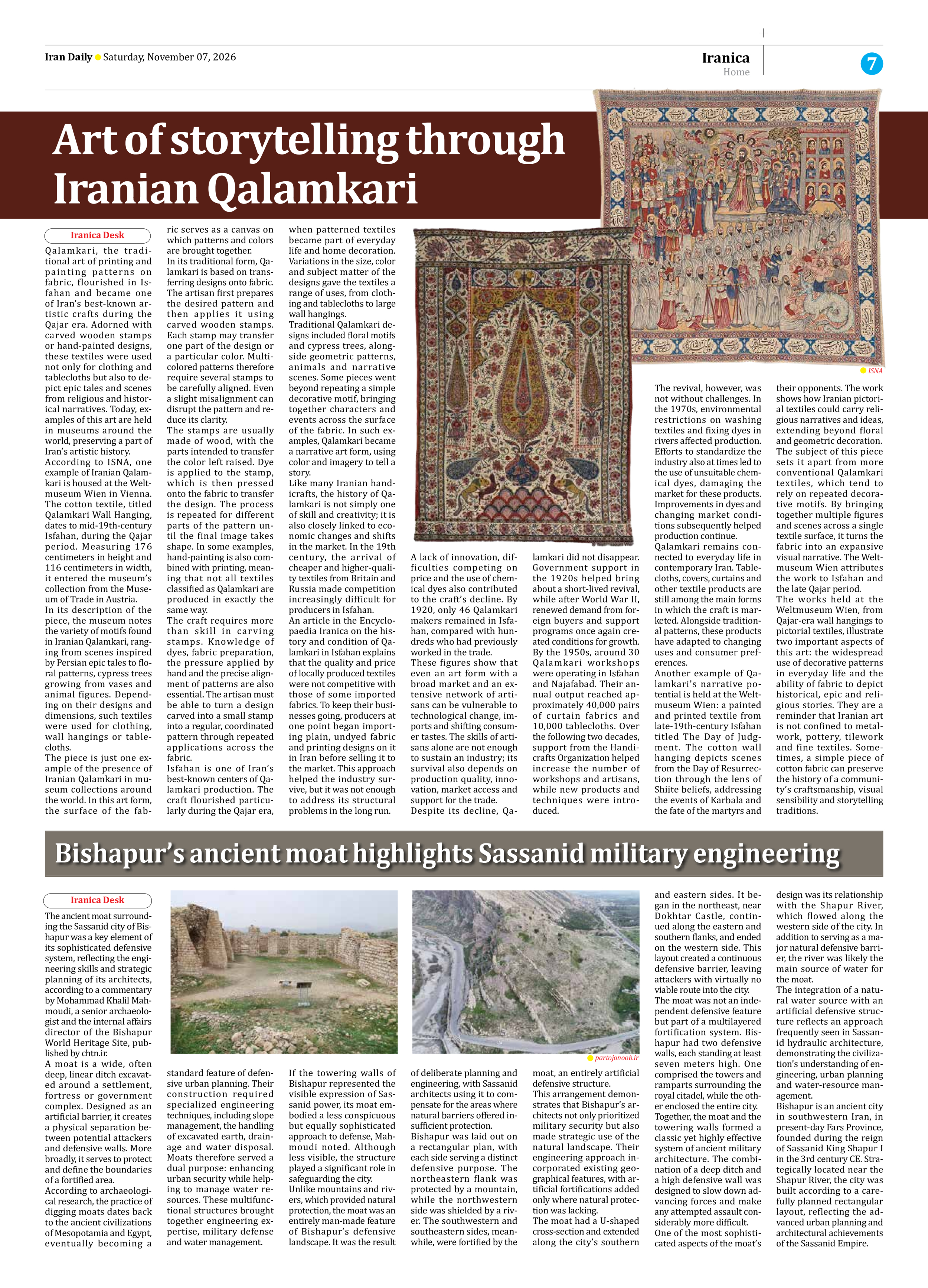
According to ISNA, one example of Iranian Qalamkari is housed at the Weltmuseum Wien in Vienna. The cotton textile, titled Qalamkari Wall Hanging, dates to mid-19th-century Isfahan, during the Qajar period. Measuring 176 centimeters in height and 116 centimeters in width, it entered the museum’s collection from the Museum of Trade in Austria.
In its description of the piece, the museum notes the variety of motifs found in Iranian Qalamkari, ranging from scenes inspired by Persian epic tales to floral patterns, cypress trees growing from vases and animal figures. Depending on their designs and dimensions, such textiles were used for clothing, wall hangings or tablecloths.
The piece is just one example of the presence of Iranian Qalamkari in museum collections around the world. In this art form, the surface of the fabric serves as a canvas on which patterns and colors are brought together.
In its traditional form, Qalamkari is based on transferring designs onto fabric. The artisan first prepares the desired pattern and then applies it using carved wooden stamps. Each stamp may transfer one part of the design or a particular color. Multicolored patterns therefore require several stamps to be carefully aligned. Even a slight misalignment can disrupt the pattern and reduce its clarity.
The stamps are usually made of wood, with the parts intended to transfer the color left raised. Dye is applied to the stamp, which is then pressed onto the fabric to transfer the design. The process is repeated for different parts of the pattern until the final image takes shape. In some examples, hand-painting is also combined with printing, meaning that not all textiles classified as Qalamkari are produced in exactly the same way.
The craft requires more than skill in carving stamps. Knowledge of dyes, fabric preparation, the pressure applied by hand and the precise alignment of patterns are also essential. The artisan must be able to turn a design carved into a small stamp into a regular, coordinated pattern through repeated applications across the fabric.
Isfahan is one of Iran’s best-known centers of Qalamkari production. The craft flourished particularly during the Qajar era, when patterned textiles became part of everyday life and home decoration. Variations in the size, color and subject matter of the designs gave the textiles a range of uses, from clothing and tablecloths to large wall hangings.
Traditional Qalamkari designs included floral motifs and cypress trees, alongside geometric patterns, animals and narrative scenes. Some pieces went beyond repeating a simple decorative motif, bringing together characters and events across the surface of the fabric. In such examples, Qalamkari became a narrative art form, using color and imagery to tell a story.
Like many Iranian handicrafts, the history of Qalamkari is not simply one of skill and creativity; it is also closely linked to economic changes and shifts in the market. In the 19th century, the arrival of cheaper and higher-quality textiles from Britain and Russia made competition increasingly difficult for producers in Isfahan.
An article in the Encyclopaedia Iranica on the history and condition of Qalamkari in Isfahan explains that the quality and price of locally produced textiles were not competitive with those of some imported fabrics. To keep their businesses going, producers at one point began importing plain, undyed fabric and printing designs on it in Iran before selling it to the market. This approach helped the industry survive, but it was not enough to address its structural problems in the long run.
A lack of innovation, difficulties competing on price and the use of chemical dyes also contributed to the craft’s decline. By 1920, only 46 Qalamkari makers remained in Isfahan, compared with hundreds who had previously worked in the trade.
These figures show that even an art form with a broad market and an extensive network of artisans can be vulnerable to technological change, imports and shifting consumer tastes. The skills of artisans alone are not enough to sustain an industry; its survival also depends on production quality, innovation, market access and support for the trade.
Despite its decline, Qalamkari did not disappear. Government support in the 1920s helped bring about a short-lived revival, while after World War II, renewed demand from foreign buyers and support programs once again created conditions for growth.
By the 1950s, around 30 Qalamkari workshops were operating in Isfahan and Najafabad. Their annual output reached approximately 40,000 pairs of curtain fabrics and 10,000 tablecloths. Over the following two decades, support from the Handicrafts Organization helped increase the number of workshops and artisans, while new products and techniques were introduced.
The revival, however, was not without challenges. In the 1970s, environmental restrictions on washing textiles and fixing dyes in rivers affected production. Efforts to standardize the industry also at times led to the use of unsuitable chemical dyes, damaging the market for these products. Improvements in dyes and changing market conditions subsequently helped production continue.
Qalamkari remains connected to everyday life in contemporary Iran. Tablecloths, covers, curtains and other textile products are still among the main forms in which the craft is marketed. Alongside traditional patterns, these products have adapted to changing uses and consumer preferences.
Another example of Qalamkari’s narrative potential is held at the Weltmuseum Wien: a painted and printed textile from late-19th-century Isfahan titled The Day of Judgment. The cotton wall hanging depicts scenes from the Day of Resurrection through the lens of Shiite beliefs, addressing the events of Karbala and the fate of the martyrs and their opponents. The work shows how Iranian pictorial textiles could carry religious narratives and ideas, extending beyond floral and geometric decoration.
The subject of this piece sets it apart from more conventional Qalamkari textiles, which tend to rely on repeated decorative motifs. By bringing together multiple figures and scenes across a single textile surface, it turns the fabric into an expansive visual narrative. The Weltmuseum Wien attributes the work to Isfahan and the late Qajar period.
The works held at the Weltmuseum Wien, from Qajar-era wall hangings to pictorial textiles, illustrate two important aspects of this art: the widespread use of decorative patterns in everyday life and the ability of fabric to depict historical, epic and religious stories. They are a reminder that Iranian art is not confined to metalwork, pottery, tilework and fine textiles. Sometimes, a simple piece of cotton fabric can preserve the history of a community’s craftsmanship, visual sensibility and storytelling traditions.