




TPO official urges higher-value exports, stronger corridors in China ties
Iran and China should prioritize expanding exports of higher value-added goods and strengthening trade corridors as two strategic areas for deepening bilateral economic and trade cooperation, a senior Iranian trade official said on Thursday.
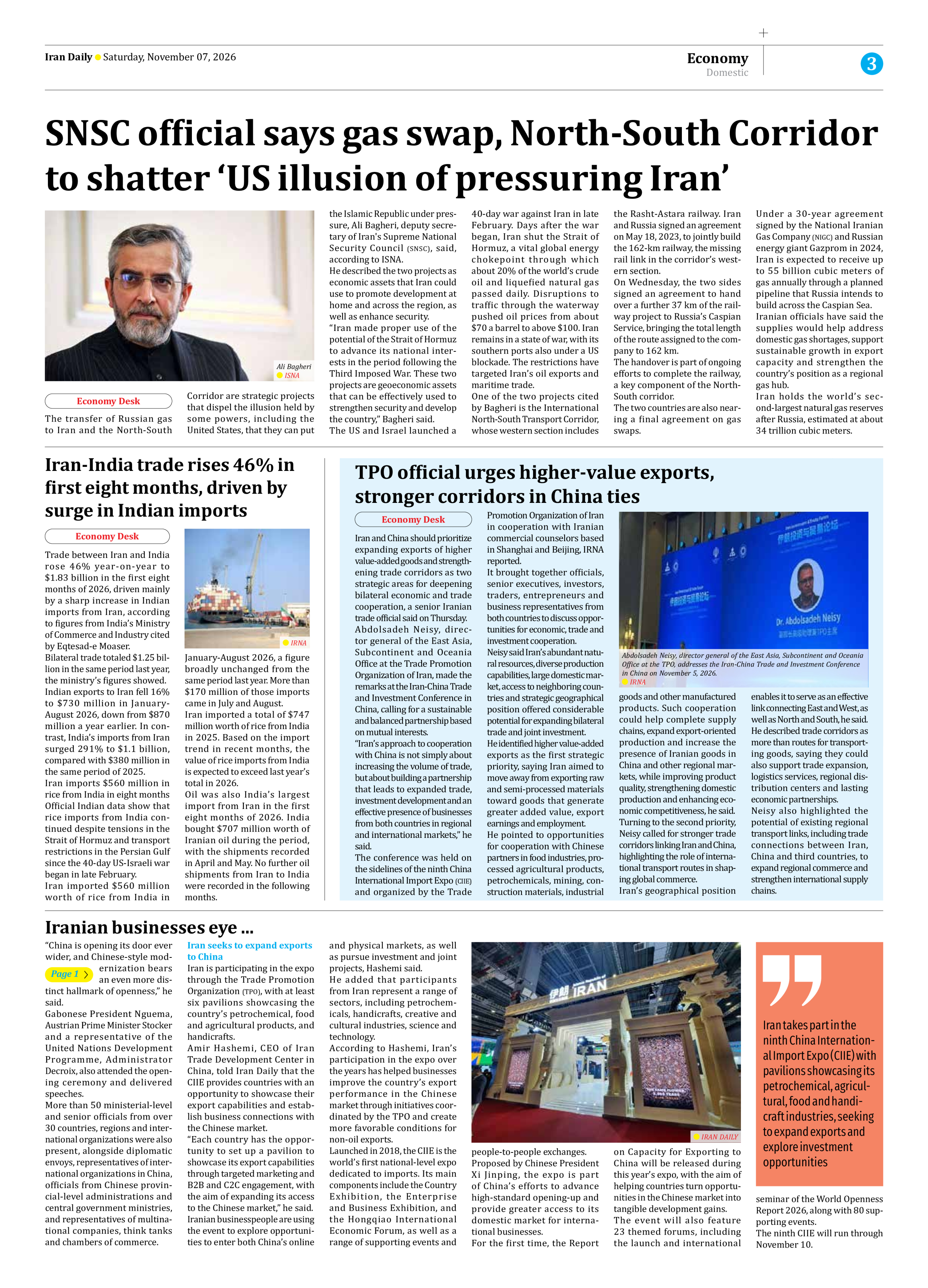
Abdolsadeh Neisy, director general of the East Asia, Subcontinent and Oceania Office at the Trade Promotion Organization of Iran, made the remarks at the Iran-China Trade and Investment Conference in China, calling for a sustainable and balanced partnership based on mutual interests.
“Iran’s approach to cooperation with China is not simply about increasing the volume of trade, but about building a partnership that leads to expanded trade, investment development and an effective presence of businesses from both countries in regional and international markets,” he said.
The conference was held on the sidelines of the ninth China International Import Expo (CIIE) and organized by the Trade Promotion Organization of Iran in cooperation with Iranian commercial counselors based in Shanghai and Beijing, IRNA reported.
It brought together officials, senior executives, investors, traders, entrepreneurs and business representatives from both countries to discuss opportunities for economic, trade and investment cooperation.
Neisy said Iran’s abundant natural resources, diverse production capabilities, large domestic market, access to neighboring countries and strategic geographical position offered considerable potential for expanding bilateral trade and joint investment.
He identified higher value-added exports as the first strategic priority, saying Iran aimed to move away from exporting raw and semi-processed materials toward goods that generate greater added value, export earnings and employment.
He pointed to opportunities for cooperation with Chinese partners in food industries, processed agricultural products, petrochemicals, mining, construction materials, industrial goods and other manufactured products. Such cooperation could help complete supply chains, expand export-oriented production and increase the presence of Iranian goods in China and other regional markets, while improving product quality, strengthening domestic production and enhancing economic competitiveness, he said.
Turning to the second priority, Neisy called for stronger trade corridors linking Iran and China, highlighting the role of international transport routes in shaping global commerce.
Iran’s geographical position enables it to serve as an effective link connecting East and West, as well as North and South, he said.
He described trade corridors as more than routes for transporting goods, saying they could also support trade expansion, logistics services, regional distribution centers and lasting economic partnerships.
Neisy also highlighted the potential of existing regional transport links, including trade connections between Iran, China and third countries, to expand regional commerce and strengthen international supply chains.