




SNSC official says gas swap, North-South Corridor to shatter ‘US illusion of pressuring Iran’
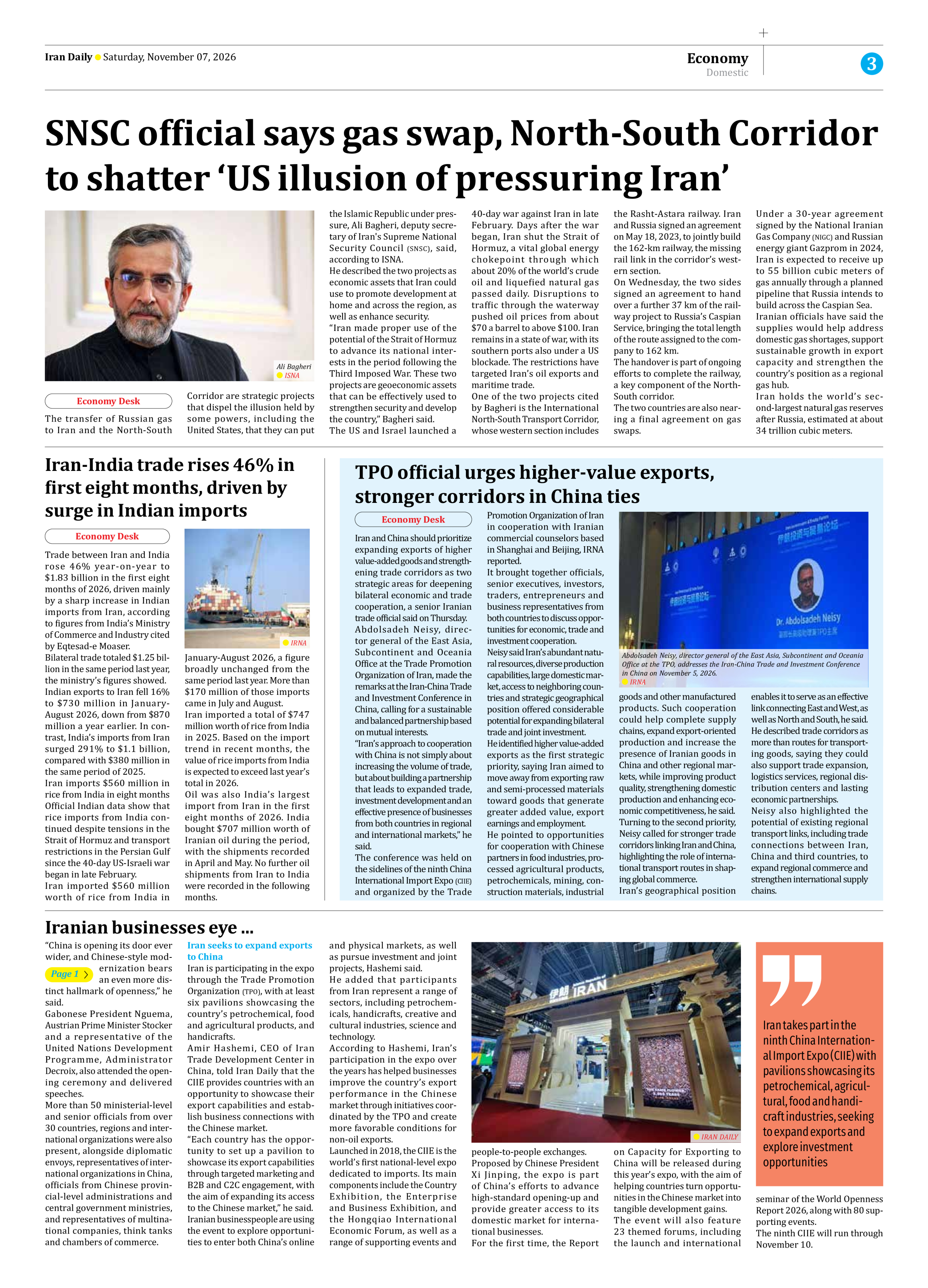
The transfer of Russian gas to Iran and the North-South Corridor are strategic projects that dispel the illusion held by some powers, including the United States, that they can put the Islamic Republic under pressure, Ali Bagheri, deputy secretary of Iran's Supreme National Security Council (SNSC), said, according to ISNA.
He described the two projects as economic assets that Iran could use to promote development at home and across the region, as well as enhance security.
“Iran made proper use of the potential of the Strait of Hormuz to advance its national interests in the period following the Third Imposed War. These two projects are geoeconomic assets that can be effectively used to strengthen security and develop the country,” Bagheri said.
The US and Israel launched a 40-day war against Iran in late February. Days after the war began, Iran shut the Strait of Hormuz, a vital global energy chokepoint through which about 20% of the world’s crude oil and liquefied natural gas passed daily. Disruptions to traffic through the waterway pushed oil prices from about $70 a barrel to above $100. Iran remains in a state of war, with its southern ports also under a US blockade. The restrictions have targeted Iran’s oil exports and maritime trade.
One of the two projects cited by Bagheri is the International North-South Transport Corridor, whose western section includes the Rasht-Astara railway. Iran and Russia signed an agreement on May 18, 2023, to jointly build the 162-km railway, the missing rail link in the corridor’s western section.
On Wednesday, the two sides signed an agreement to hand over a further 37 km of the railway project to Russia’s Caspian Service, bringing the total length of the route assigned to the company to 162 km.
The handover is part of ongoing efforts to complete the railway, a key component of the North-South corridor.
The two countries are also nearing a final agreement on gas swaps.
Under a 30-year agreement signed by the National Iranian Gas Company (NIGC) and Russian energy giant Gazprom in 2024, Iran is expected to receive up to 55 billion cubic meters of gas annually through a planned pipeline that Russia intends to build across the Caspian Sea.
Iranian officials have said the supplies would help address domestic gas shortages, support sustainable growth in export capacity and strengthen the country’s position as a regional gas hub.
Iran holds the world’s second-largest natural gas reserves after Russia, estimated at about 34 trillion cubic meters.