




Copy in clipboard...
Persian carpet art finds place in Yazd’s historic bazaar
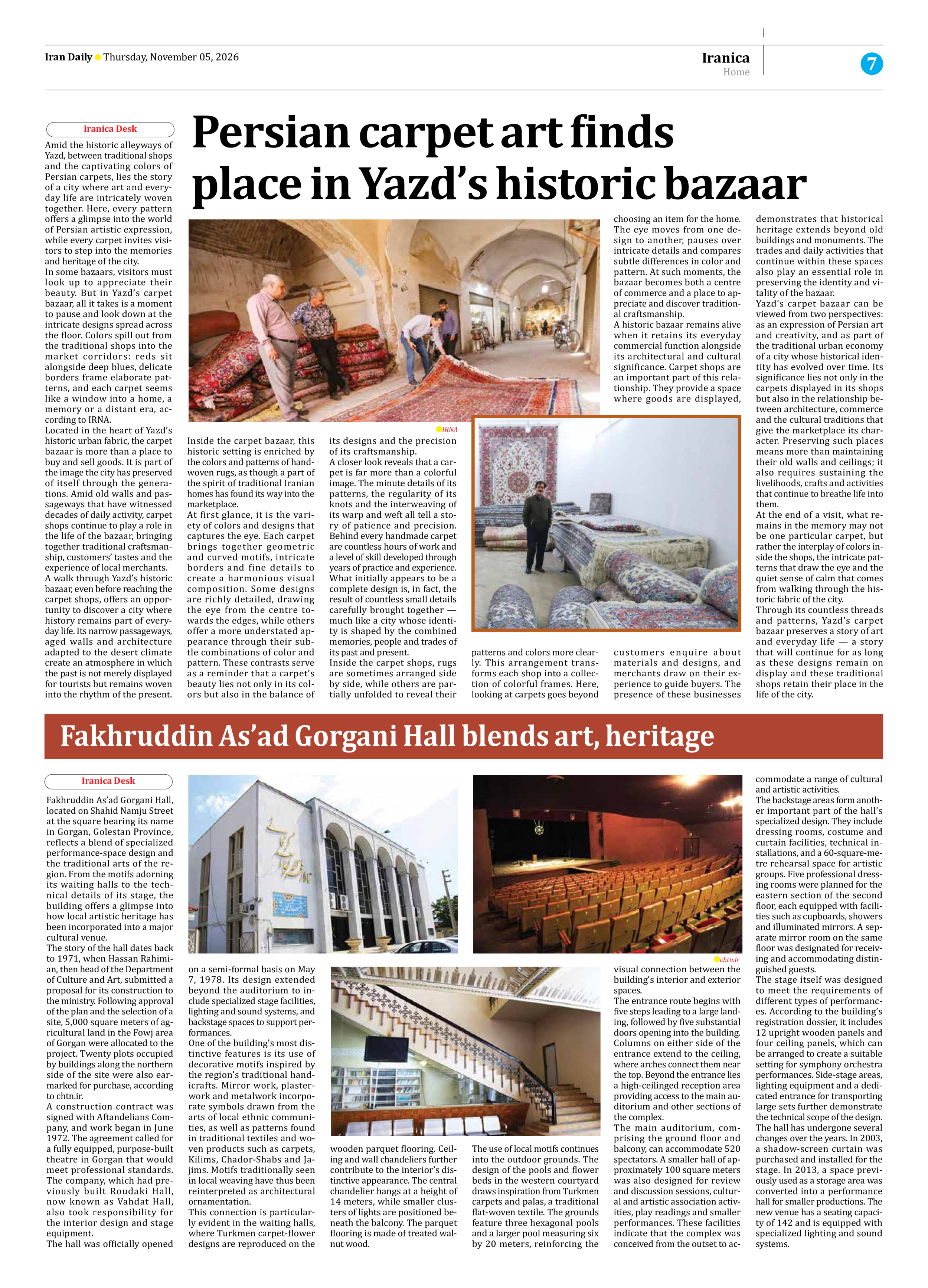
In some bazaars, visitors must look up to appreciate their beauty. But in Yazd’s carpet bazaar, all it takes is a moment to pause and look down at the intricate designs spread across the floor. Colors spill out from the traditional shops into the market corridors: reds sit alongside deep blues, delicate borders frame elaborate patterns, and each carpet seems like a window into a home, a memory or a distant era, according to IRNA.
Located in the heart of Yazd’s historic urban fabric, the carpet bazaar is more than a place to buy and sell goods. It is part of the image the city has preserved of itself through the generations. Amid old walls and passageways that have witnessed decades of daily activity, carpet shops continue to play a role in the life of the bazaar, bringing together traditional craftsmanship, customers’ tastes and the experience of local merchants.
A walk through Yazd’s historic bazaar, even before reaching the carpet shops, offers an opportunity to discover a city where history remains part of everyday life. Its narrow passageways, aged walls and architecture adapted to the desert climate create an atmosphere in which the past is not merely displayed for tourists but remains woven into the rhythm of the present. Inside the carpet bazaar, this historic setting is enriched by the colors and patterns of handwoven rugs, as though a part of the spirit of traditional Iranian homes has found its way into the marketplace.
At first glance, it is the variety of colors and designs that captures the eye. Each carpet brings together geometric and curved motifs, intricate borders and fine details to create a harmonious visual composition. Some designs are richly detailed, drawing the eye from the centre towards the edges, while others offer a more understated appearance through their subtle combinations of color and pattern. These contrasts serve as a reminder that a carpet’s beauty lies not only in its colors but also in the balance of its designs and the precision of its craftsmanship.
A closer look reveals that a carpet is far more than a colorful image. The minute details of its patterns, the regularity of its knots and the interweaving of its warp and weft all tell a story of patience and precision. Behind every handmade carpet are countless hours of work and a level of skill developed through years of practice and experience. What initially appears to be a complete design is, in fact, the result of countless small details carefully brought together — much like a city whose identity is shaped by the combined memories, people and trades of its past and present.
Inside the carpet shops, rugs are sometimes arranged side by side, while others are partially unfolded to reveal their patterns and colors more clearly. This arrangement transforms each shop into a collection of colorful frames. Here, looking at carpets goes beyond choosing an item for the home. The eye moves from one design to another, pauses over intricate details and compares subtle differences in color and pattern. At such moments, the bazaar becomes both a centre of commerce and a place to appreciate and discover traditional craftsmanship.
A historic bazaar remains alive when it retains its everyday commercial function alongside its architectural and cultural significance. Carpet shops are an important part of this relationship. They provide a space where goods are displayed, customers enquire about materials and designs, and merchants draw on their experience to guide buyers. The presence of these businesses demonstrates that historical heritage extends beyond old buildings and monuments. The trades and daily activities that continue within these spaces also play an essential role in preserving the identity and vitality of the bazaar.
Yazd’s carpet bazaar can be viewed from two perspectives: as an expression of Persian art and creativity, and as part of the traditional urban economy of a city whose historical identity has evolved over time. Its significance lies not only in the carpets displayed in its shops but also in the relationship between architecture, commerce and the cultural traditions that give the marketplace its character. Preserving such places means more than maintaining their old walls and ceilings; it also requires sustaining the livelihoods, crafts and activities that continue to breathe life into them.
At the end of a visit, what remains in the memory may not be one particular carpet, but rather the interplay of colors inside the shops, the intricate patterns that draw the eye and the quiet sense of calm that comes from walking through the historic fabric of the city.
Through its countless threads and patterns, Yazd’s carpet bazaar preserves a story of art and everyday life — a story that will continue for as long as these designs remain on display and these traditional shops retain their place in the life of the city.