




Ilam’s Chamar ritual faces uncertain future
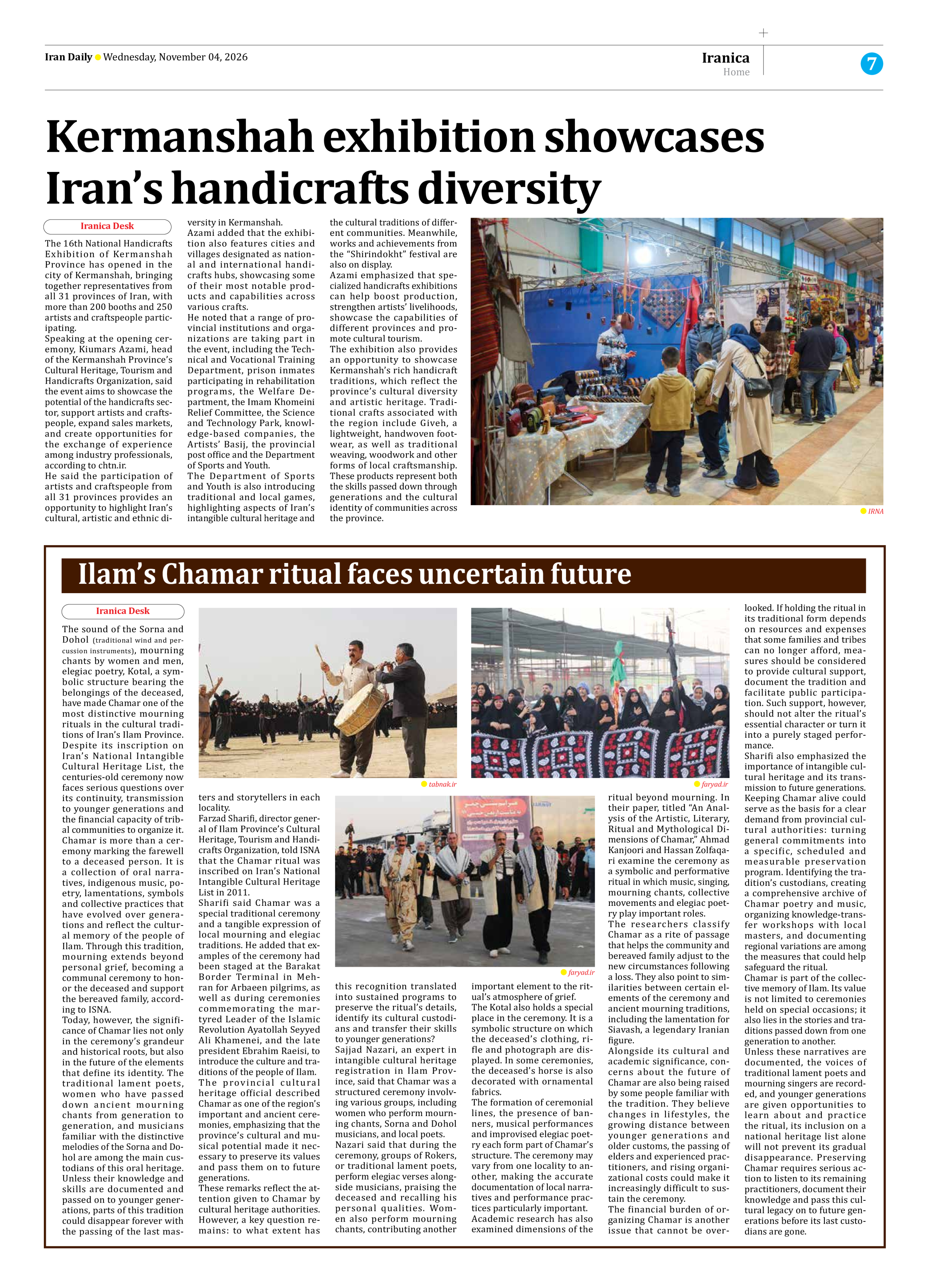
The sound of the Sorna and Dohol (traditional wind and percussion instruments), mourning chants by women and men, elegiac poetry, Kotal, a symbolic structure bearing the belongings of the deceased, have made Chamar one of the most distinctive mourning rituals in the cultural traditions of Iran’s Ilam Province. Despite its inscription on Iran’s National Intangible Cultural Heritage List, the centuries-old ceremony now faces serious questions over its continuity, transmission to younger generations and the financial capacity of tribal communities to organize it.
Chamar is more than a ceremony marking the farewell to a deceased person. It is a collection of oral narratives, indigenous music, poetry, lamentations, symbols and collective practices that have evolved over generations and reflect the cultural memory of the people of Ilam. Through this tradition, mourning extends beyond personal grief, becoming a communal ceremony to honor the deceased and support the bereaved family, according to ISNA.
Today, however, the significance of Chamar lies not only in the ceremony’s grandeur and historical roots, but also in the future of the elements that define its identity. The traditional lament poets, women who have passed down ancient mourning chants from generation to generation, and musicians familiar with the distinctive melodies of the Sorna and Dohol are among the main custodians of this oral heritage. Unless their knowledge and skills are documented and passed on to younger generations, parts of this tradition could disappear forever with the passing of the last masters and storytellers in each locality.
Farzad Sharifi, director general of Ilam Province’s Cultural Heritage, Tourism and Handicrafts Organization, told ISNA that the Chamar ritual was inscribed on Iran’s National Intangible Cultural Heritage List in 2011.
Sharifi said Chamar was a special traditional ceremony and a tangible expression of local mourning and elegiac traditions. He added that examples of the ceremony had been staged at the Barakat Border Terminal in Mehran for Arbaeen pilgrims, as well as during ceremonies commemorating the martyred Leader of the Islamic Revolution Ayatollah Seyyed Ali Khamenei, and the late president Ebrahim Raeisi, to introduce the culture and traditions of the people of Ilam.
The provincial cultural heritage official described Chamar as one of the region’s important and ancient ceremonies, emphasizing that the province’s cultural and musical potential made it necessary to preserve its values and pass them on to future generations.
These remarks reflect the attention given to Chamar by cultural heritage authorities. However, a key question remains: to what extent has this recognition translated into sustained programs to preserve the ritual’s details, identify its cultural custodians and transfer their skills to younger generations?
Sajjad Nazari, an expert in intangible cultural heritage registration in Ilam Province, said that Chamar was a structured ceremony involving various groups, including women who perform mourning chants, Sorna and Dohol musicians, and local poets.
Nazari said that during the ceremony, groups of Rokers, or traditional lament poets, perform elegiac verses alongside musicians, praising the deceased and recalling his personal qualities. Women also perform mourning chants, contributing another important element to the ritual’s atmosphere of grief.
The Kotal also holds a special place in the ceremony. It is a symbolic structure on which the deceased’s clothing, rifle and photograph are displayed. In some ceremonies, the deceased’s horse is also decorated with ornamental fabrics.
The formation of ceremonial lines, the presence of banners, musical performances and improvised elegiac poetry each form part of Chamar’s structure. The ceremony may vary from one locality to another, making the accurate documentation of local narratives and performance practices particularly important.
Academic research has also examined dimensions of the ritual beyond mourning. In their paper, titled “An Analysis of the Artistic, Literary, Ritual and Mythological Dimensions of Chamar,” Ahmad Kanjoori and Hassan Zolfaqari examine the ceremony as a symbolic and performative ritual in which music, singing, mourning chants, collective movements and elegiac poetry play important roles.
The researchers classify Chamar as a rite of passage that helps the community and bereaved family adjust to the new circumstances following a loss. They also point to similarities between certain elements of the ceremony and ancient mourning traditions, including the lamentation for Siavash, a legendary Iranian figure.
Alongside its cultural and academic significance, concerns about the future of Chamar are also being raised by some people familiar with the tradition. They believe changes in lifestyles, the growing distance between younger generations and older customs, the passing of elders and experienced practitioners, and rising organizational costs could make it increasingly difficult to sustain the ceremony.
The financial burden of organizing Chamar is another issue that cannot be overlooked. If holding the ritual in its traditional form depends on resources and expenses that some families and tribes can no longer afford, measures should be considered to provide cultural support, document the tradition and facilitate public participation. Such support, however, should not alter the ritual’s essential character or turn it into a purely staged performance.
Sharifi also emphasized the importance of intangible cultural heritage and its transmission to future generations.
Keeping Chamar alive could serve as the basis for a clear demand from provincial cultural authorities: turning general commitments into a specific, scheduled and measurable preservation program. Identifying the tradition’s custodians, creating a comprehensive archive of Chamar poetry and music, organizing knowledge-transfer workshops with local masters, and documenting regional variations are among the measures that could help safeguard the ritual.
Chamar is part of the collective memory of Ilam. Its value is not limited to ceremonies held on special occasions; it also lies in the stories and traditions passed down from one generation to another.
Unless these narratives are documented, the voices of traditional lament poets and mourning singers are recorded, and younger generations are given opportunities to learn about and practice the ritual, its inclusion on a national heritage list alone will not prevent its gradual disappearance. Preserving Chamar requires serious action to listen to its remaining practitioners, document their knowledge and pass this cultural legacy on to future generations before its last custodians are gone.