




Tehran calls for stronger agricultural diplomacy to improve food security
Tehran calls for stronger agricultural diplomacy to improve food security
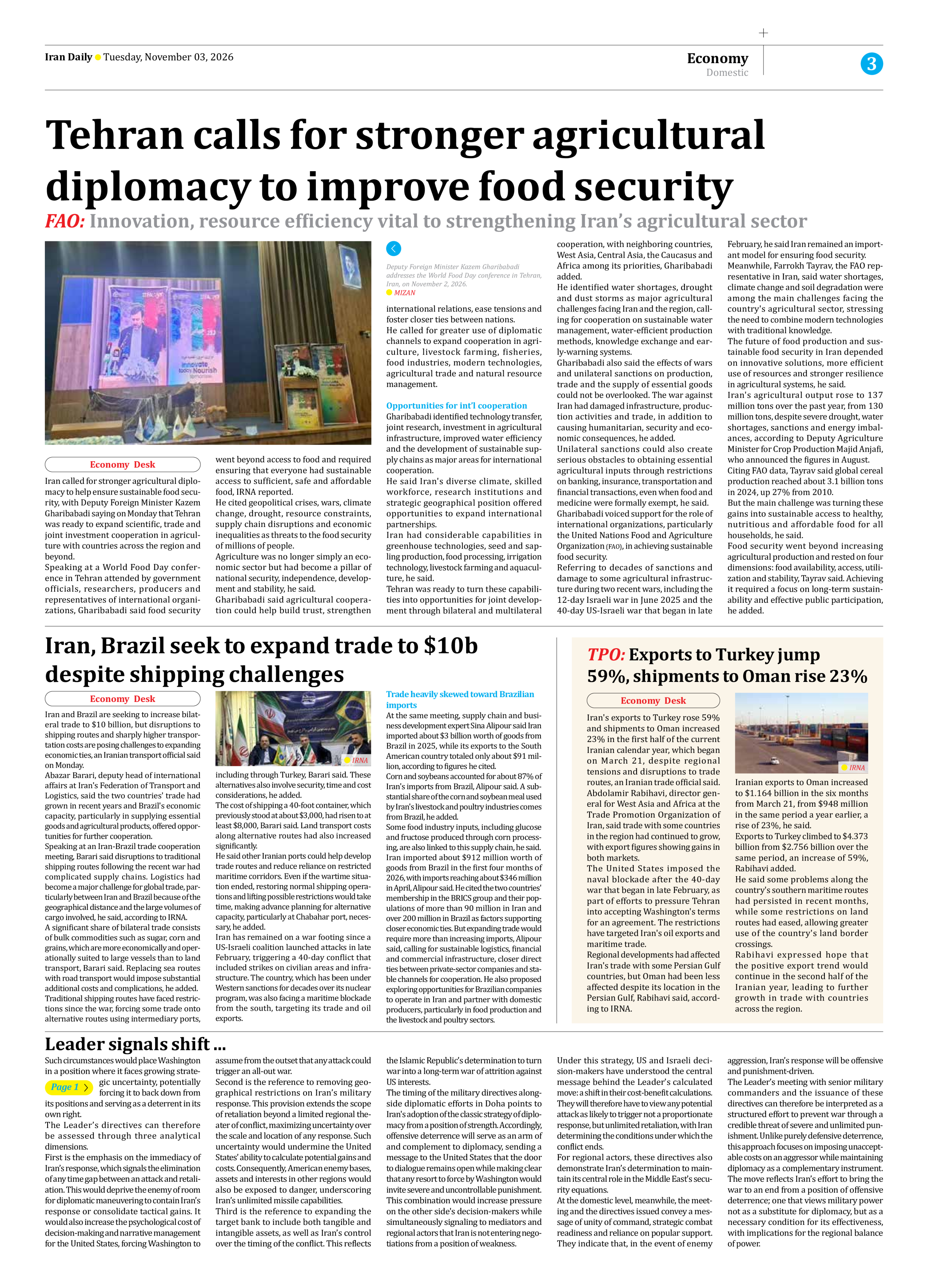
Iran called for stronger agricultural diplomacy to help ensure sustainable food security, with Deputy Foreign Minister Kazem Gharibabadi saying on Monday that Tehran was ready to expand scientific, trade and joint investment cooperation in agriculture with countries across the region and beyond.
Speaking at a World Food Day conference in Tehran attended by government officials, researchers, producers and representatives of international organizations, Gharibabadi said food security went beyond access to food and required ensuring that everyone had sustainable access to sufficient, safe and affordable food, IRNA reported.
He cited geopolitical crises, wars, climate change, drought, resource constraints, supply chain disruptions and economic inequalities as threats to the food security of millions of people.
Agriculture was no longer simply an economic sector but had become a pillar of national security, independence, development and stability, he said.
Gharibabadi said agricultural cooperation could help build trust, strengthen international relations, ease tensions and foster closer ties between nations.
He called for greater use of diplomatic channels to expand cooperation in agriculture, livestock farming, fisheries, food industries, modern technologies, agricultural trade and natural resource management.
Opportunities for int’l cooperation
Gharibabadi identified technology transfer, joint research, investment in agricultural infrastructure, improved water efficiency and the development of sustainable supply chains as major areas for international cooperation.
He said Iran's diverse climate, skilled workforce, research institutions and strategic geographical position offered opportunities to expand international partnerships.
Iran had considerable capabilities in greenhouse technologies, seed and sapling production, food processing, irrigation technology, livestock farming and aquaculture, he said.
Tehran was ready to turn these capabilities into opportunities for joint development through bilateral and multilateral cooperation, with neighboring countries, West Asia, Central Asia, the Caucasus and Africa among its priorities, Gharibabadi added.
He identified water shortages, drought and dust storms as major agricultural challenges facing Iran and the region, calling for cooperation on sustainable water management, water-efficient production methods, knowledge exchange and early-warning systems.
Gharibabadi also said the effects of wars and unilateral sanctions on production, trade and the supply of essential goods could not be overlooked. The war against Iran had damaged infrastructure, production activities and trade, in addition to causing humanitarian, security and economic consequences, he added.
Unilateral sanctions could also create serious obstacles to obtaining essential agricultural inputs through restrictions on banking, insurance, transportation and financial transactions, even when food and medicine were formally exempt, he said.
Gharibabadi voiced support for the role of international organizations, particularly the United Nations Food and Agriculture Organization (FAO), in achieving sustainable food security.
Referring to decades of sanctions and damage to some agricultural infrastructure during two recent wars, including the 12-day Israeli war in June 2025 and the 40-day US-Israeli war that began in late February, he said Iran remained an important model for ensuring food security.
Meanwhile, Farrokh Tayrav, the FAO representative in Iran, said water shortages, climate change and soil degradation were among the main challenges facing the country's agricultural sector, stressing the need to combine modern technologies with traditional knowledge.
The future of food production and sustainable food security in Iran depended on innovative solutions, more efficient use of resources and stronger resilience in agricultural systems, he said.
Iran's agricultural output rose to 137 million tons over the past year, from 130 million tons, despite severe drought, water shortages, sanctions and energy imbalances, according to Deputy Agriculture Minister for Crop Production Majid Anjafi, who announced the figures in August.
Citing FAO data, Tayrav said global cereal production reached about 3.1 billion tons in 2024, up 27% from 2010.
But the main challenge was turning these gains into sustainable access to healthy, nutritious and affordable food for all households, he said.
Food security went beyond increasing agricultural production and rested on four dimensions: food availability, access, utilization and stability, Tayrav said. Achieving it required a focus on long-term sustainability and effective public participation, he added.